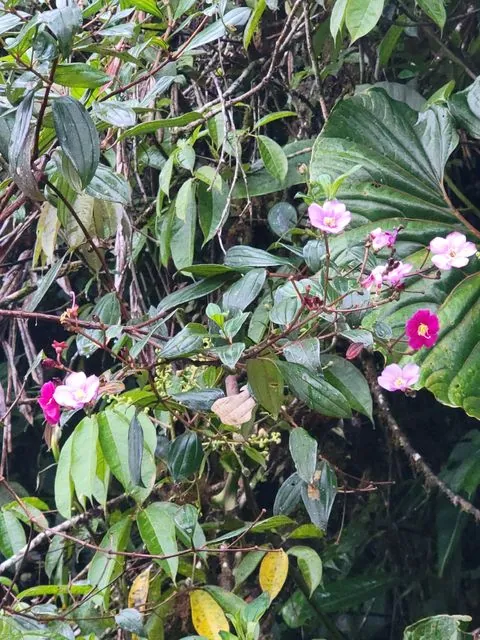
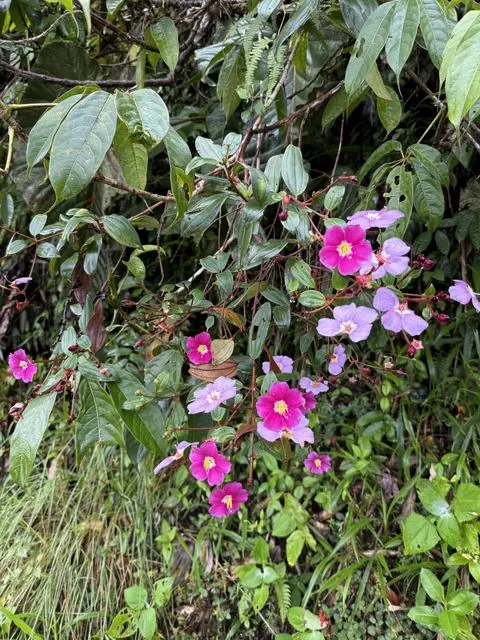
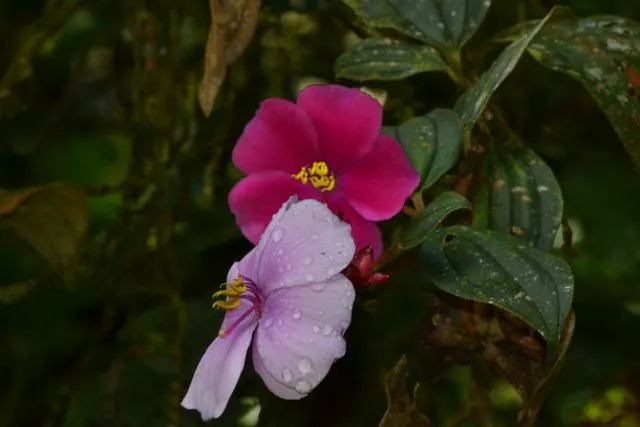
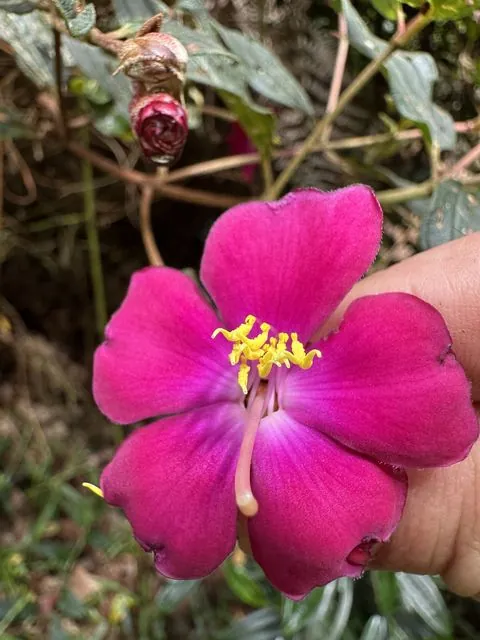
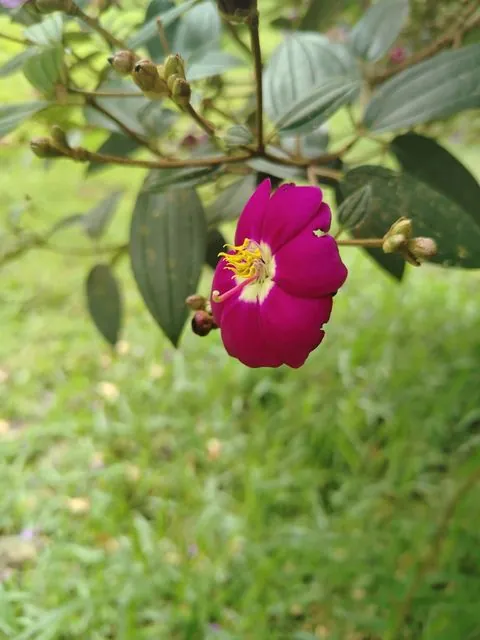
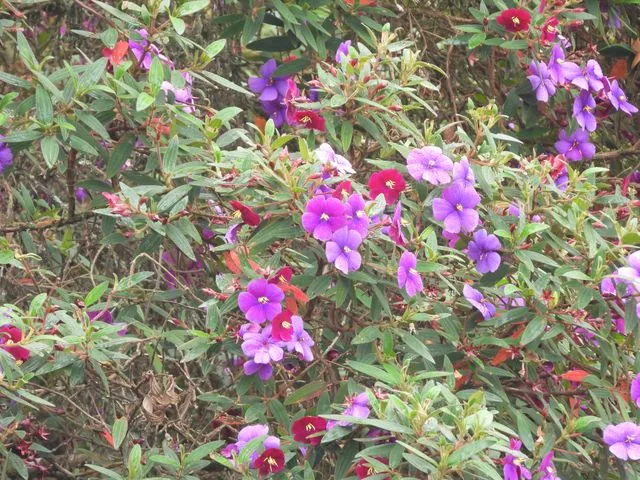
Canonical name: The scientific name without its authorship or date, for example Zea mays instead of Zea mays L. — The scientific name without its authorship or date, for example Zea mays instead of Zea mays L.
Andesanthus lepidotus
Authorship: The author or authors credited with publishing the scientific name. It is written after the name, sometimes with the year, for example L. (Linnaeus) in Zea mays L. An author in parentheses first published the name in another genus or rank. — The author or authors credited with publishing the scientific name. It is written after the name, sometimes with the year, for example L. (Linnaeus) in Zea mays L. An author in parentheses first published the name in another genus or rank.
(Humb. & Bonpl.) P.J.F.Guim. & Michelang.
Common names
alstonvilleNames in other languages (7)Sietecueros, Tibouchina, flor de mayo, Тибухина чешуйчатая, 安牡花, 安第斯公主花, 艷紫野牡丹
Kingdom: One of the broadest ranks of biological classification. It groups organisms that share very basic features, for example plants (Plantae), animals (Animalia) or fungi (Fungi). — One of the broadest ranks of biological classification. It groups organisms that share very basic features, for example plants (Plantae), animals (Animalia) or fungi (Fungi).
Plantae
Phylum: Rank below kingdom that groups organisms with a shared general body plan, for example chordates (Chordata), arthropods (Arthropoda) or vascular plants (Tracheophyta). In botany the same rank is also called division. — Rank below kingdom that groups organisms with a shared general body plan, for example chordates (Chordata), arthropods (Arthropoda) or vascular plants (Tracheophyta). In botany the same rank is also called division.
Tracheophyta
Class: Rank below phylum, for example mammals (Mammalia), birds (Aves), insects (Insecta) or monocot plants such as grasses and orchids (Liliopsida). — Rank below phylum, for example mammals (Mammalia), birds (Aves), insects (Insecta) or monocot plants such as grasses and orchids (Liliopsida).
Magnoliopsida
Order: Rank below class that groups related families, for example grasses and their relatives (Poales) or bats (Chiroptera). — Rank below class that groups related families, for example grasses and their relatives (Poales) or bats (Chiroptera).
Myrtales
Family: Rank below order that groups related genera. Family names usually end in -aceae in botany (for example Poaceae, the grass family) and in -idae in zoology (for example Felidae, the cat family). — Rank below order that groups related genera. Family names usually end in -aceae in botany (for example Poaceae, the grass family) and in -idae in zoology (for example Felidae, the cat family).
Melastomataceae
Genus: Rank that groups closely related species. Its name is the first word of a species' scientific name and starts with a capital letter, for example Zea in Zea mays. — Rank that groups closely related species. Its name is the first word of a species' scientific name and starts with a capital letter, for example Zea in Zea mays.
Andesanthus
Specific epithet: The second word of a species' scientific name. On its own it does not name the species: it always goes with the genus, for example mays in Zea mays. — The second word of a species' scientific name. On its own it does not name the species: it always goes with the genus, for example mays in Zea mays.
lepidotus
Taxonomic rank: The level a name occupies in the hierarchy of biological classification, such as kingdom, family, genus, species or subspecies. — The level a name occupies in the hierarchy of biological classification, such as kingdom, family, genus, species or subspecies.
species
Reference species
Andesanthus lepidotus
Taxonomic status: Whether the taxonomic catalogue the record comes from currently accepts this name for the organism, or treats it as a synonym of another accepted name or as doubtful. — Whether the taxonomic catalogue the record comes from currently accepts this name for the organism, or treats it as a synonym of another accepted name or as doubtful.
accepted name
Photos and conservation status
IUCN Red List category: The extinction-risk category that the International Union for Conservation of Nature (IUCN) assigns to a species on its Red List. EX Extinct: there is no reasonable doubt that the last individual has died. EW Extinct in the wild: it survives only in cultivation, in captivity or as a population far outside its past range. CR Critically endangered, EN Endangered and VU Vulnerable: the three threatened categories, from an extremely high to a high risk of extinction in the wild. NT Near threatened: close to qualifying as threatened. LC Least concern: evaluated and not threatened. DD Data deficient: there is not enough information to assess its risk. NE Not evaluated: not yet assessed against the criteria. It describes the risk of the species worldwide, not its situation in a project's area. — The extinction-risk category that the International Union for Conservation of Nature (IUCN) assigns to a species on its Red List. EX Extinct: there is no reasonable doubt that the last individual has died. EW Extinct in the wild: it survives only in cultivation, in captivity or as a population far outside its past range. CR Critically endangered, EN Endangered and VU Vulnerable: the three threatened categories, from an extremely high to a high risk of extinction in the wild. NT Near threatened: close to qualifying as threatened. LC Least concern: evaluated and not threatened. DD Data deficient: there is not enough information to assess its risk. NE Not evaluated: not yet assessed against the criteria. It describes the risk of the species worldwide, not its situation in a project's area.
Least concern (LC)
Source: IUCN Red List via GBIF, queried on 2026-10-12 18:00.
Research-grade iNaturalist observations via GBIF, CC0 or CC BY licences only, queried on 2026-10-12 18:00.
Interacciones documentadas
GloBI says it is documented somewhere in the world. Biolitica answers whether it could happen here.
A documented interaction means it was recorded somewhere in the world. It does not mean it occurs here.
Types shown: 3 of 3
is a host of
×
is eaten by
×
interacts with
×
Blocks that do not sit under a navigation concept heading keep the source's own term: no navigation concept has been assigned to them yet.
is a host of
4 organisms
The authority declares no effect on this species for this term: neither that it harms it nor that it benefits it. In the source ontology symbiosis covers mutualism, commensalism and parasitism alike, so this block holds attackers and allies side by side.
Organism
Reads as
Studies
Where it was documented
Actions
Chrysoporthe inopinaCryphonectriaceae
is a host of
5
no location
5 sources · 5 records
Ferreira, M.A., de Oliveira, M.E.S., Silva, G.A., Mathioni, S.M., and Mafia, R.G.. 2019. %Capillaureum caryovora% gen. sp. nov. (Cryphonectriaceae) pathogenic to pequi (%Caryocar brasiliense%) in Brazil. Mycol. Progr. 18(3):385-403
Published in globalbioticinteractions/usda-fungus-host
Context: Colombia · no date published
Claim type
Published relationship between two taxa
Version
GloBI 0.11
Reuse
This release publishes no reuse terms for this record.
Colombia · no date publishedWhere it is: line:hash://sha256/021a206a1459bcca7e251c73f5bd180fc3ac342a09c499855fe42e21fc09edcf!/interactions.tsv.gz!/L4142529
No public URL for this record
Gryzenhout, M. , Wingfield, B.D., and Wingfield, M.J.. 2009. Taxonomy, Phylogeny, and Ecology of Bark-Inhabiting and Tree-Pathogenic Fungi in the Cryphonectriaceae. APS Press, St. Paul, Minnesota :119
Published in globalbioticinteractions/usda-fungus-host
Context: Colombia · no date published
Claim type
Published relationship between two taxa
Version
GloBI 0.11
Reuse
This release publishes no reuse terms for this record.
Colombia · no date publishedWhere it is: line:hash://sha256/021a206a1459bcca7e251c73f5bd180fc3ac342a09c499855fe42e21fc09edcf!/interactions.tsv.gz!/L4233238
No public URL for this record
Chen, S.F., Liu, Q.L., Li, G.Q., Wingfield, M.J., and Roux, J.. 2018. A new genus of Cryphonectriaceae isolated from %Lagerstroemia speciosa% in southern China. Pl. Pathol. 67(1):107-123
Published in globalbioticinteractions/usda-fungus-host
Context: Colombia · no date published
Claim type
Published relationship between two taxa
Version
GloBI 0.11
Reuse
This release publishes no reuse terms for this record.
Colombia · no date publishedWhere it is: line:hash://sha256/021a206a1459bcca7e251c73f5bd180fc3ac342a09c499855fe42e21fc09edcf!/interactions.tsv.gz!/L4297180
No public URL for this record
Mausse-Sitoe, S.N.D., Rodas, C.A., Wingfield, M.J., Chen, S.F., and Roux, J.. 2016. Endophytic Cryphonectriaceae on native Myrtales: Possible origin of Chrysoporthe canker on plantation-grown %Eucalyptus%. Fung. Biol. 120:827-835
Published in globalbioticinteractions/usda-fungus-host
Context: Colombia · no date published
Claim type
Published relationship between two taxa
Version
GloBI 0.11
Reuse
This release publishes no reuse terms for this record.
Colombia · no date publishedWhere it is: line:hash://sha256/021a206a1459bcca7e251c73f5bd180fc3ac342a09c499855fe42e21fc09edcf!/interactions.tsv.gz!/L4407598
No public URL for this record
Chen, S.F., Gryzenhout, M. , Roux, J., Xie, Y.J., Wingfield, M.J., and Zhou, X.D.. 2010. Identification and pathogenicity of %Chrysoporthe cubensis% on %Eucalyptus% and %Syzygium% spp. in South China. Pl. Dis. 94:1143-1150
Published in globalbioticinteractions/usda-fungus-host
Context: Colombia · no date published
Claim type
Published relationship between two taxa
Version
GloBI 0.11
Reuse
This release publishes no reuse terms for this record.
Colombia · no date publishedWhere it is: line:hash://sha256/021a206a1459bcca7e251c73f5bd180fc3ac342a09c499855fe42e21fc09edcf!/interactions.tsv.gz!/L4409051
No public URL for this record
A published relationship says these two taxa were documented interacting. It does not say how often, or that it happens in this project's region.
Neofusicoccum parvumBotryosphaeriaceae
is a host of
5
no location
5 sources · 8 records
Heath, R.N., Roux, J., Slippers, B. , Drenth, A., Pennycook, S.R., Wingfield, B.D., and Wingfield, M.J.. 2011. Occurence and pathogenicity of %Neofusicoccum parvum% and %N. mangiferae% on ornamental %Tibouchina% species. Forest Pathol. 41:48-51
Published in globalbioticinteractions/usda-fungus-host
Record contexts (sample): South Africa · no date published; New Zealand · no date published
Claim type
Published relationship between two taxa
Version
GloBI 0.11
Reuse
This release publishes no reuse terms for this record.
South Africa · no date publishedWhere it is: line:hash://sha256/021a206a1459bcca7e251c73f5bd180fc3ac342a09c499855fe42e21fc09edcf!/interactions.tsv.gz!/L4428892
New Zealand · no date publishedWhere it is: line:hash://sha256/021a206a1459bcca7e251c73f5bd180fc3ac342a09c499855fe42e21fc09edcf!/interactions.tsv.gz!/L4428893
Australia · no date publishedWhere it is: line:hash://sha256/021a206a1459bcca7e251c73f5bd180fc3ac342a09c499855fe42e21fc09edcf!/interactions.tsv.gz!/L4428895
No public URL for this record
Sakalidis, M.L., Slippers, B., Wingfield, B.D., St. J. Hardy, G.E., and Burgess, T.I.. 2013. The challenge of understanding the origin, pathways and extent of fungal invasions: global populations of the %Neofusicoccum parvum% - %N. ribis% species complex. Div. Distrib. 19:873-883
Published in globalbioticinteractions/usda-fungus-host
Record contexts (sample): Australia · no date published; New Zealand · no date published
Claim type
Published relationship between two taxa
Version
GloBI 0.11
Reuse
This release publishes no reuse terms for this record.
Australia · no date publishedWhere it is: line:hash://sha256/021a206a1459bcca7e251c73f5bd180fc3ac342a09c499855fe42e21fc09edcf!/interactions.tsv.gz!/L4418689
New Zealand · no date publishedWhere it is: line:hash://sha256/021a206a1459bcca7e251c73f5bd180fc3ac342a09c499855fe42e21fc09edcf!/interactions.tsv.gz!/L4418690
No public URL for this record
Burgess, T.I., Tan, Y.P., Garnas, J., Edwards, J., Scarlett, K.A., Shuttleworth, L.A., Daniel, R., Dann, E.K., Parkinson, L.E., Dinh, Q., Shivas, R.G., and Jami, F.. 2019. Current status of the Botryosphaeriaceae in Australia. Australas. Pl. Pathol. 48(1):35-44
Published in globalbioticinteractions/usda-fungus-host
Context: Australia · no date published
Claim type
Published relationship between two taxa
Version
GloBI 0.11
Reuse
This release publishes no reuse terms for this record.
Australia · no date publishedWhere it is: line:hash://sha256/021a206a1459bcca7e251c73f5bd180fc3ac342a09c499855fe42e21fc09edcf!/interactions.tsv.gz!/L4270749
No public URL for this record
Moral, J., Munoz-Diez, C., Gonzalez, N., Trapero, A., and Michailides, T.J.. 2010. Characterization and pathogenicity of %Botryosphaeriaceae% species collected from olive and other hosts in Spain and California. Phytopathology 100(12):1340-1351
Published in globalbioticinteractions/usda-fungus-host
Context: Australia · no date published
Claim type
Published relationship between two taxa
Version
GloBI 0.11
Reuse
This release publishes no reuse terms for this record.
Australia · no date publishedWhere it is: line:hash://sha256/021a206a1459bcca7e251c73f5bd180fc3ac342a09c499855fe42e21fc09edcf!/interactions.tsv.gz!/L4295122
No public URL for this record
Zlatkovic, M., Wingfield, M.J., Jami, F., and Slippers, B.. 2019. Genetic uniformity characterizes the invasive spread of %Neofusicoccum parvum% and %Diplodia sapinea% in the Western Balkans. Forest Pathol. 49(1):e12491
Published in globalbioticinteractions/usda-fungus-host
Context: Australia · no date published
Claim type
Published relationship between two taxa
Version
GloBI 0.11
Reuse
This release publishes no reuse terms for this record.
Australia · no date publishedWhere it is: line:hash://sha256/021a206a1459bcca7e251c73f5bd180fc3ac342a09c499855fe42e21fc09edcf!/interactions.tsv.gz!/L4395001
No public URL for this record
A published relationship says these two taxa were documented interacting. It does not say how often, or that it happens in this project's region.
Chrysoporthe hodgesianaCryphonectriaceae
is a host of
2
no location
2 sources · 2 records
Gryzenhout, M. , Wingfield, B.D., and Wingfield, M.J.. 2009. Taxonomy, Phylogeny, and Ecology of Bark-Inhabiting and Tree-Pathogenic Fungi in the Cryphonectriaceae. APS Press, St. Paul, Minnesota :119
Published in globalbioticinteractions/usda-fungus-host
Context: Colombia · no date published
Claim type
Published relationship between two taxa
Version
GloBI 0.11
Reuse
This release publishes no reuse terms for this record.
Colombia · no date publishedWhere it is: line:hash://sha256/021a206a1459bcca7e251c73f5bd180fc3ac342a09c499855fe42e21fc09edcf!/interactions.tsv.gz!/L4233241
No public URL for this record
Gryzenhout, M. , Myburg, H., van der Merwe, N.A., Wingfield, B.D., and Wingfield, M.J.. 2004. %Chrysoporthe%, a new genus to accommodate %Cryphonectria cubensis%. Stud. Mycol. 50:119-142
Published in globalbioticinteractions/usda-fungus-host
Context: Colombia · no date published
Claim type
Published relationship between two taxa
Version
GloBI 0.11
Reuse
This release publishes no reuse terms for this record.
Colombia · no date publishedWhere it is: line:hash://sha256/021a206a1459bcca7e251c73f5bd180fc3ac342a09c499855fe42e21fc09edcf!/interactions.tsv.gz!/L4416512
No public URL for this record
A published relationship says these two taxa were documented interacting. It does not say how often, or that it happens in this project's region.
Aurapex penicillataCryphonectriaceae
is a host of
1
no location
1 source · 1 record
Gryzenhout, M. , Wingfield, B.D., and Wingfield, M.J.. 2009. Taxonomy, Phylogeny, and Ecology of Bark-Inhabiting and Tree-Pathogenic Fungi in the Cryphonectriaceae. APS Press, St. Paul, Minnesota :119
Published in globalbioticinteractions/usda-fungus-host
Context: Colombia · no date published
Claim type
Published relationship between two taxa
Version
GloBI 0.11
Reuse
This release publishes no reuse terms for this record.
Colombia · no date publishedWhere it is: line:hash://sha256/021a206a1459bcca7e251c73f5bd180fc3ac342a09c499855fe42e21fc09edcf!/interactions.tsv.gz!/L4233212
No public URL for this record
A published relationship says these two taxa were documented interacting. It does not say how often, or that it happens in this project's region.
Showing 4 of 4, by number of studies
is eaten by
3 organisms
This term does declare that the organism harms this species.
Organism
Reads as
Studies
Where it was documented
Actions
Lycoderides luteusMembracidae
is eaten by
1
no location
1 source · 1 record
Flórez-Valencia, C., Lapèze, J. & Urban, J.M. (2025) Taxonomic and ecological notes on <i>Lycoderides</i> Sakakibara (Hemiptera: Membracidae), including two new species from the highlands of the Colombian Andes. <i>Zootaxa</i>, 5665(2), 151–186. https://doi.org/10.11646/zoot…
Published in urn:lsid:checklistbank.org:dataset:2317
Context: no place published · no date published
Claim type
Published relationship between two taxa
Version
GloBI 0.11
Reuse
This release publishes no reuse terms for this record.
no place published · no date publishedWhere it is: line:hash://sha256/021a206a1459bcca7e251c73f5bd180fc3ac342a09c499855fe42e21fc09edcf!/interactions.tsv.gz!/L1304307
A published relationship says these two taxa were documented interacting. It does not say how often, or that it happens in this project's region.
Andean Black LonghornThygater aethiopsApidae
is eaten by
1
not compared
1 source · 1 record
Nates-Parra, G., Parra, H., Rodríguez, A., Vélez, D. (2006) Abejas silvestres (Hymenoptera: Apoidea) en ecosistemas urbanos: Estudio en la ciudad de Bogotá y sus alrededores. Revista Colombiana de Entomología 32, 77-107.
Published in globalbioticinteractions/delrisco2021
Context: Bogotá, Colombia · no date published
Claim type
Published relationship between two taxa
Version
GloBI 0.11
Reuse
This release publishes no reuse terms for this record.
Bogotá, Colombia · no date publishedWhere it is: line:hash://sha256/021a206a1459bcca7e251c73f5bd180fc3ac342a09c499855fe42e21fc09edcf!/interactions.tsv.gz!/L18976935
No public URL for this record
A published relationship says these two taxa were documented interacting. It does not say how often, or that it happens in this project's region.
European Honey BeeApis melliferaApidae
is eaten by
1
not compared
1 source · 1 record
Salamanca-Grosso, G., Osorio-Tangarife, M.P., Casas-Restrepo, L.C. (2014) Origen botánico y dominancia cromática de las cargas de polen corbicular colectado por Apis mellifera L.(Hymenoptera: Apidae) en cuatro zonas biogeográficas colombianas. Zootecnia Tropical 32, 377-390.
Published in globalbioticinteractions/delrisco2021
Context: Bogotá, Colombia · no date published
Claim type
Published relationship between two taxa
Version
GloBI 0.11
Reuse
This release publishes no reuse terms for this record.
Bogotá, Colombia · no date publishedWhere it is: line:hash://sha256/021a206a1459bcca7e251c73f5bd180fc3ac342a09c499855fe42e21fc09edcf!/interactions.tsv.gz!/L18977729
No public URL for this record
A published relationship says these two taxa were documented interacting. It does not say how often, or that it happens in this project's region.
Showing 3 of 3, by number of studies
interacts with
1 organism
The authority declares no effect on this species for this term: neither that it harms it nor that it benefits it.
Organism
Reads as
Studies
Where it was documented
Actions
Paulista Bumble BeeBombus pauloensis
interacts with
1
not compared
1 source · 1 record
Téllez-Farfán, L., Posada-Flórez, F.J. (2013) Pollination activity and floral preferences of Bombus spp. (Hymenoptera: Apidae) present in a Hedge. Revista UDCA Actualidad & Divulgación Científica 16, 359-367.
Published in globalbioticinteractions/delrisco2021
Context: Bogotá, Colombia · no date published
Claim type
Published relationship between two taxa
Version
GloBI 0.11
Reuse
This release publishes no reuse terms for this record.
Bogotá, Colombia · no date publishedWhere it is: line:hash://sha256/021a206a1459bcca7e251c73f5bd180fc3ac342a09c499855fe42e21fc09edcf!/interactions.tsv.gz!/L18978050
No public URL for this record
A published relationship says these two taxa were documented interacting. It does not say how often, or that it happens in this project's region.
Showing 1 of 1, by number of studies
Acompañantes documentados
This agronomic reading comes from a source reserved for internal use, so it is not shown here.
Documented uses and recommendations
Uses and recommendations that a source documents for this species beside a crop, each in its own context. They are the source's statements, not traits of the species and not Biolítica's recommendations, and none of them is a relation between two species.
Among the sources you can read, none documents a use or recommendation of this species beside a crop.