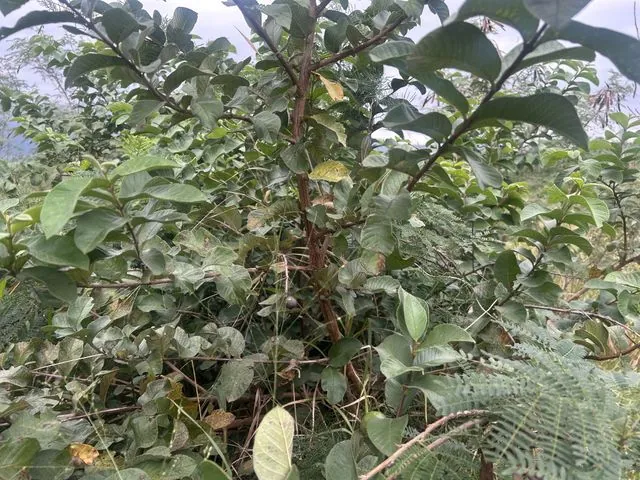
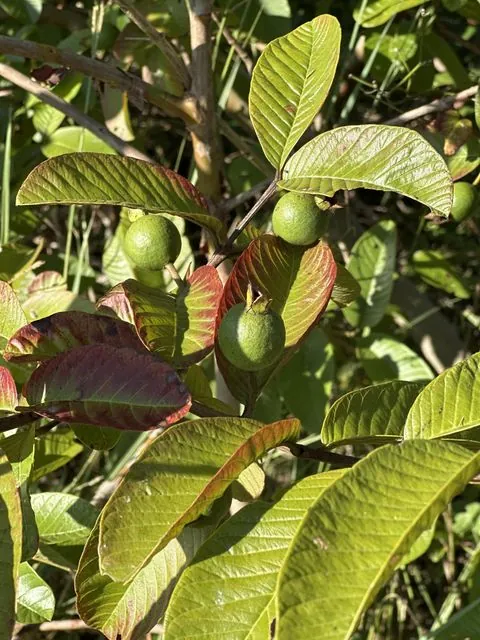
Canonical name: The scientific name without its authorship or date, for example Zea mays instead of Zea mays L. — The scientific name without its authorship or date, for example Zea mays instead of Zea mays L.
Psidium guajava
Authorship: The author or authors credited with publishing the scientific name. It is written after the name, sometimes with the year, for example L. (Linnaeus) in Zea mays L. An author in parentheses first published the name in another genus or rank. — The author or authors credited with publishing the scientific name. It is written after the name, sometimes with the year, for example L. (Linnaeus) in Zea mays L. An author in parentheses first published the name in another genus or rank.
Kingdom: One of the broadest ranks of biological classification. It groups organisms that share very basic features, for example plants (Plantae), animals (Animalia) or fungi (Fungi). — One of the broadest ranks of biological classification. It groups organisms that share very basic features, for example plants (Plantae), animals (Animalia) or fungi (Fungi).
Plantae
Phylum: Rank below kingdom that groups organisms with a shared general body plan, for example chordates (Chordata), arthropods (Arthropoda) or vascular plants (Tracheophyta). In botany the same rank is also called division. — Rank below kingdom that groups organisms with a shared general body plan, for example chordates (Chordata), arthropods (Arthropoda) or vascular plants (Tracheophyta). In botany the same rank is also called division.
Tracheophyta
Class: Rank below phylum, for example mammals (Mammalia), birds (Aves), insects (Insecta) or monocot plants such as grasses and orchids (Liliopsida). — Rank below phylum, for example mammals (Mammalia), birds (Aves), insects (Insecta) or monocot plants such as grasses and orchids (Liliopsida).
Magnoliopsida
Order: Rank below class that groups related families, for example grasses and their relatives (Poales) or bats (Chiroptera). — Rank below class that groups related families, for example grasses and their relatives (Poales) or bats (Chiroptera).
Myrtales
Family: Rank below order that groups related genera. Family names usually end in -aceae in botany (for example Poaceae, the grass family) and in -idae in zoology (for example Felidae, the cat family). — Rank below order that groups related genera. Family names usually end in -aceae in botany (for example Poaceae, the grass family) and in -idae in zoology (for example Felidae, the cat family).
Myrtaceae
Genus: Rank that groups closely related species. Its name is the first word of a species' scientific name and starts with a capital letter, for example Zea in Zea mays. — Rank that groups closely related species. Its name is the first word of a species' scientific name and starts with a capital letter, for example Zea in Zea mays.
Psidium
Specific epithet: The second word of a species' scientific name. On its own it does not name the species: it always goes with the genus, for example mays in Zea mays. — The second word of a species' scientific name. On its own it does not name the species: it always goes with the genus, for example mays in Zea mays.
guajava
Taxonomic rank: The level a name occupies in the hierarchy of biological classification, such as kingdom, family, genus, species or subspecies. — The level a name occupies in the hierarchy of biological classification, such as kingdom, family, genus, species or subspecies.
species
Reference species
Psidium guajava
Taxonomic status: Whether the taxonomic catalogue the record comes from currently accepts this name for the organism, or treats it as a synonym of another accepted name or as doubtful. — Whether the taxonomic catalogue the record comes from currently accepts this name for the organism, or treats it as a synonym of another accepted name or as doubtful.
accepted name
Photos and conservation status
IUCN Red List category: The extinction-risk category that the International Union for Conservation of Nature (IUCN) assigns to a species on its Red List. EX Extinct: there is no reasonable doubt that the last individual has died. EW Extinct in the wild: it survives only in cultivation, in captivity or as a population far outside its past range. CR Critically endangered, EN Endangered and VU Vulnerable: the three threatened categories, from an extremely high to a high risk of extinction in the wild. NT Near threatened: close to qualifying as threatened. LC Least concern: evaluated and not threatened. DD Data deficient: there is not enough information to assess its risk. NE Not evaluated: not yet assessed against the criteria. It describes the risk of the species worldwide, not its situation in a project's area. — The extinction-risk category that the International Union for Conservation of Nature (IUCN) assigns to a species on its Red List. EX Extinct: there is no reasonable doubt that the last individual has died. EW Extinct in the wild: it survives only in cultivation, in captivity or as a population far outside its past range. CR Critically endangered, EN Endangered and VU Vulnerable: the three threatened categories, from an extremely high to a high risk of extinction in the wild. NT Near threatened: close to qualifying as threatened. LC Least concern: evaluated and not threatened. DD Data deficient: there is not enough information to assess its risk. NE Not evaluated: not yet assessed against the criteria. It describes the risk of the species worldwide, not its situation in a project's area.
Least concern (LC)
Source: IUCN Red List via GBIF, queried on 2026-10-09 12:15.
Research-grade iNaturalist observations via GBIF, CC0 or CC BY licences only, queried on 2026-10-09 12:15.
Interacciones documentadas
GloBI says it is documented somewhere in the world. Biolitica answers whether it could happen here.
A documented interaction means it was recorded somewhere in the world. It does not mean it occurs here.
Types shown: 12 of 15
is a host of
×
is eaten by
×
interacts with (this species is the record's destination)
×
has as a parasite
×
has its flowers visited by
×
has as a vector
×
is pollinated by
×
is adjacent to
×
is dispersed by
×
is a mutualist of
×
is visited by
×
interacts with (this species is the record's origin)
×
3 more types with data for this species
Blocks that do not sit under a navigation concept heading keep the source's own term: no navigation concept has been assigned to them yet.
is a host of
742 organisms
The authority declares no effect on this species for this term: neither that it harms it nor that it benefits it. In the source ontology symbiosis covers mutualism, commensalism and parasitism alike, so this block holds attackers and allies side by side.
Context: Valle del Cibao, Moca, at La Rosa · May 30, 1931 · Preserved specimen
Claim type
Published relationship between two taxa
Version
GloBI 0.11
Reuse
This release publishes no reuse terms for this record.
Valle del Cibao, Moca, at La Rosa · May 30, 1931 · Preserved specimenAs published: 1931-05-30T00:00:00Z · PreservedSpecimenWhere it is: line:hash://sha256/021a206a1459bcca7e251c73f5bd180fc3ac342a09c499855fe42e21fc09edcf!/interactions.tsv.gz!/L16533832
Context: Mayaguez · March 9, 1913 · Preserved specimen
Claim type
Published relationship between two taxa
Version
GloBI 0.11
Reuse
This release publishes no reuse terms for this record.
Mayaguez · March 9, 1913 · Preserved specimenAs published: 1913-03-09T00:00:00Z · PreservedSpecimenWhere it is: line:hash://sha256/021a206a1459bcca7e251c73f5bd180fc3ac342a09c499855fe42e21fc09edcf!/interactions.tsv.gz!/L16533836
Context: Maricao · March 23, 1916 · Preserved specimen
Claim type
Published relationship between two taxa
Version
GloBI 0.11
Reuse
This release publishes no reuse terms for this record.
Maricao · March 23, 1916 · Preserved specimenAs published: 1916-03-23T00:00:00Z · PreservedSpecimenWhere it is: line:hash://sha256/021a206a1459bcca7e251c73f5bd180fc3ac342a09c499855fe42e21fc09edcf!/interactions.tsv.gz!/L16533837
Context: Limbe · July 4, 1931 · Preserved specimen
Claim type
Published relationship between two taxa
Version
GloBI 0.11
Reuse
This release publishes no reuse terms for this record.
Limbe · July 4, 1931 · Preserved specimenAs published: 1931-07-04T00:00:00Z · PreservedSpecimenWhere it is: line:hash://sha256/021a206a1459bcca7e251c73f5bd180fc3ac342a09c499855fe42e21fc09edcf!/interactions.tsv.gz!/L16533839
Context: 1 1/2 mi. NNW of Ulster Spring · Aug. 22, 1956 · Preserved specimen
Claim type
Published relationship between two taxa
Version
GloBI 0.11
Reuse
This release publishes no reuse terms for this record.
1 1/2 mi. NNW of Ulster Spring · Aug. 22, 1956 · Preserved specimenAs published: 1956-08-22T00:00:00Z · PreservedSpecimenWhere it is: line:hash://sha256/021a206a1459bcca7e251c73f5bd180fc3ac342a09c499855fe42e21fc09edcf!/interactions.tsv.gz!/L16533843
Context: Para · Jan. 21, 1908 · Preserved specimen
Claim type
Published relationship between two taxa
Version
GloBI 0.11
Reuse
This release publishes no reuse terms for this record.
Para · Jan. 21, 1908 · Preserved specimenAs published: 1908-01-21T00:00:00Z · PreservedSpecimenWhere it is: line:hash://sha256/021a206a1459bcca7e251c73f5bd180fc3ac342a09c499855fe42e21fc09edcf!/interactions.tsv.gz!/L16533848
Anonymous. 1960. Index of Plant Diseases in the United States. U.S.D.A. Agric. Handb. 165:1-531
Published in globalbioticinteractions/usda-fungus-host
Record contexts (sample): United States · no date published; United States · no date published
Claim type
Published relationship between two taxa
Version
GloBI 0.11
Reuse
This release publishes no reuse terms for this record.
United States · no date publishedWhere it is: line:hash://sha256/021a206a1459bcca7e251c73f5bd180fc3ac342a09c499855fe42e21fc09edcf!/interactions.tsv.gz!/L3637140
United States · no date publishedWhere it is: line:hash://sha256/021a206a1459bcca7e251c73f5bd180fc3ac342a09c499855fe42e21fc09edcf!/interactions.tsv.gz!/L3637181
United States · no date publishedWhere it is: line:hash://sha256/021a206a1459bcca7e251c73f5bd180fc3ac342a09c499855fe42e21fc09edcf!/interactions.tsv.gz!/L3637239
Published in globalbioticinteractions/usda-fungus-host
Record contexts (sample): Dominican Republic · no date published; Dominican Republic · no date published
Claim type
Published relationship between two taxa
Version
GloBI 0.11
Reuse
This release publishes no reuse terms for this record.
Dominican Republic · no date publishedWhere it is: line:hash://sha256/021a206a1459bcca7e251c73f5bd180fc3ac342a09c499855fe42e21fc09edcf!/interactions.tsv.gz!/L3945139
Dominican Republic · no date publishedWhere it is: line:hash://sha256/021a206a1459bcca7e251c73f5bd180fc3ac342a09c499855fe42e21fc09edcf!/interactions.tsv.gz!/L3946850
Context: Washington · Dec. 1, 1907 · Preserved specimen
Claim type
Published relationship between two taxa
Version
GloBI 0.11
Reuse
This release publishes no reuse terms for this record.
Washington · Dec. 1, 1907 · Preserved specimenAs published: 1907-12-01T00:00:00Z · PreservedSpecimenWhere it is: line:hash://sha256/021a206a1459bcca7e251c73f5bd180fc3ac342a09c499855fe42e21fc09edcf!/interactions.tsv.gz!/L17281354
Context: Washington · Oct. 1, 1907 · Preserved specimen
Claim type
Published relationship between two taxa
Version
GloBI 0.11
Reuse
This release publishes no reuse terms for this record.
Washington · Oct. 1, 1907 · Preserved specimenAs published: 1907-10-01T00:00:00Z · PreservedSpecimenWhere it is: line:hash://sha256/021a206a1459bcca7e251c73f5bd180fc3ac342a09c499855fe42e21fc09edcf!/interactions.tsv.gz!/L17281355
Context: Washington · Jan. 29, 1908 · Preserved specimen
Claim type
Published relationship between two taxa
Version
GloBI 0.11
Reuse
This release publishes no reuse terms for this record.
Washington · Jan. 29, 1908 · Preserved specimenAs published: 1908-01-29T00:00:00Z · PreservedSpecimenWhere it is: line:hash://sha256/021a206a1459bcca7e251c73f5bd180fc3ac342a09c499855fe42e21fc09edcf!/interactions.tsv.gz!/L17281356
Context: Washington · Nov. 30, 1907 · Preserved specimen
Claim type
Published relationship between two taxa
Version
GloBI 0.11
Reuse
This release publishes no reuse terms for this record.
Washington · Nov. 30, 1907 · Preserved specimenAs published: 1907-11-30T00:00:00Z · PreservedSpecimenWhere it is: line:hash://sha256/021a206a1459bcca7e251c73f5bd180fc3ac342a09c499855fe42e21fc09edcf!/interactions.tsv.gz!/L17281358
Lindquist, J.C.. 1982. Royas de la Republica Argentina y Zonas Limitrofes.. Inst. Nacional de Tecnologia Agropecuaria. :574
Published in globalbioticinteractions/usda-fungus-host
Record contexts (sample): Brazil · no date published; Argentina · no date published
Claim type
Published relationship between two taxa
Version
GloBI 0.11
Reuse
This release publishes no reuse terms for this record.
Brazil · no date publishedWhere it is: line:hash://sha256/021a206a1459bcca7e251c73f5bd180fc3ac342a09c499855fe42e21fc09edcf!/interactions.tsv.gz!/L4081287
Argentina · no date publishedWhere it is: line:hash://sha256/021a206a1459bcca7e251c73f5bd180fc3ac342a09c499855fe42e21fc09edcf!/interactions.tsv.gz!/L4081288
Uruguay · no date publishedWhere it is: line:hash://sha256/021a206a1459bcca7e251c73f5bd180fc3ac342a09c499855fe42e21fc09edcf!/interactions.tsv.gz!/L4081290
No public URL for this record
Stevenson, J.A.. 1975. Fungi of Puerto Rico and the American Virgin Islands. Contr. Reed Herb. 23:743
Published in globalbioticinteractions/usda-fungus-host
Record contexts (sample): Puerto Rico · no date published; Virgin Islands · no date published
Claim type
Published relationship between two taxa
Version
GloBI 0.11
Reuse
This release publishes no reuse terms for this record.
Puerto Rico · no date publishedWhere it is: line:hash://sha256/021a206a1459bcca7e251c73f5bd180fc3ac342a09c499855fe42e21fc09edcf!/interactions.tsv.gz!/L3943170
Virgin Islands · no date publishedWhere it is: line:hash://sha256/021a206a1459bcca7e251c73f5bd180fc3ac342a09c499855fe42e21fc09edcf!/interactions.tsv.gz!/L3943200
No public URL for this record
Glen, M., Alfenas, A.C., Zauza, E.A.V., Wingfield, M.J., and Mohammed, C.. 2007. %Puccinia psidii%: a threat to the Autralian environment and economy - a review. Australas. Pl. Pathol. 36:1-16
Published in globalbioticinteractions/usda-fungus-host
Record contexts (sample): United States · no date published; Colombia · no date published
Claim type
Published relationship between two taxa
Version
GloBI 0.11
Reuse
This release publishes no reuse terms for this record.
United States · no date publishedWhere it is: line:hash://sha256/021a206a1459bcca7e251c73f5bd180fc3ac342a09c499855fe42e21fc09edcf!/interactions.tsv.gz!/L4339013
Colombia · no date publishedWhere it is: line:hash://sha256/021a206a1459bcca7e251c73f5bd180fc3ac342a09c499855fe42e21fc09edcf!/interactions.tsv.gz!/L4339016
No public URL for this record
Granados, G.M., McTaggart, A.R., Barnes, I., Rodas, C.A., Roux, J., and Wingfield, M.J.. 2017. The pandemic biotype of %Austropuccinia psidii% discovered in South America. Australas. Pl. Pathol. 46(3):267-275
Published in globalbioticinteractions/usda-fungus-host
Record contexts (sample): Brazil · no date published; Colombia · no date published
Claim type
Published relationship between two taxa
Version
GloBI 0.11
Reuse
This release publishes no reuse terms for this record.
Brazil · no date publishedWhere it is: line:hash://sha256/021a206a1459bcca7e251c73f5bd180fc3ac342a09c499855fe42e21fc09edcf!/interactions.tsv.gz!/L4429996
Colombia · no date publishedWhere it is: line:hash://sha256/021a206a1459bcca7e251c73f5bd180fc3ac342a09c499855fe42e21fc09edcf!/interactions.tsv.gz!/L4429997
Context: Rio de Janeiro · Nov. 14, 1921 · Preserved specimen
Claim type
Published relationship between two taxa
Version
GloBI 0.11
Reuse
This release publishes no reuse terms for this record.
Rio de Janeiro · Nov. 14, 1921 · Preserved specimenAs published: 1921-11-14T00:00:00Z · PreservedSpecimenWhere it is: line:hash://sha256/021a206a1459bcca7e251c73f5bd180fc3ac342a09c499855fe42e21fc09edcf!/interactions.tsv.gz!/L16470824
Context: Rio de Janeiro · Nov. 14, 1921 · Preserved specimen
Claim type
Published relationship between two taxa
Version
GloBI 0.11
Reuse
This release publishes no reuse terms for this record.
Rio de Janeiro · Nov. 14, 1921 · Preserved specimenAs published: 1921-11-14T00:00:00Z · PreservedSpecimenWhere it is: line:hash://sha256/021a206a1459bcca7e251c73f5bd180fc3ac342a09c499855fe42e21fc09edcf!/interactions.tsv.gz!/L16817897
Context: Rio de Janeiro · Nov. 14, 1921 · Preserved specimen
Claim type
Published relationship between two taxa
Version
GloBI 0.11
Reuse
This release publishes no reuse terms for this record.
Rio de Janeiro · Nov. 14, 1921 · Preserved specimenAs published: 1921-11-14T00:00:00Z · PreservedSpecimenWhere it is: line:hash://sha256/021a206a1459bcca7e251c73f5bd180fc3ac342a09c499855fe42e21fc09edcf!/interactions.tsv.gz!/L16817898
Context: Intercepted New York New York #174331 · Dec. 30, 1961 · Preserved specimen
Claim type
Published relationship between two taxa
Version
GloBI 0.11
Reuse
This release publishes no reuse terms for this record.
Intercepted New York New York #174331 · Dec. 30, 1961 · Preserved specimenAs published: 1961-12-30T00:00:00Z · PreservedSpecimenWhere it is: line:hash://sha256/021a206a1459bcca7e251c73f5bd180fc3ac342a09c499855fe42e21fc09edcf!/interactions.tsv.gz!/L16817899
Stevenson, J.A.. 1975. Fungi of Puerto Rico and the American Virgin Islands. Contr. Reed Herb. 23:743
Published in globalbioticinteractions/usda-fungus-host
Record contexts (sample): Puerto Rico · no date published; Virgin Islands · no date published
Claim type
Published relationship between two taxa
Version
GloBI 0.11
Reuse
This release publishes no reuse terms for this record.
Puerto Rico · no date publishedWhere it is: line:hash://sha256/021a206a1459bcca7e251c73f5bd180fc3ac342a09c499855fe42e21fc09edcf!/interactions.tsv.gz!/L3944413
Virgin Islands · no date publishedWhere it is: line:hash://sha256/021a206a1459bcca7e251c73f5bd180fc3ac342a09c499855fe42e21fc09edcf!/interactions.tsv.gz!/L3944414
Context: Intercepted J. F. K. I. A. New York #02228 · Oct. 13, 1963 · Preserved specimen
Claim type
Published relationship between two taxa
Version
GloBI 0.11
Reuse
This release publishes no reuse terms for this record.
Intercepted J. F. K. I. A. New York #02228 · Oct. 13, 1963 · Preserved specimenAs published: 1963-10-13T00:00:00Z · PreservedSpecimenWhere it is: line:hash://sha256/021a206a1459bcca7e251c73f5bd180fc3ac342a09c499855fe42e21fc09edcf!/interactions.tsv.gz!/L17168185
This term does declare that the organism harms this species.
Organism
Reads as
Studies
Where it was documented
Actions
Great Fruit-eating BatArtibeus lituratusPhyllostomidae
is eaten by
13
not compared
13 sources · 21 records
Zapata-Mesa 2017
Published in globalbioticinteractions/fricke2020
Record contexts (sample): Colombia · no date published; Colombia · no date published
Claim type
Published relationship between two taxa
Version
GloBI 0.11
Reuse
This release publishes no reuse terms for this record.
Colombia · no date publishedWhere it is: line:hash://sha256/021a206a1459bcca7e251c73f5bd180fc3ac342a09c499855fe42e21fc09edcf!/interactions.tsv.gz!/L13392377
Colombia · no date publishedWhere it is: line:hash://sha256/021a206a1459bcca7e251c73f5bd180fc3ac342a09c499855fe42e21fc09edcf!/interactions.tsv.gz!/L13392384
Colombia · no date publishedWhere it is: line:hash://sha256/021a206a1459bcca7e251c73f5bd180fc3ac342a09c499855fe42e21fc09edcf!/interactions.tsv.gz!/L13392398
And 2 more records of this source, not listed here.
No public URL for this record
doi:10.1002/ecy.1818
Published in globalbioticinteractions/bello2017
Record contexts (sample): no place published · no date published; no place published · no date published
Claim type
Published relationship between two taxa
Version
GloBI 0.11
Reuse
This release publishes no reuse terms for this record.
no place published · no date publishedWhere it is: line:hash://sha256/021a206a1459bcca7e251c73f5bd180fc3ac342a09c499855fe42e21fc09edcf!/interactions.tsv.gz!/L7027302
no place published · no date publishedWhere it is: line:hash://sha256/021a206a1459bcca7e251c73f5bd180fc3ac342a09c499855fe42e21fc09edcf!/interactions.tsv.gz!/L7027522
no place published · no date publishedWhere it is: line:hash://sha256/021a206a1459bcca7e251c73f5bd180fc3ac342a09c499855fe42e21fc09edcf!/interactions.tsv.gz!/L7027559
And 2 more records of this source, not listed here.
This release publishes no reuse terms for this record.
Brazil · no date publishedWhere it is: line:hash://sha256/021a206a1459bcca7e251c73f5bd180fc3ac342a09c499855fe42e21fc09edcf!/interactions.tsv.gz!/L13285293
No public URL for this record
Castano 2018
Published in globalbioticinteractions/fricke2020
Context: Colombia · no date published
Claim type
Published relationship between two taxa
Version
GloBI 0.11
Reuse
This release publishes no reuse terms for this record.
Colombia · no date publishedWhere it is: line:hash://sha256/021a206a1459bcca7e251c73f5bd180fc3ac342a09c499855fe42e21fc09edcf!/interactions.tsv.gz!/L13309732
No public URL for this record
Dos Reis 1983
Published in globalbioticinteractions/fricke2020
Context: Brazil · no date published
Claim type
Published relationship between two taxa
Version
GloBI 0.11
Reuse
This release publishes no reuse terms for this record.
Brazil · no date publishedWhere it is: line:hash://sha256/021a206a1459bcca7e251c73f5bd180fc3ac342a09c499855fe42e21fc09edcf!/interactions.tsv.gz!/L13326629
No public URL for this record
Garcia-Estrada 2012
Published in globalbioticinteractions/fricke2020
Context: Guatemala · no date published
Claim type
Published relationship between two taxa
Version
GloBI 0.11
Reuse
This release publishes no reuse terms for this record.
Guatemala · no date publishedWhere it is: line:hash://sha256/021a206a1459bcca7e251c73f5bd180fc3ac342a09c499855fe42e21fc09edcf!/interactions.tsv.gz!/L13337670
No public URL for this record
Garcia-Morales 2012
Published in globalbioticinteractions/fricke2020
Context: Mexico · no date published
Claim type
Published relationship between two taxa
Version
GloBI 0.11
Reuse
This release publishes no reuse terms for this record.
Mexico · no date publishedWhere it is: line:hash://sha256/021a206a1459bcca7e251c73f5bd180fc3ac342a09c499855fe42e21fc09edcf!/interactions.tsv.gz!/L13337816
No public URL for this record
Moreno-Mosquera 2011
Published in globalbioticinteractions/fricke2020
Context: Colombia · no date published
Claim type
Published relationship between two taxa
Version
GloBI 0.11
Reuse
This release publishes no reuse terms for this record.
Colombia · no date publishedWhere it is: line:hash://sha256/021a206a1459bcca7e251c73f5bd180fc3ac342a09c499855fe42e21fc09edcf!/interactions.tsv.gz!/L13354479
No public URL for this record
And 5 more sources, with fewer records, not listed here.
A published relationship says these two taxa were documented interacting. It does not say how often, or that it happens in this project's region.
Record contexts (sample): no place published · no date published; no place published · no date published
Claim type
Published relationship between two taxa
Version
GloBI 0.11
Reuse
This release publishes no reuse terms for this record.
no place published · no date publishedWhere it is: line:hash://sha256/021a206a1459bcca7e251c73f5bd180fc3ac342a09c499855fe42e21fc09edcf!/interactions.tsv.gz!/L7027121
no place published · no date publishedWhere it is: line:hash://sha256/021a206a1459bcca7e251c73f5bd180fc3ac342a09c499855fe42e21fc09edcf!/interactions.tsv.gz!/L7027527
no place published · no date publishedWhere it is: line:hash://sha256/021a206a1459bcca7e251c73f5bd180fc3ac342a09c499855fe42e21fc09edcf!/interactions.tsv.gz!/L7027793
And 1 more record of this source, not listed here.
This release publishes no reuse terms for this record.
Colombia · no date publishedWhere it is: line:hash://sha256/021a206a1459bcca7e251c73f5bd180fc3ac342a09c499855fe42e21fc09edcf!/interactions.tsv.gz!/L13309722
No public URL for this record
Garcia-Estrada 2012
Published in globalbioticinteractions/fricke2020
Context: Guatemala · no date published
Claim type
Published relationship between two taxa
Version
GloBI 0.11
Reuse
This release publishes no reuse terms for this record.
Guatemala · no date publishedWhere it is: line:hash://sha256/021a206a1459bcca7e251c73f5bd180fc3ac342a09c499855fe42e21fc09edcf!/interactions.tsv.gz!/L13337715
No public URL for this record
Garcia-Morales 2012
Published in globalbioticinteractions/fricke2020
Context: Mexico · no date published
Claim type
Published relationship between two taxa
Version
GloBI 0.11
Reuse
This release publishes no reuse terms for this record.
Mexico · no date publishedWhere it is: line:hash://sha256/021a206a1459bcca7e251c73f5bd180fc3ac342a09c499855fe42e21fc09edcf!/interactions.tsv.gz!/L13337795
No public URL for this record
Moreno-Mosquera 2011
Published in globalbioticinteractions/fricke2020
Context: Colombia · no date published
Claim type
Published relationship between two taxa
Version
GloBI 0.11
Reuse
This release publishes no reuse terms for this record.
Colombia · no date publishedWhere it is: line:hash://sha256/021a206a1459bcca7e251c73f5bd180fc3ac342a09c499855fe42e21fc09edcf!/interactions.tsv.gz!/L13354553
No public URL for this record
Saldana-Vasquez 2010
Published in globalbioticinteractions/fricke2020
Context: Mexico · no date published
Claim type
Published relationship between two taxa
Version
GloBI 0.11
Reuse
This release publishes no reuse terms for this record.
Mexico · no date publishedWhere it is: line:hash://sha256/021a206a1459bcca7e251c73f5bd180fc3ac342a09c499855fe42e21fc09edcf!/interactions.tsv.gz!/L13373880
No public URL for this record
Zapata-Mesa 2017
Published in globalbioticinteractions/fricke2020
Context: Colombia · no date published
Claim type
Published relationship between two taxa
Version
GloBI 0.11
Reuse
This release publishes no reuse terms for this record.
Colombia · no date publishedWhere it is: line:hash://sha256/021a206a1459bcca7e251c73f5bd180fc3ac342a09c499855fe42e21fc09edcf!/interactions.tsv.gz!/L13392486
No public URL for this record
Carvalho, C.T., de. 1961. Sobre os h�bitos alimentares de Phillostom�deos (Mammalia, Chiroptera). Revista Biologia Tropical 9: 53-60
Published in globalbioticinteractions/NeoBat_Interactions
Context: no place published · no date published
Claim type
Published relationship between two taxa
Version
GloBI 0.11
Reuse
This release publishes no reuse terms for this record.
no place published · no date publishedWhere it is: line:hash://sha256/021a206a1459bcca7e251c73f5bd180fc3ac342a09c499855fe42e21fc09edcf!/interactions.tsv.gz!/L24374037
No public URL for this record
And 3 more sources, with fewer records, not listed here.
A published relationship says these two taxa were documented interacting. It does not say how often, or that it happens in this project's region.
Record contexts (sample): Colombia · no date published; Colombia · no date published
Claim type
Published relationship between two taxa
Version
GloBI 0.11
Reuse
This release publishes no reuse terms for this record.
Colombia · no date publishedWhere it is: line:hash://sha256/021a206a1459bcca7e251c73f5bd180fc3ac342a09c499855fe42e21fc09edcf!/interactions.tsv.gz!/L13392339
Colombia · no date publishedWhere it is: line:hash://sha256/021a206a1459bcca7e251c73f5bd180fc3ac342a09c499855fe42e21fc09edcf!/interactions.tsv.gz!/L13392379
Colombia · no date publishedWhere it is: line:hash://sha256/021a206a1459bcca7e251c73f5bd180fc3ac342a09c499855fe42e21fc09edcf!/interactions.tsv.gz!/L13392387
And 2 more records of this source, not listed here.
No public URL for this record
doi:10.1002/ecy.1818
Published in globalbioticinteractions/bello2017
Record contexts (sample): no place published · no date published; no place published · no date published
Claim type
Published relationship between two taxa
Version
GloBI 0.11
Reuse
This release publishes no reuse terms for this record.
no place published · no date publishedWhere it is: line:hash://sha256/021a206a1459bcca7e251c73f5bd180fc3ac342a09c499855fe42e21fc09edcf!/interactions.tsv.gz!/L7027625
no place published · no date publishedWhere it is: line:hash://sha256/021a206a1459bcca7e251c73f5bd180fc3ac342a09c499855fe42e21fc09edcf!/interactions.tsv.gz!/L7027641
no place published · no date publishedWhere it is: line:hash://sha256/021a206a1459bcca7e251c73f5bd180fc3ac342a09c499855fe42e21fc09edcf!/interactions.tsv.gz!/L7027711
And 1 more record of this source, not listed here.
This release publishes no reuse terms for this record.
Brazil · no date publishedWhere it is: line:hash://sha256/021a206a1459bcca7e251c73f5bd180fc3ac342a09c499855fe42e21fc09edcf!/interactions.tsv.gz!/L13288857
No public URL for this record
Castano 2018
Published in globalbioticinteractions/fricke2020
Context: Colombia · no date published
Claim type
Published relationship between two taxa
Version
GloBI 0.11
Reuse
This release publishes no reuse terms for this record.
Colombia · no date publishedWhere it is: line:hash://sha256/021a206a1459bcca7e251c73f5bd180fc3ac342a09c499855fe42e21fc09edcf!/interactions.tsv.gz!/L13309744
No public URL for this record
Dos Reis 1983
Published in globalbioticinteractions/fricke2020
Context: Brazil · no date published
Claim type
Published relationship between two taxa
Version
GloBI 0.11
Reuse
This release publishes no reuse terms for this record.
Brazil · no date publishedWhere it is: line:hash://sha256/021a206a1459bcca7e251c73f5bd180fc3ac342a09c499855fe42e21fc09edcf!/interactions.tsv.gz!/L13326546
No public URL for this record
Mikich 2002
Published in globalbioticinteractions/fricke2020
Context: Brazil · no date published
Claim type
Published relationship between two taxa
Version
GloBI 0.11
Reuse
This release publishes no reuse terms for this record.
Brazil · no date publishedWhere it is: line:hash://sha256/021a206a1459bcca7e251c73f5bd180fc3ac342a09c499855fe42e21fc09edcf!/interactions.tsv.gz!/L13353414
No public URL for this record
Moreno-Mosquera 2011
Published in globalbioticinteractions/fricke2020
Context: Colombia · no date published
Claim type
Published relationship between two taxa
Version
GloBI 0.11
Reuse
This release publishes no reuse terms for this record.
Colombia · no date publishedWhere it is: line:hash://sha256/021a206a1459bcca7e251c73f5bd180fc3ac342a09c499855fe42e21fc09edcf!/interactions.tsv.gz!/L13354511
No public URL for this record
Sanchez 2012
Published in globalbioticinteractions/fricke2020
Context: Argentina · no date published
Claim type
Published relationship between two taxa
Version
GloBI 0.11
Reuse
This release publishes no reuse terms for this record.
Argentina · no date publishedWhere it is: line:hash://sha256/021a206a1459bcca7e251c73f5bd180fc3ac342a09c499855fe42e21fc09edcf!/interactions.tsv.gz!/L13374000
No public URL for this record
And 2 more sources, with fewer records, not listed here.
A published relationship says these two taxa were documented interacting. It does not say how often, or that it happens in this project's region.
Greater Shortnosed Fruit BatCynopterus sphinxPteropodidae
is eaten by
10
not compared
10 sources · 11 records
https://www.inaturalist.org/observations/64511715
Published in globalbioticinteractions/inaturalist
Record contexts (sample): no place published · Nov. 7, 2020 · Human observation; no place published · Nov. 7, 2020 · Human observation
Claim type
Published relationship between two taxa
Version
GloBI 0.11
Reuse
This release publishes no reuse terms for this record.
no place published · Nov. 7, 2020 · Human observationAs published: 2020-11-07T21:12:00Z · HumanObservationWhere it is: line:hash://sha256/021a206a1459bcca7e251c73f5bd180fc3ac342a09c499855fe42e21fc09edcf!/interactions.tsv.gz!/L5665541
no place published · Nov. 7, 2020 · Human observationAs published: 2020-11-07T21:12:00Z · HumanObservationWhere it is: line:hash://sha256/021a206a1459bcca7e251c73f5bd180fc3ac342a09c499855fe42e21fc09edcf!/interactions.tsv.gz!/L5665542
Bhat, H. 1994. Observations on the food and feeding behaviour of Cynopterus sphinx Vahl (Chiroptera, Pteropodidae) at Pune, India. Mammalia 58 (3): 363-370.
Published in globalbioticinteractions/batbase
Context: Pune · no date published
Claim type
Published relationship between two taxa
Version
GloBI 0.11
Reuse
This release publishes no reuse terms for this record.
Pune · no date publishedWhere it is: line:hash://sha256/021a206a1459bcca7e251c73f5bd180fc3ac342a09c499855fe42e21fc09edcf!/interactions.tsv.gz!/L12444787
No public URL for this record
Rajan, K. E., N. G. Nair & R. Subbaraj. 1999. Seasonal food preferences of the Indian short nosed fruit bat Cynopterus sphinx (Vahl) (Chiroptera: Pteropodidae). Journal of the Bombay Natural History Society 96 (1): 24-27.
Published in globalbioticinteractions/batbase
Context: Madurai · no date published
Claim type
Published relationship between two taxa
Version
GloBI 0.11
Reuse
This release publishes no reuse terms for this record.
Madurai · no date publishedWhere it is: line:hash://sha256/021a206a1459bcca7e251c73f5bd180fc3ac342a09c499855fe42e21fc09edcf!/interactions.tsv.gz!/L12445378
No public URL for this record
Sudhakaran, M. R. & P. S. Doss. 2012. Food and foraging preferences of three pteropodid bats in southern India. Journal of Threatened Taxa 4 (1): 2295-2303.
Published in globalbioticinteractions/batbase
Context: Tamil Nadu · no date published
Claim type
Published relationship between two taxa
Version
GloBI 0.11
Reuse
This release publishes no reuse terms for this record.
Tamil Nadu · no date publishedWhere it is: line:hash://sha256/021a206a1459bcca7e251c73f5bd180fc3ac342a09c499855fe42e21fc09edcf!/interactions.tsv.gz!/L12445746
No public URL for this record
Mickleburgh, S. P., A. M. Hutson & P. Racey. 1992. Old World Fruit Bats: An Action Plan for their Conservation. International Union for Conservation of Nature and Natural Resources, Gland, Switzerland.
Published in globalbioticinteractions/batbase
Context: Sri Lanka · no date published
Claim type
Published relationship between two taxa
Version
GloBI 0.11
Reuse
This release publishes no reuse terms for this record.
Sri Lanka · no date publishedWhere it is: line:hash://sha256/021a206a1459bcca7e251c73f5bd180fc3ac342a09c499855fe42e21fc09edcf!/interactions.tsv.gz!/L12452756
No public URL for this record
Sudhakaran 2012
Published in globalbioticinteractions/fricke2020
Context: India · no date published
Claim type
Published relationship between two taxa
Version
GloBI 0.11
Reuse
This release publishes no reuse terms for this record.
India · no date publishedWhere it is: line:hash://sha256/021a206a1459bcca7e251c73f5bd180fc3ac342a09c499855fe42e21fc09edcf!/interactions.tsv.gz!/L13388127
No public URL for this record
Bhat, H. R. 1994. Observations of the food and feeding behavior of Cynopterus sphinx Vahl (Chiroptera, Pteropodidae) at Pune, India. Mammalia, 58: 363-370.
Published in globalbioticinteractions/bat-co-roosting-database
Context: Pune city (18°32'N ; 73°5TE) · Jan. 1, 1986
Claim type
Published relationship between two taxa
Version
GloBI 0.11
Reuse
This release publishes no reuse terms for this record.
Pune city (18°32'N ; 73°5TE) · Jan. 1, 1986As published: 1986-01-01T00:00:00ZWhere it is: line:hash://sha256/021a206a1459bcca7e251c73f5bd180fc3ac342a09c499855fe42e21fc09edcf!/interactions.tsv.gz!/L7057126
Ruby, J., P.. Nathan, J. Balasingh,and. H. Kunz. 2000. Chemical composition ofleaves and fruits eaten by short-nosed fruit bat, Cynopterus sphinx (Megachiroptera). Journal of Chemical Ecology, 26: 2825-2841.
Published in globalbioticinteractions/bat-co-roosting-database
Context: St. Johns College, Palayamkottai, South India (8°44′N, 77°42′E) · no date published
Claim type
Published relationship between two taxa
Version
GloBI 0.11
Reuse
This release publishes no reuse terms for this record.
St. Johns College, Palayamkottai, South India (8°44′N, 77°42′E) · no date publishedWhere it is: line:hash://sha256/021a206a1459bcca7e251c73f5bd180fc3ac342a09c499855fe42e21fc09edcf!/interactions.tsv.gz!/L7064275
And 186 more sources, with fewer records, not listed here.
A published relationship says these two taxa were documented interacting. It does not say how often, or that it happens in this project's region.
Phocides lileaHesperiidae
interacts with
17
not compared
17 sources · 17 records
https://www.inaturalist.org/observations/4740313
Published in globalbioticinteractions/inaturalist
Context: no place published · Dec. 9, 2016 · Human observation
Claim type
Published relationship between two taxa
Version
GloBI 0.11
Reuse
This release publishes no reuse terms for this record.
no place published · Dec. 9, 2016 · Human observationAs published: 2016-12-09T04:08:00Z · HumanObservationWhere it is: line:hash://sha256/021a206a1459bcca7e251c73f5bd180fc3ac342a09c499855fe42e21fc09edcf!/interactions.tsv.gz!/L4592848
Context: no place published · June 3, 2017 · Human observation
Claim type
Published relationship between two taxa
Version
GloBI 0.11
Reuse
This release publishes no reuse terms for this record.
no place published · June 3, 2017 · Human observationAs published: 2017-06-03T07:00:00Z · HumanObservationWhere it is: line:hash://sha256/021a206a1459bcca7e251c73f5bd180fc3ac342a09c499855fe42e21fc09edcf!/interactions.tsv.gz!/L4657455
Context: no place published · June 14, 2024 · Human observation
Claim type
Published relationship between two taxa
Version
GloBI 0.11
Reuse
This release publishes no reuse terms for this record.
no place published · June 14, 2024 · Human observationAs published: 2024-06-14T14:45:14Z · HumanObservationWhere it is: line:hash://sha256/021a206a1459bcca7e251c73f5bd180fc3ac342a09c499855fe42e21fc09edcf!/interactions.tsv.gz!/L4752498
Context: no place published · Nov. 13, 2022 · Human observation
Claim type
Published relationship between two taxa
Version
GloBI 0.11
Reuse
This release publishes no reuse terms for this record.
no place published · Nov. 13, 2022 · Human observationAs published: 2022-11-13T18:44:00Z · HumanObservationWhere it is: line:hash://sha256/021a206a1459bcca7e251c73f5bd180fc3ac342a09c499855fe42e21fc09edcf!/interactions.tsv.gz!/L5212735
Context: no place published · March 4, 2020 · Human observation
Claim type
Published relationship between two taxa
Version
GloBI 0.11
Reuse
This release publishes no reuse terms for this record.
no place published · March 4, 2020 · Human observationAs published: 2020-03-04T11:29:07Z · HumanObservationWhere it is: line:hash://sha256/021a206a1459bcca7e251c73f5bd180fc3ac342a09c499855fe42e21fc09edcf!/interactions.tsv.gz!/L5286655
Context: no place published · March 9, 2023 · Human observation
Claim type
Published relationship between two taxa
Version
GloBI 0.11
Reuse
This release publishes no reuse terms for this record.
no place published · March 9, 2023 · Human observationAs published: 2023-03-09T01:58:00Z · HumanObservationWhere it is: line:hash://sha256/021a206a1459bcca7e251c73f5bd180fc3ac342a09c499855fe42e21fc09edcf!/interactions.tsv.gz!/L5319106
Context: no place published · March 21, 2023 · Human observation
Claim type
Published relationship between two taxa
Version
GloBI 0.11
Reuse
This release publishes no reuse terms for this record.
no place published · March 21, 2023 · Human observationAs published: 2023-03-21T03:31:00Z · HumanObservationWhere it is: line:hash://sha256/021a206a1459bcca7e251c73f5bd180fc3ac342a09c499855fe42e21fc09edcf!/interactions.tsv.gz!/L5335255
Context: no place published · Nov. 10, 2022 · Human observation
Claim type
Published relationship between two taxa
Version
GloBI 0.11
Reuse
This release publishes no reuse terms for this record.
no place published · Nov. 10, 2022 · Human observationAs published: 2022-11-10T21:43:44Z · HumanObservationWhere it is: line:hash://sha256/021a206a1459bcca7e251c73f5bd180fc3ac342a09c499855fe42e21fc09edcf!/interactions.tsv.gz!/L5383174
Context: no place published · March 15, 2024 · Human observation
Claim type
Published relationship between two taxa
Version
GloBI 0.11
Reuse
This release publishes no reuse terms for this record.
no place published · March 15, 2024 · Human observationAs published: 2024-03-15T11:24:00Z · HumanObservationWhere it is: line:hash://sha256/021a206a1459bcca7e251c73f5bd180fc3ac342a09c499855fe42e21fc09edcf!/interactions.tsv.gz!/L4517040
Context: no place published · March 20, 2024 · Human observation
Claim type
Published relationship between two taxa
Version
GloBI 0.11
Reuse
This release publishes no reuse terms for this record.
no place published · March 20, 2024 · Human observationAs published: 2024-03-20T11:33:00Z · HumanObservationWhere it is: line:hash://sha256/021a206a1459bcca7e251c73f5bd180fc3ac342a09c499855fe42e21fc09edcf!/interactions.tsv.gz!/L4519271
Context: no place published · March 28, 2024 · Human observation
Claim type
Published relationship between two taxa
Version
GloBI 0.11
Reuse
This release publishes no reuse terms for this record.
no place published · March 28, 2024 · Human observationAs published: 2024-03-28T11:47:00Z · HumanObservationWhere it is: line:hash://sha256/021a206a1459bcca7e251c73f5bd180fc3ac342a09c499855fe42e21fc09edcf!/interactions.tsv.gz!/L4533758
Context: no place published · April 1, 2024 · Human observation
Claim type
Published relationship between two taxa
Version
GloBI 0.11
Reuse
This release publishes no reuse terms for this record.
no place published · April 1, 2024 · Human observationAs published: 2024-04-01T13:21:00Z · HumanObservationWhere it is: line:hash://sha256/021a206a1459bcca7e251c73f5bd180fc3ac342a09c499855fe42e21fc09edcf!/interactions.tsv.gz!/L4541518
Context: no place published · April 9, 2024 · Human observation
Claim type
Published relationship between two taxa
Version
GloBI 0.11
Reuse
This release publishes no reuse terms for this record.
no place published · April 9, 2024 · Human observationAs published: 2024-04-09T12:08:00Z · HumanObservationWhere it is: line:hash://sha256/021a206a1459bcca7e251c73f5bd180fc3ac342a09c499855fe42e21fc09edcf!/interactions.tsv.gz!/L4554778
Context: no place published · June 13, 2024 · Human observation
Claim type
Published relationship between two taxa
Version
GloBI 0.11
Reuse
This release publishes no reuse terms for this record.
no place published · June 13, 2024 · Human observationAs published: 2024-06-13T11:37:00Z · HumanObservationWhere it is: line:hash://sha256/021a206a1459bcca7e251c73f5bd180fc3ac342a09c499855fe42e21fc09edcf!/interactions.tsv.gz!/L4749094
Context: no place published · Oct. 12, 2024 · Human observation
Claim type
Published relationship between two taxa
Version
GloBI 0.11
Reuse
This release publishes no reuse terms for this record.
no place published · Oct. 12, 2024 · Human observationAs published: 2024-10-12T12:40:00Z · HumanObservationWhere it is: line:hash://sha256/021a206a1459bcca7e251c73f5bd180fc3ac342a09c499855fe42e21fc09edcf!/interactions.tsv.gz!/L5222257
Context: no place published · March 28, 2023 · Human observation
Claim type
Published relationship between two taxa
Version
GloBI 0.11
Reuse
This release publishes no reuse terms for this record.
no place published · March 28, 2023 · Human observationAs published: 2023-03-28T11:58:00Z · HumanObservationWhere it is: line:hash://sha256/021a206a1459bcca7e251c73f5bd180fc3ac342a09c499855fe42e21fc09edcf!/interactions.tsv.gz!/L5343699
And 9 more sources, with fewer records, not listed here.
A published relationship says these two taxa were documented interacting. It does not say how often, or that it happens in this project's region.
Indian Flying FoxPteropus giganteusPteropodidae
interacts with
16
no location
16 sources · 16 records
Chakravarthy and Girish, 2003
Published in globalbioticinteractions/aziz2021
Context: India · no date published
Claim type
Published relationship between two taxa
Version
GloBI 0.11
Reuse
This release publishes no reuse terms for this record.
India · no date publishedWhere it is: line:hash://sha256/021a206a1459bcca7e251c73f5bd180fc3ac342a09c499855fe42e21fc09edcf!/interactions.tsv.gz!/L13004658
No public URL for this record
Sudhakaran and Doss, 2012
Published in globalbioticinteractions/aziz2021
Context: India · no date published
Claim type
Published relationship between two taxa
Version
GloBI 0.11
Reuse
This release publishes no reuse terms for this record.
India · no date publishedWhere it is: line:hash://sha256/021a206a1459bcca7e251c73f5bd180fc3ac342a09c499855fe42e21fc09edcf!/interactions.tsv.gz!/L13004699
No public URL for this record
Krishnarathi and Isaac, 2016
Published in globalbioticinteractions/aziz2021
Context: India · no date published
Claim type
Published relationship between two taxa
Version
GloBI 0.11
Reuse
This release publishes no reuse terms for this record.
India · no date publishedWhere it is: line:hash://sha256/021a206a1459bcca7e251c73f5bd180fc3ac342a09c499855fe42e21fc09edcf!/interactions.tsv.gz!/L13004916
No public URL for this record
Prasad et al., 2014
Published in globalbioticinteractions/aziz2021
Context: India · no date published
Claim type
Published relationship between two taxa
Version
GloBI 0.11
Reuse
This release publishes no reuse terms for this record.
India · no date publishedWhere it is: line:hash://sha256/021a206a1459bcca7e251c73f5bd180fc3ac342a09c499855fe42e21fc09edcf!/interactions.tsv.gz!/L13006335
No public URL for this record
Tiwari et al,. 2019
Published in globalbioticinteractions/aziz2021
Context: Nepal · no date published
Claim type
Published relationship between two taxa
Version
GloBI 0.11
Reuse
This release publishes no reuse terms for this record.
Nepal · no date publishedWhere it is: line:hash://sha256/021a206a1459bcca7e251c73f5bd180fc3ac342a09c499855fe42e21fc09edcf!/interactions.tsv.gz!/L13006358
No public URL for this record
Vendan and Kaleeswaran, 2011
Published in globalbioticinteractions/aziz2021
Context: India · no date published
Claim type
Published relationship between two taxa
Version
GloBI 0.11
Reuse
This release publishes no reuse terms for this record.
India · no date publishedWhere it is: line:hash://sha256/021a206a1459bcca7e251c73f5bd180fc3ac342a09c499855fe42e21fc09edcf!/interactions.tsv.gz!/L13006368
No public URL for this record
Dookia and Tak, 2004
Published in globalbioticinteractions/aziz2021
Context: India · no date published
Claim type
Published relationship between two taxa
Version
GloBI 0.11
Reuse
This release publishes no reuse terms for this record.
India · no date publishedWhere it is: line:hash://sha256/021a206a1459bcca7e251c73f5bd180fc3ac342a09c499855fe42e21fc09edcf!/interactions.tsv.gz!/L13006391
No public URL for this record
Divakar, 2015
Published in globalbioticinteractions/aziz2021
Context: India · no date published
Claim type
Published relationship between two taxa
Version
GloBI 0.11
Reuse
This release publishes no reuse terms for this record.
India · no date publishedWhere it is: line:hash://sha256/021a206a1459bcca7e251c73f5bd180fc3ac342a09c499855fe42e21fc09edcf!/interactions.tsv.gz!/L13006395
No public URL for this record
And 8 more sources, with fewer records, not listed here.
A published relationship says these two taxa were documented interacting. It does not say how often, or that it happens in this project's region.
This term does declare that the organism harms this species.
Organism
Reads as
Studies
Where it was documented
Actions
Parasitoid waspBlepyrus insularisEncyrtidae
has as a parasite
7
no location
7 sources · 7 records
TrjapiBeRu2004 via Universal Chalcidoidea Database
Published in globalbioticinteractions/natural-history-museum-london-interactions-bank
Context: no place published · no date published
Claim type
Published relationship between two taxa
Version
GloBI 0.11
Reuse
This release publishes no reuse terms for this record.
no place published · no date publishedWhere it is: line:hash://sha256/021a206a1459bcca7e251c73f5bd180fc3ac342a09c499855fe42e21fc09edcf!/interactions.tsv.gz!/L18814988
No public URL for this record
Hayat2006c via Universal Chalcidoidea Database
Published in globalbioticinteractions/natural-history-museum-london-interactions-bank
Context: no place published · no date published
Claim type
Published relationship between two taxa
Version
GloBI 0.11
Reuse
This release publishes no reuse terms for this record.
no place published · no date publishedWhere it is: line:hash://sha256/021a206a1459bcca7e251c73f5bd180fc3ac342a09c499855fe42e21fc09edcf!/interactions.tsv.gz!/L18821899
No public URL for this record
Noyes2000 via Universal Chalcidoidea Database
Published in globalbioticinteractions/natural-history-museum-london-interactions-bank
Context: no place published · no date published
Claim type
Published relationship between two taxa
Version
GloBI 0.11
Reuse
This release publishes no reuse terms for this record.
no place published · no date publishedWhere it is: line:hash://sha256/021a206a1459bcca7e251c73f5bd180fc3ac342a09c499855fe42e21fc09edcf!/interactions.tsv.gz!/L18847066
No public URL for this record
ManiKr990 via Universal Chalcidoidea Database
Published in globalbioticinteractions/natural-history-museum-london-interactions-bank
Context: no place published · no date published
Claim type
Published relationship between two taxa
Version
GloBI 0.11
Reuse
This release publishes no reuse terms for this record.
no place published · no date publishedWhere it is: line:hash://sha256/021a206a1459bcca7e251c73f5bd180fc3ac342a09c499855fe42e21fc09edcf!/interactions.tsv.gz!/L18914526
No public URL for this record
ManiKr989 via Universal Chalcidoidea Database
Published in globalbioticinteractions/natural-history-museum-london-interactions-bank
Context: no place published · no date published
Claim type
Published relationship between two taxa
Version
GloBI 0.11
Reuse
This release publishes no reuse terms for this record.
no place published · no date publishedWhere it is: line:hash://sha256/021a206a1459bcca7e251c73f5bd180fc3ac342a09c499855fe42e21fc09edcf!/interactions.tsv.gz!/L18914528
No public URL for this record
SimutnTr2009b via Universal Chalcidoidea Database
Published in globalbioticinteractions/natural-history-museum-london-interactions-bank
Context: no place published · no date published
Claim type
Published relationship between two taxa
Version
GloBI 0.11
Reuse
This release publishes no reuse terms for this record.
no place published · no date publishedWhere it is: line:hash://sha256/021a206a1459bcca7e251c73f5bd180fc3ac342a09c499855fe42e21fc09edcf!/interactions.tsv.gz!/L18914536
No public URL for this record
Bhuiya2001 via Universal Chalcidoidea Database
Published in globalbioticinteractions/natural-history-museum-london-interactions-bank
Context: no place published · no date published
Claim type
Published relationship between two taxa
Version
GloBI 0.11
Reuse
This release publishes no reuse terms for this record.
no place published · no date publishedWhere it is: line:hash://sha256/021a206a1459bcca7e251c73f5bd180fc3ac342a09c499855fe42e21fc09edcf!/interactions.tsv.gz!/L18935807
No public URL for this record
A published relationship says these two taxa were documented interacting. It does not say how often, or that it happens in this project's region.
Parasitoid waspEncarsia guadeloupaeAphelinidae
has as a parasite
6
no location
6 sources · 6 records
MyartsEv2008 via Universal Chalcidoidea Database
Published in globalbioticinteractions/natural-history-museum-london-interactions-bank
Context: no place published · no date published
Claim type
Published relationship between two taxa
Version
GloBI 0.11
Reuse
This release publishes no reuse terms for this record.
no place published · no date publishedWhere it is: line:hash://sha256/021a206a1459bcca7e251c73f5bd180fc3ac342a09c499855fe42e21fc09edcf!/interactions.tsv.gz!/L18834714
No public URL for this record
Viggia993c via Universal Chalcidoidea Database
Published in globalbioticinteractions/natural-history-museum-london-interactions-bank
Context: no place published · no date published
Claim type
Published relationship between two taxa
Version
GloBI 0.11
Reuse
This release publishes no reuse terms for this record.
no place published · no date publishedWhere it is: line:hash://sha256/021a206a1459bcca7e251c73f5bd180fc3ac342a09c499855fe42e21fc09edcf!/interactions.tsv.gz!/L18895361
No public URL for this record
Myarts2007 via Universal Chalcidoidea Database
Published in globalbioticinteractions/natural-history-museum-london-interactions-bank
Context: no place published · no date published
Claim type
Published relationship between two taxa
Version
GloBI 0.11
Reuse
This release publishes no reuse terms for this record.
no place published · no date publishedWhere it is: line:hash://sha256/021a206a1459bcca7e251c73f5bd180fc3ac342a09c499855fe42e21fc09edcf!/interactions.tsv.gz!/L18909398
No public URL for this record
ChienChCh2000 via Universal Chalcidoidea Database
Published in globalbioticinteractions/natural-history-museum-london-interactions-bank
Context: no place published · no date published
Claim type
Published relationship between two taxa
Version
GloBI 0.11
Reuse
This release publishes no reuse terms for this record.
no place published · no date publishedWhere it is: line:hash://sha256/021a206a1459bcca7e251c73f5bd180fc3ac342a09c499855fe42e21fc09edcf!/interactions.tsv.gz!/L18922089
No public URL for this record
D'AlmeLyNe998 via Universal Chalcidoidea Database
Published in globalbioticinteractions/natural-history-museum-london-interactions-bank
Context: no place published · no date published
Claim type
Published relationship between two taxa
Version
GloBI 0.11
Reuse
This release publishes no reuse terms for this record.
no place published · no date publishedWhere it is: line:hash://sha256/021a206a1459bcca7e251c73f5bd180fc3ac342a09c499855fe42e21fc09edcf!/interactions.tsv.gz!/L18922309
No public URL for this record
ManiDiKr2003 via Universal Chalcidoidea Database
Published in globalbioticinteractions/natural-history-museum-london-interactions-bank
Context: no place published · no date published
Claim type
Published relationship between two taxa
Version
GloBI 0.11
Reuse
This release publishes no reuse terms for this record.
no place published · no date publishedWhere it is: line:hash://sha256/021a206a1459bcca7e251c73f5bd180fc3ac342a09c499855fe42e21fc09edcf!/interactions.tsv.gz!/L18922329
No public URL for this record
A published relationship says these two taxa were documented interacting. It does not say how often, or that it happens in this project's region.
Parasitoid waspAenasius advenaEncyrtidae
has as a parasite
6
no location
6 sources · 6 records
BhuiyaChKa997 via Universal Chalcidoidea Database
Published in globalbioticinteractions/natural-history-museum-london-interactions-bank
Context: no place published · no date published
Claim type
Published relationship between two taxa
Version
GloBI 0.11
Reuse
This release publishes no reuse terms for this record.
no place published · no date publishedWhere it is: line:hash://sha256/021a206a1459bcca7e251c73f5bd180fc3ac342a09c499855fe42e21fc09edcf!/interactions.tsv.gz!/L18805621
No public URL for this record
TrjapiBeRu2004 via Universal Chalcidoidea Database
Published in globalbioticinteractions/natural-history-museum-london-interactions-bank
Context: no place published · no date published
Claim type
Published relationship between two taxa
Version
GloBI 0.11
Reuse
This release publishes no reuse terms for this record.
no place published · no date publishedWhere it is: line:hash://sha256/021a206a1459bcca7e251c73f5bd180fc3ac342a09c499855fe42e21fc09edcf!/interactions.tsv.gz!/L18814987
No public URL for this record
Hayat981b via Universal Chalcidoidea Database
Published in globalbioticinteractions/natural-history-museum-london-interactions-bank
Context: no place published · no date published
Claim type
Published relationship between two taxa
Version
GloBI 0.11
Reuse
This release publishes no reuse terms for this record.
no place published · no date publishedWhere it is: line:hash://sha256/021a206a1459bcca7e251c73f5bd180fc3ac342a09c499855fe42e21fc09edcf!/interactions.tsv.gz!/L18871749
No public URL for this record
BhuiyaChKa2000 via Universal Chalcidoidea Database
Published in globalbioticinteractions/natural-history-museum-london-interactions-bank
Context: no place published · no date published
Claim type
Published relationship between two taxa
Version
GloBI 0.11
Reuse
This release publishes no reuse terms for this record.
no place published · no date publishedWhere it is: line:hash://sha256/021a206a1459bcca7e251c73f5bd180fc3ac342a09c499855fe42e21fc09edcf!/interactions.tsv.gz!/L18910676
No public URL for this record
ManiKrSi990 via Universal Chalcidoidea Database
Published in globalbioticinteractions/natural-history-museum-london-interactions-bank
Context: no place published · no date published
Claim type
Published relationship between two taxa
Version
GloBI 0.11
Reuse
This release publishes no reuse terms for this record.
no place published · no date publishedWhere it is: line:hash://sha256/021a206a1459bcca7e251c73f5bd180fc3ac342a09c499855fe42e21fc09edcf!/interactions.tsv.gz!/L18914688
No public URL for this record
Bhuiya2001 via Universal Chalcidoidea Database
Published in globalbioticinteractions/natural-history-museum-london-interactions-bank
Context: no place published · no date published
Claim type
Published relationship between two taxa
Version
GloBI 0.11
Reuse
This release publishes no reuse terms for this record.
no place published · no date publishedWhere it is: line:hash://sha256/021a206a1459bcca7e251c73f5bd180fc3ac342a09c499855fe42e21fc09edcf!/interactions.tsv.gz!/L18935811
No public URL for this record
A published relationship says these two taxa were documented interacting. It does not say how often, or that it happens in this project's region.
Encyrtid waspAnagyrus indicusEncyrtidae
has as a parasite
5
no location
5 sources · 5 records
NoyesHa994 via Universal Chalcidoidea Database
Published in globalbioticinteractions/natural-history-museum-london-interactions-bank
Context: no place published · no date published
Claim type
Published relationship between two taxa
Version
GloBI 0.11
Reuse
This release publishes no reuse terms for this record.
no place published · no date publishedWhere it is: line:hash://sha256/021a206a1459bcca7e251c73f5bd180fc3ac342a09c499855fe42e21fc09edcf!/interactions.tsv.gz!/L18796837
No public URL for this record
Trjapi989b via Universal Chalcidoidea Database
Published in globalbioticinteractions/natural-history-museum-london-interactions-bank
Context: no place published · no date published
Claim type
Published relationship between two taxa
Version
GloBI 0.11
Reuse
This release publishes no reuse terms for this record.
no place published · no date publishedWhere it is: line:hash://sha256/021a206a1459bcca7e251c73f5bd180fc3ac342a09c499855fe42e21fc09edcf!/interactions.tsv.gz!/L18806534
No public URL for this record
Hoffer976e via Universal Chalcidoidea Database
Published in globalbioticinteractions/natural-history-museum-london-interactions-bank
Context: no place published · no date published
Claim type
Published relationship between two taxa
Version
GloBI 0.11
Reuse
This release publishes no reuse terms for this record.
no place published · no date publishedWhere it is: line:hash://sha256/021a206a1459bcca7e251c73f5bd180fc3ac342a09c499855fe42e21fc09edcf!/interactions.tsv.gz!/L18817241
No public URL for this record
NaliniMa2011b via Universal Chalcidoidea Database
Published in globalbioticinteractions/natural-history-museum-london-interactions-bank
Context: no place published · no date published
Claim type
Published relationship between two taxa
Version
GloBI 0.11
Reuse
This release publishes no reuse terms for this record.
no place published · no date publishedWhere it is: line:hash://sha256/021a206a1459bcca7e251c73f5bd180fc3ac342a09c499855fe42e21fc09edcf!/interactions.tsv.gz!/L18855216
No public URL for this record
HayatAlAg975 via Universal Chalcidoidea Database
Published in globalbioticinteractions/natural-history-museum-london-interactions-bank
Context: no place published · no date published
Claim type
Published relationship between two taxa
Version
GloBI 0.11
Reuse
This release publishes no reuse terms for this record.
no place published · no date publishedWhere it is: line:hash://sha256/021a206a1459bcca7e251c73f5bd180fc3ac342a09c499855fe42e21fc09edcf!/interactions.tsv.gz!/L18865974
No public URL for this record
A published relationship says these two taxa were documented interacting. It does not say how often, or that it happens in this project's region.
The authority declares no effect on this species for this term: neither that it harms it nor that it benefits it. Visiting a flower is not pollinating it. «Pollinates» is a different term and a different block, and merging the two is the measured defect that turned ~88 shared «pollinators» into birds and primates.
Organism
Reads as
Studies
Where it was documented
Actions
European Honey BeeApis melliferaApidae
has its flowers visited by
3
not compared
3 sources · 14 records
Cyrille, N., Lelièvre, Y., Dumbardon-Martial, E. et al. Wild insect flower visitor assemblages and resource use in tropical gardens: driven by floral offer, modulated by honeybees. Biodivers Conserv 35, 213 (2026). https://doi.org/10.1007/s10531-026-03395-9. Accessed at <https:/…
Published in globalbioticinteractions/cyrille2026
Record contexts (sample): Martinique · 0023-01-08T00:00:00Z; Martinique · 0023-04-09T00:00:00Z
Claim type
Published relationship between two taxa
Version
GloBI 0.11
Reuse
This release publishes no reuse terms for this record.
Martinique · 0023-01-08T00:00:00ZAs published: 0023-01-08T00:00:00ZWhere it is: line:hash://sha256/021a206a1459bcca7e251c73f5bd180fc3ac342a09c499855fe42e21fc09edcf!/interactions.tsv.gz!/L11491817
Martinique · 0023-04-09T00:00:00ZAs published: 0023-04-09T00:00:00ZWhere it is: line:hash://sha256/021a206a1459bcca7e251c73f5bd180fc3ac342a09c499855fe42e21fc09edcf!/interactions.tsv.gz!/L11492198
Martinique · 0023-04-09T00:00:00ZAs published: 0023-04-09T00:00:00ZWhere it is: line:hash://sha256/021a206a1459bcca7e251c73f5bd180fc3ac342a09c499855fe42e21fc09edcf!/interactions.tsv.gz!/L11492290
And 5 more records of this source, not listed here.
Hagen, M. and Kraemer, M., 2010. Agricultural surroundings support flower–visitor networks in an Afrotropical rain forest. Biological Conservation, 143(7), pp.1654-1663.
Published in millerse/Pollination-Collection
Record contexts (sample): northern part of Kakamega Forest · no date published; northern part of Kakamega Forest · no date published
Claim type
Published relationship between two taxa
Version
GloBI 0.11
Reuse
This release publishes no reuse terms for this record.
northern part of Kakamega Forest · no date publishedWhere it is: line:hash://sha256/021a206a1459bcca7e251c73f5bd180fc3ac342a09c499855fe42e21fc09edcf!/interactions.tsv.gz!/L730486
northern part of Kakamega Forest · no date publishedWhere it is: line:hash://sha256/021a206a1459bcca7e251c73f5bd180fc3ac342a09c499855fe42e21fc09edcf!/interactions.tsv.gz!/L730624
northern part of Kakamega Forest · no date publishedWhere it is: line:hash://sha256/021a206a1459bcca7e251c73f5bd180fc3ac342a09c499855fe42e21fc09edcf!/interactions.tsv.gz!/L730655
And 1 more record of this source, not listed here.
No public URL for this record
Records of organisms other than plants having flower visitors are probably errors
Published in globalbioticinteractions/refuted-biotic-interactions-by-eol
Record contexts (sample): no place published · no date published; no place published · no date published
Claim type
Published relationship between two taxa
Version
GloBI 0.11
Reuse
This release publishes no reuse terms for this record.
no place published · no date publishedWhere it is: line:hash://sha256/021a206a1459bcca7e251c73f5bd180fc3ac342a09c499855fe42e21fc09edcf!/refuted-interactions.tsv.gz!/L14442
no place published · no date publishedWhere it is: line:hash://sha256/021a206a1459bcca7e251c73f5bd180fc3ac342a09c499855fe42e21fc09edcf!/refuted-interactions.tsv.gz!/L344491
No public URL for this record
A published relationship says these two taxa were documented interacting. It does not say how often, or that it happens in this project's region.
Lipotriches welwitschiHalictidae
has its flowers visited by
2
not compared
2 sources · 2 records
Hagen, M. and Kraemer, M., 2010. Agricultural surroundings support flower–visitor networks in an Afrotropical rain forest. Biological Conservation, 143(7), pp.1654-1663.
Published in millerse/Pollination-Collection
Context: northern part of Kakamega Forest · no date published
Claim type
Published relationship between two taxa
Version
GloBI 0.11
Reuse
This release publishes no reuse terms for this record.
northern part of Kakamega Forest · no date publishedWhere it is: line:hash://sha256/021a206a1459bcca7e251c73f5bd180fc3ac342a09c499855fe42e21fc09edcf!/interactions.tsv.gz!/L730565
No public URL for this record
Records of organisms other than plants having flower visitors are probably errors
Published in globalbioticinteractions/refuted-biotic-interactions-by-eol
Context: no place published · no date published
Claim type
Published relationship between two taxa
Version
GloBI 0.11
Reuse
This release publishes no reuse terms for this record.
no place published · no date publishedWhere it is: line:hash://sha256/021a206a1459bcca7e251c73f5bd180fc3ac342a09c499855fe42e21fc09edcf!/refuted-interactions.tsv.gz!/L14512
No public URL for this record
A published relationship says these two taxa were documented interacting. It does not say how often, or that it happens in this project's region.
Galápagos carpenter beeXylocopa darwini
has its flowers visited by
2
not compared
2 sources · 2 records
McCullen, C. K. 1993. Flower-visiting insects of the Galapagos Islands. Pan-Pacific Entomologist 69:95-106.
Published in millerse/Plant-Pollinator-Web
Context: Pinta Island · no date published
Claim type
Published relationship between two taxa
Version
GloBI 0.11
Reuse
This release publishes no reuse terms for this record.
Pinta Island · no date publishedWhere it is: line:hash://sha256/021a206a1459bcca7e251c73f5bd180fc3ac342a09c499855fe42e21fc09edcf!/interactions.tsv.gz!/L733131
No public URL for this record
Records of organisms other than plants having flower visitors are probably errors
Published in globalbioticinteractions/refuted-biotic-interactions-by-eol
Context: no place published · no date published
Claim type
Published relationship between two taxa
Version
GloBI 0.11
Reuse
This release publishes no reuse terms for this record.
no place published · no date publishedWhere it is: line:hash://sha256/021a206a1459bcca7e251c73f5bd180fc3ac342a09c499855fe42e21fc09edcf!/refuted-interactions.tsv.gz!/L15425
No public URL for this record
A published relationship says these two taxa were documented interacting. It does not say how often, or that it happens in this project's region.
Context: no place published · April 14, 2010 · Human observation
Claim type
Published relationship between two taxa
Version
GloBI 0.11
Reuse
This release publishes no reuse terms for this record.
no place published · April 14, 2010 · Human observationAs published: 2010-04-14T03:43:00Z · HumanObservationWhere it is: line:hash://sha256/021a206a1459bcca7e251c73f5bd180fc3ac342a09c499855fe42e21fc09edcf!/interactions.tsv.gz!/L5660440
Records of organisms other than plants having flower visitors are probably errors
Published in globalbioticinteractions/refuted-biotic-interactions-by-eol
Context: no place published · no date published
Claim type
Published relationship between two taxa
Version
GloBI 0.11
Reuse
This release publishes no reuse terms for this record.
no place published · no date publishedWhere it is: line:hash://sha256/021a206a1459bcca7e251c73f5bd180fc3ac342a09c499855fe42e21fc09edcf!/refuted-interactions.tsv.gz!/L20463
No public URL for this record
A published relationship says these two taxa were documented interacting. It does not say how often, or that it happens in this project's region.
Goodwin, G. G. & A. M. Greenhall. 1961. A review of the bats of Trinidad and Tobago. Bulletin of the American Museum of Natural History 122: 187-301.
Published in globalbioticinteractions/batbase
Context: Trinidad and Tobago · no date published
Claim type
Published relationship between two taxa
Version
GloBI 0.11
Reuse
This release publishes no reuse terms for this record.
Trinidad and Tobago · no date publishedWhere it is: line:hash://sha256/021a206a1459bcca7e251c73f5bd180fc3ac342a09c499855fe42e21fc09edcf!/interactions.tsv.gz!/L12438928
No public URL for this record
Greenhall, A. M. 1957. Food preferences by Trinidad fruit bats. Journal of Mammalogy 38: 409-410.
Published in globalbioticinteractions/batbase
Context: Trinidad and Tobago · no date published
Claim type
Published relationship between two taxa
Version
GloBI 0.11
Reuse
This release publishes no reuse terms for this record.
Trinidad and Tobago · no date publishedWhere it is: line:hash://sha256/021a206a1459bcca7e251c73f5bd180fc3ac342a09c499855fe42e21fc09edcf!/interactions.tsv.gz!/L12439246
No public URL for this record
Jimbo, S. & H. O. Schwassmann. 1967. Feeding behavior and the daily emergence pattern of Artibeus jamaicensis Leach Chiroptera Phyllostomidae. Atas do Simposio sobre a Biota Amazonica 5: 239-253.
Published in globalbioticinteractions/batbase
Context: Museu Goeldi, Belem · no date published
Claim type
Published relationship between two taxa
Version
GloBI 0.11
Reuse
This release publishes no reuse terms for this record.
Museu Goeldi, Belem · no date publishedWhere it is: line:hash://sha256/021a206a1459bcca7e251c73f5bd180fc3ac342a09c499855fe42e21fc09edcf!/interactions.tsv.gz!/L12439693
No public URL for this record
Ruschi, A. 1953d. Morcêgos do estado do Espírito Santo. XVIII. Família Phyllostomidae. Descrição das espécies Artibeus jamaicensis lituratus e Vampyrops lineatus, com algumas observações. Boletim do Museu de Biologia Mello Leitão, Series Zoologia 20: 1-8.
Published in globalbioticinteractions/batbase
Context: Espírito Santo-Forest · no date published
Claim type
Published relationship between two taxa
Version
GloBI 0.11
Reuse
This release publishes no reuse terms for this record.
Espírito Santo-Forest · no date publishedWhere it is: line:hash://sha256/021a206a1459bcca7e251c73f5bd180fc3ac342a09c499855fe42e21fc09edcf!/interactions.tsv.gz!/L12440501
No public URL for this record
Fernandez, A. B. 1982. Murciélagos de Venezuela II : Phyllostomidae-Stenodermatinae. Revista de la Facultad de Agronomía de la Universidad del Zulia 12: 327-352.
Published in globalbioticinteractions/batbase
Context: Venezuela · no date published
Claim type
Published relationship between two taxa
Version
GloBI 0.11
Reuse
This release publishes no reuse terms for this record.
Venezuela · no date publishedWhere it is: line:hash://sha256/021a206a1459bcca7e251c73f5bd180fc3ac342a09c499855fe42e21fc09edcf!/interactions.tsv.gz!/L12440724
No public URL for this record
Gardner, A. L. 1977. Feeding habits. In: Biology of bats of the New World family Phyllostomatidae. Part II (R. J. Baker, J. K. Jones & D. C. Carter, eds.). pp. 293-350. The Museum, Texas Tech University Press, Lubbock, USA.
Published in globalbioticinteractions/batbase
Context: Colombia · no date published
Claim type
Published relationship between two taxa
Version
GloBI 0.11
Reuse
This release publishes no reuse terms for this record.
Colombia · no date publishedWhere it is: line:hash://sha256/021a206a1459bcca7e251c73f5bd180fc3ac342a09c499855fe42e21fc09edcf!/interactions.tsv.gz!/L12441133
No public URL for this record
de Carvalho, C. T. 1961. Sobre os hábitos alimentares de Phillostomídeos (Mammalia, Chiroptera). Revista de Biologia Tropical 9 (1): 53-60.
Published in globalbioticinteractions/batbase
Context: Museu Goeldi, Belem · no date published
Claim type
Published relationship between two taxa
Version
GloBI 0.11
Reuse
This release publishes no reuse terms for this record.
Museu Goeldi, Belem · no date publishedWhere it is: line:hash://sha256/021a206a1459bcca7e251c73f5bd180fc3ac342a09c499855fe42e21fc09edcf!/interactions.tsv.gz!/L12441757
No public URL for this record
Silva-Taboada, G. 1979. Los murciélagos de Cuba. pp. 1-423. Editorial Academia, Havana, Cuba.
Published in globalbioticinteractions/batbase
Context: Cuba · no date published
Claim type
Published relationship between two taxa
Version
GloBI 0.11
Reuse
This release publishes no reuse terms for this record.
Cuba · no date publishedWhere it is: line:hash://sha256/021a206a1459bcca7e251c73f5bd180fc3ac342a09c499855fe42e21fc09edcf!/interactions.tsv.gz!/L12442888
No public URL for this record
A published relationship says these two taxa were documented interacting. It does not say how often, or that it happens in this project's region.
Great Fruit-eating BatArtibeus lituratusPhyllostomidae
has as a vector
8
not compared
8 sources · 10 records
Sazima, I., et al. 1994. The fruit bat Artibeus lituratus as a forest and city dweller. Ciência e Cultura 46: 164-168.
Published in globalbioticinteractions/batbase
Record contexts (sample): City of Campinas · no date published; Reserve Mata de Santa Genebra · no date published
Claim type
Published relationship between two taxa
Version
GloBI 0.11
Reuse
This release publishes no reuse terms for this record.
City of Campinas · no date publishedWhere it is: line:hash://sha256/021a206a1459bcca7e251c73f5bd180fc3ac342a09c499855fe42e21fc09edcf!/interactions.tsv.gz!/L12442666
Reserve Mata de Santa Genebra · no date publishedWhere it is: line:hash://sha256/021a206a1459bcca7e251c73f5bd180fc3ac342a09c499855fe42e21fc09edcf!/interactions.tsv.gz!/L12442667
No public URL for this record
Enríquez-Acevedo, T., et al. 2020. Seed dispersal by fruit bats in Colombia generates ecosystem services. Agronomy for Sustainable Development 40 (6): 45.
Published in globalbioticinteractions/batbase
Record contexts (sample): Farm La Floresta, Quimbaya, Quindio · no date published; El Topacio, Alcala, Valle del Cauca · no date published
Claim type
Published relationship between two taxa
Version
GloBI 0.11
Reuse
This release publishes no reuse terms for this record.
Farm La Floresta, Quimbaya, Quindio · no date publishedWhere it is: line:hash://sha256/021a206a1459bcca7e251c73f5bd180fc3ac342a09c499855fe42e21fc09edcf!/interactions.tsv.gz!/L12452636
El Topacio, Alcala, Valle del Cauca · no date publishedWhere it is: line:hash://sha256/021a206a1459bcca7e251c73f5bd180fc3ac342a09c499855fe42e21fc09edcf!/interactions.tsv.gz!/L12452652
No public URL for this record
Greenhall, A. M. 1957. Food preferences by Trinidad fruit bats. Journal of Mammalogy 38: 409-410.
Published in globalbioticinteractions/batbase
Context: Trinidad and Tobago · no date published
Claim type
Published relationship between two taxa
Version
GloBI 0.11
Reuse
This release publishes no reuse terms for this record.
Trinidad and Tobago · no date publishedWhere it is: line:hash://sha256/021a206a1459bcca7e251c73f5bd180fc3ac342a09c499855fe42e21fc09edcf!/interactions.tsv.gz!/L12439245
No public URL for this record
dos-Reis, N. R. & A. L. Peracchi. 1987. Quirópteros da região de Manaus, Amazonas, Brasil (Mammalia, Chiroptera). Boletim do Museu Paraense Para Emilio Goeldi de História Natural e Ethnographia 3 (2): 161-182.
Published in globalbioticinteractions/batbase
Context: Manaus-Forest · no date published
Claim type
Published relationship between two taxa
Version
GloBI 0.11
Reuse
This release publishes no reuse terms for this record.
Manaus-Forest · no date publishedWhere it is: line:hash://sha256/021a206a1459bcca7e251c73f5bd180fc3ac342a09c499855fe42e21fc09edcf!/interactions.tsv.gz!/L12440376
No public URL for this record
Fernandez, A. B. 1982. Murciélagos de Venezuela II : Phyllostomidae-Stenodermatinae. Revista de la Facultad de Agronomía de la Universidad del Zulia 12: 327-352.
Published in globalbioticinteractions/batbase
Context: Venezuela · no date published
Claim type
Published relationship between two taxa
Version
GloBI 0.11
Reuse
This release publishes no reuse terms for this record.
Venezuela · no date publishedWhere it is: line:hash://sha256/021a206a1459bcca7e251c73f5bd180fc3ac342a09c499855fe42e21fc09edcf!/interactions.tsv.gz!/L12440708
No public URL for this record
Galetti, M. & L. P. Morellato. 1994. Diet of the large fruit-eating bat Artibeus lituratus in a forest fragment in Brazil. Mammalia 58 (4): 661-665.
Published in globalbioticinteractions/batbase
Context: Brazil-Galetti1994 · no date published
Claim type
Published relationship between two taxa
Version
GloBI 0.11
Reuse
This release publishes no reuse terms for this record.
Brazil-Galetti1994 · no date publishedWhere it is: line:hash://sha256/021a206a1459bcca7e251c73f5bd180fc3ac342a09c499855fe42e21fc09edcf!/interactions.tsv.gz!/L12440957
No public URL for this record
Gardner, A. L. 1977. Feeding habits. In: Biology of bats of the New World family Phyllostomatidae. Part II (R. J. Baker, J. K. Jones & D. C. Carter, eds.). pp. 293-350. The Museum, Texas Tech University Press, Lubbock, USA.
Published in globalbioticinteractions/batbase
Context: Unspecified · no date published
Claim type
Published relationship between two taxa
Version
GloBI 0.11
Reuse
This release publishes no reuse terms for this record.
Unspecified · no date publishedWhere it is: line:hash://sha256/021a206a1459bcca7e251c73f5bd180fc3ac342a09c499855fe42e21fc09edcf!/interactions.tsv.gz!/L12441211
No public URL for this record
Zortéa, M. & A. G. Chiarello. 1994. Observations on the big fruit-eating bat, Artibeus lituratus, in an urban reserve of south-east Brazil. Mammalia 58 (4): 665-670.
Published in globalbioticinteractions/batbase
Context: Museu de Biologia Mello Leitao, Espiritu Santo · no date published
Claim type
Published relationship between two taxa
Version
GloBI 0.11
Reuse
This release publishes no reuse terms for this record.
Museu de Biologia Mello Leitao, Espiritu Santo · no date publishedWhere it is: line:hash://sha256/021a206a1459bcca7e251c73f5bd180fc3ac342a09c499855fe42e21fc09edcf!/interactions.tsv.gz!/L12442617
No public URL for this record
A published relationship says these two taxa were documented interacting. It does not say how often, or that it happens in this project's region.
Little Big-Eared BatMicronycteris megalotisPhyllostomidae
has as a vector
4
no location
4 sources · 5 records
Gardner, A. L. 1977. Feeding habits. In: Biology of bats of the New World family Phyllostomatidae. Part II (R. J. Baker, J. K. Jones & D. C. Carter, eds.). pp. 293-350. The Museum, Texas Tech University Press, Lubbock, USA.
Published in globalbioticinteractions/batbase
Record contexts (sample): Trinidad and Tobago · no date published; Mexico · no date published
Claim type
Published relationship between two taxa
Version
GloBI 0.11
Reuse
This release publishes no reuse terms for this record.
Trinidad and Tobago · no date publishedWhere it is: line:hash://sha256/021a206a1459bcca7e251c73f5bd180fc3ac342a09c499855fe42e21fc09edcf!/interactions.tsv.gz!/L12438546
Mexico · no date publishedWhere it is: line:hash://sha256/021a206a1459bcca7e251c73f5bd180fc3ac342a09c499855fe42e21fc09edcf!/interactions.tsv.gz!/L12438547
No public URL for this record
Goodwin, G. G. & A. M. Greenhall. 1961. A review of the bats of Trinidad and Tobago. Bulletin of the American Museum of Natural History 122: 187-301.
Published in globalbioticinteractions/batbase
Context: Trinidad and Tobago · no date published
Claim type
Published relationship between two taxa
Version
GloBI 0.11
Reuse
This release publishes no reuse terms for this record.
Trinidad and Tobago · no date publishedWhere it is: line:hash://sha256/021a206a1459bcca7e251c73f5bd180fc3ac342a09c499855fe42e21fc09edcf!/interactions.tsv.gz!/L12439012
No public URL for this record
Ruschi, A. 1953a. Morcegos do estado do Espírito Santo XII. Família Phyllostomidae: Descrição das espécies: Micronycteris megalotis megalotus e Phyllostomus hastatus hastatus, com algumas observações biológicas a respeito. Boletim do Museu de Biologia Mello Leitão, Series Zoolog…
Published in globalbioticinteractions/batbase
Context: Espírito Santo-Forest · no date published
Claim type
Published relationship between two taxa
Version
GloBI 0.11
Reuse
This release publishes no reuse terms for this record.
Espírito Santo-Forest · no date publishedWhere it is: line:hash://sha256/021a206a1459bcca7e251c73f5bd180fc3ac342a09c499855fe42e21fc09edcf!/interactions.tsv.gz!/L12440463
No public URL for this record
Dalquest, W. W. 1953. Mammals of the Mexican state of San Luis Potosi. 1. pp. 1-229. Louisiana State University Studies, Biological Science Series 1, Baton Rouge, USA.
Published in globalbioticinteractions/batbase
Context: San Luis Potosi-Forest · no date published
Claim type
Published relationship between two taxa
Version
GloBI 0.11
Reuse
This release publishes no reuse terms for this record.
San Luis Potosi-Forest · no date publishedWhere it is: line:hash://sha256/021a206a1459bcca7e251c73f5bd180fc3ac342a09c499855fe42e21fc09edcf!/interactions.tsv.gz!/L12441976
No public URL for this record
A published relationship says these two taxa were documented interacting. It does not say how often, or that it happens in this project's region.
Niamien, C., et al. 2017. Preliminary study on Eidolon helvum (Kerr, 1792) population dynamic in Cote d'Ivoire, West Africa. Journal of Experimental Biology and Agricultural Sciences 5 (6): 890-898.
Published in globalbioticinteractions/batbase
Context: Abidjan-Artifical Landscape · no date published
Claim type
Published relationship between two taxa
Version
GloBI 0.11
Reuse
This release publishes no reuse terms for this record.
Abidjan-Artifical Landscape · no date publishedWhere it is: line:hash://sha256/021a206a1459bcca7e251c73f5bd180fc3ac342a09c499855fe42e21fc09edcf!/interactions.tsv.gz!/L12443929
No public URL for this record
Ayensu, E. S. 1974. Plant and Bat Interactions in West Africa. Annals of the Missouri Botanical Garden 61 (3): 702-727.
Published in globalbioticinteractions/batbase
Context: University of Ghana Botanic Garden · no date published
Claim type
Published relationship between two taxa
Version
GloBI 0.11
Reuse
This release publishes no reuse terms for this record.
University of Ghana Botanic Garden · no date publishedWhere it is: line:hash://sha256/021a206a1459bcca7e251c73f5bd180fc3ac342a09c499855fe42e21fc09edcf!/interactions.tsv.gz!/L12446496
No public URL for this record
Allen, J. A., H. Lang & J. P. Chapin. 1917. Article XVIII - The American Museum Congo Expedition collection of bats. Bulletin of the American Museum of Natural History 37: 405-563.
Published in globalbioticinteractions/batbase
Context: Congo, Democratic Republic of the · no date published
Claim type
Published relationship between two taxa
Version
GloBI 0.11
Reuse
This release publishes no reuse terms for this record.
Congo, Democratic Republic of the · no date publishedWhere it is: line:hash://sha256/021a206a1459bcca7e251c73f5bd180fc3ac342a09c499855fe42e21fc09edcf!/interactions.tsv.gz!/L12449965
No public URL for this record
Ayensu, E. S., 1974. Plant and Bat Interactions in West Africa. Annals of the Missouri Botanical Garden, 61(3), pp.702-727.
Published in globalbioticinteractions/AfricaTreeDatabase
Context: no place published · no date published · direct observation
Claim type
Published relationship between two taxa
Version
GloBI 0.11
Reuse
This release publishes no reuse terms for this record.
no place published · no date published · direct observationAs published: direct observationWhere it is: line:hash://sha256/021a206a1459bcca7e251c73f5bd180fc3ac342a09c499855fe42e21fc09edcf!/interactions.tsv.gz!/L9145338
No public URL for this record
A published relationship says these two taxa were documented interacting. It does not say how often, or that it happens in this project's region.
This term declares that the organism benefits this species. «Visits the flowers of» is a different term and a different block: a visitor is not a pollinator, and merging the two is the measured defect that turned ~88 shared «pollinators» into birds and primates.
Organism
Reads as
Studies
Where it was documented
Actions
Small Carpenter BeesCeratina nigrolateralisApidae
is pollinated by
1
not compared
1 source · 1 record
Katrine Hansen, Tuanjit Sritongchuay, Benno I. Simmons and Bo Dalsgaard
Published in ibartomeus/CropPol
Context: no place published · Jan. 1, 2019
Claim type
Published relationship between two taxa
Version
GloBI 0.11
Reuse
This release publishes no reuse terms for this record.
no place published · Jan. 1, 2019As published: 2019-01-01T00:00:00ZWhere it is: line:hash://sha256/021a206a1459bcca7e251c73f5bd180fc3ac342a09c499855fe42e21fc09edcf!/interactions.tsv.gz!/L794398
A published relationship says these two taxa were documented interacting. It does not say how often, or that it happens in this project's region.
Giant Honey BeeApis dorsataApidae
is pollinated by
1
not compared
1 source · 1 record
Katrine Hansen, Tuanjit Sritongchuay, Benno I. Simmons and Bo Dalsgaard
Published in ibartomeus/CropPol
Context: no place published · Jan. 1, 2019
Claim type
Published relationship between two taxa
Version
GloBI 0.11
Reuse
This release publishes no reuse terms for this record.
no place published · Jan. 1, 2019As published: 2019-01-01T00:00:00ZWhere it is: line:hash://sha256/021a206a1459bcca7e251c73f5bd180fc3ac342a09c499855fe42e21fc09edcf!/interactions.tsv.gz!/L794412
Ugo Mendes Diniz, Alexander Keller, Gunnar Brehm, Sabine Fernanda Viteri Lalama, Kilian Frühholz, Maximilian Pitz, Julia Windl, Santiago Erazo, Santiago Fernando Burneo, Marco Tschapka, Sara Diana Leonhardt; The neglected pollinators: settling moths are keystone floral visitors …
Published in globalbioticinteractions/mendes-diniz-2025
Context: Ecuador · April 4, 2023
Claim type
Published relationship between two taxa
Version
GloBI 0.11
Reuse
This release publishes no reuse terms for this record.
Ecuador · April 4, 2023As published: 2023-04-04T00:00:00ZWhere it is: line:hash://sha256/021a206a1459bcca7e251c73f5bd180fc3ac342a09c499855fe42e21fc09edcf!/interactions.tsv.gz!/L12455239
Katrine Hansen, Tuanjit Sritongchuay, Benno I. Simmons and Bo Dalsgaard
Published in ibartomeus/CropPol
Context: no place published · Jan. 1, 2019
Claim type
Published relationship between two taxa
Version
GloBI 0.11
Reuse
This release publishes no reuse terms for this record.
no place published · Jan. 1, 2019As published: 2019-01-01T00:00:00ZWhere it is: line:hash://sha256/021a206a1459bcca7e251c73f5bd180fc3ac342a09c499855fe42e21fc09edcf!/interactions.tsv.gz!/L794413
Context: Valle del Cibao, Estación Nacional Agronòmica · no date published · Preserved specimen
Claim type
Published relationship between two taxa
Version
GloBI 0.11
Reuse
This release publishes no reuse terms for this record.
Valle del Cibao, Estación Nacional Agronòmica · no date published · Preserved specimenAs published: PreservedSpecimenWhere it is: line:hash://sha256/021a206a1459bcca7e251c73f5bd180fc3ac342a09c499855fe42e21fc09edcf!/interactions.tsv.gz!/L17716549
Context: Valle del Cibao, Moca, Estación Nacional Agronómica · June 23, 1928 · Preserved specimen
Claim type
Published relationship between two taxa
Version
GloBI 0.11
Reuse
This release publishes no reuse terms for this record.
Valle del Cibao, Moca, Estación Nacional Agronómica · June 23, 1928 · Preserved specimenAs published: 1928-06-23T00:00:00Z · PreservedSpecimenWhere it is: line:hash://sha256/021a206a1459bcca7e251c73f5bd180fc3ac342a09c499855fe42e21fc09edcf!/interactions.tsv.gz!/L18218051
The authority declares no effect on this species for this term: neither that it harms it nor that it benefits it.
Organism
Reads as
Studies
Where it was documented
Actions
Sayaca TanagerThraupis sayacaThraupidae
is dispersed by
1
not compared
1 source · 1 record
Silva, W.R., P. De Marco, E. Hasui, and V.S.M. Gomes (2002) Patterns of fruit-frugivores interactions in two Atlantic Forest bird communities of South-eastern Brazil: implications for conservation. Pp. 423-435. In: D.J. Levey, W.R. Silva and M. Galetti (eds.) Seed dispersal and …
Published in globalbioticinteractions/web-of-life
Context: no place published · no date published
Claim type
Published relationship between two taxa
Version
GloBI 0.11
Reuse
This release publishes no reuse terms for this record.
no place published · no date publishedWhere it is: line:hash://sha256/021a206a1459bcca7e251c73f5bd180fc3ac342a09c499855fe42e21fc09edcf!/interactions.tsv.gz!/L11456254
No public URL for this record
A published relationship says these two taxa were documented interacting. It does not say how often, or that it happens in this project's region.
Silver-beaked TanagerRamphocelus carboThraupidae
is dispersed by
1
not compared
1 source · 1 record
Snow, B.K., Snow, D.W. 1971. The feeding ecology of tanagers and honeycreepers in Trinidad. Auk, 88: 291-322.
Published in globalbioticinteractions/web-of-life
Context: no place published · no date published
Claim type
Published relationship between two taxa
Version
GloBI 0.11
Reuse
This release publishes no reuse terms for this record.
no place published · no date publishedWhere it is: line:hash://sha256/021a206a1459bcca7e251c73f5bd180fc3ac342a09c499855fe42e21fc09edcf!/interactions.tsv.gz!/L11453586
No public URL for this record
A published relationship says these two taxa were documented interacting. It does not say how often, or that it happens in this project's region.
Rufous-bellied ThrushTurdus rufiventrisTurdidae
is dispersed by
1
not compared
1 source · 1 record
Silva, W.R., P. De Marco, E. Hasui, and V.S.M. Gomes (2002) Patterns of fruit-frugivores interactions in two Atlantic Forest bird communities of South-eastern Brazil: implications for conservation. Pp. 423-435. In: D.J. Levey, W.R. Silva and M. Galetti (eds.) Seed dispersal and …
Published in globalbioticinteractions/web-of-life
Context: no place published · no date published
Claim type
Published relationship between two taxa
Version
GloBI 0.11
Reuse
This release publishes no reuse terms for this record.
no place published · no date publishedWhere it is: line:hash://sha256/021a206a1459bcca7e251c73f5bd180fc3ac342a09c499855fe42e21fc09edcf!/interactions.tsv.gz!/L11456253
No public URL for this record
A published relationship says these two taxa were documented interacting. It does not say how often, or that it happens in this project's region.
Turquoise TanagerTangara mexicanaThraupidae
is dispersed by
1
not compared
1 source · 1 record
Snow, B.K., Snow, D.W. 1971. The feeding ecology of tanagers and honeycreepers in Trinidad. Auk, 88: 291-322.
Published in globalbioticinteractions/web-of-life
Context: no place published · no date published
Claim type
Published relationship between two taxa
Version
GloBI 0.11
Reuse
This release publishes no reuse terms for this record.
no place published · no date publishedWhere it is: line:hash://sha256/021a206a1459bcca7e251c73f5bd180fc3ac342a09c499855fe42e21fc09edcf!/interactions.tsv.gz!/L11453585
No public URL for this record
A published relationship says these two taxa were documented interacting. It does not say how often, or that it happens in this project's region.
This term declares that the organism benefits this species.
Organism
Reads as
Studies
Where it was documented
Actions
Azure-shouldered TanagerThraupis cyanoptera
is a mutualist of
1
not compared
1 source · 1 record
@article{article, author = {Silva, Wesley and De Marco Junior, Paulo and Hasui, Erica and Gomes, Veronica}, year = {2002}, month = {01}, pages = {}, title = {Patterns of Fruit-Frugivore Interactions in Two Atlantic Forest Bird Communities of South-eastern Brazil:Implications for…
Published in globalbioticinteractions/mangal
Context: no place published · March 1, 2000 · field observation/fecal analysis
Claim type
Published relationship between two taxa
Version
GloBI 0.11
Reuse
This release publishes no reuse terms for this record.
no place published · March 1, 2000 · field observation/fecal analysisAs published: 2000-03-01T00:00:00Z · field observation/fecal analysisWhere it is: line:hash://sha256/021a206a1459bcca7e251c73f5bd180fc3ac342a09c499855fe42e21fc09edcf!/interactions.tsv.gz!/L8162466
A published relationship says these two taxa were documented interacting. It does not say how often, or that it happens in this project's region.
Sayaca TanagerThraupis sayacaThraupidae
is a mutualist of
1
not compared
1 source · 4 records
@article{article, author = {Silva, Wesley and De Marco Junior, Paulo and Hasui, Erica and Gomes, Veronica}, year = {2002}, month = {01}, pages = {}, title = {Patterns of Fruit-Frugivore Interactions in Two Atlantic Forest Bird Communities of South-eastern Brazil:Implications for…
Published in globalbioticinteractions/mangal
Record contexts (sample): no place published · March 1, 2000 · field observation/fecal analysis; no place published · March 1, 2000 · field observation/fecal analysis
Claim type
Published relationship between two taxa
Version
GloBI 0.11
Reuse
This release publishes no reuse terms for this record.
no place published · March 1, 2000 · field observation/fecal analysisAs published: 2000-03-01T00:00:00Z · field observation/fecal analysisWhere it is: line:hash://sha256/021a206a1459bcca7e251c73f5bd180fc3ac342a09c499855fe42e21fc09edcf!/interactions.tsv.gz!/L8161674
no place published · March 1, 2000 · field observation/fecal analysisAs published: 2000-03-01T00:00:00Z · field observation/fecal analysisWhere it is: line:hash://sha256/021a206a1459bcca7e251c73f5bd180fc3ac342a09c499855fe42e21fc09edcf!/interactions.tsv.gz!/L8162599
no place published · March 1, 2000 · field observation/fecal analysisAs published: 2000-03-01T00:00:00Z · field observation/fecal analysisWhere it is: line:hash://sha256/021a206a1459bcca7e251c73f5bd180fc3ac342a09c499855fe42e21fc09edcf!/interactions.tsv.gz!/L8162755
And 1 more record of this source, not listed here.
A published relationship says these two taxa were documented interacting. It does not say how often, or that it happens in this project's region.
Violaceous EuphoniaEuphonia violaceaFringillidae
is a mutualist of
1
not compared
1 source · 4 records
@article{article, author = {Silva, Wesley and De Marco Junior, Paulo and Hasui, Erica and Gomes, Veronica}, year = {2002}, month = {01}, pages = {}, title = {Patterns of Fruit-Frugivore Interactions in Two Atlantic Forest Bird Communities of South-eastern Brazil:Implications for…
Published in globalbioticinteractions/mangal
Record contexts (sample): no place published · March 1, 2000 · field observation/fecal analysis; no place published · March 1, 2000 · field observation/fecal analysis
Claim type
Published relationship between two taxa
Version
GloBI 0.11
Reuse
This release publishes no reuse terms for this record.
no place published · March 1, 2000 · field observation/fecal analysisAs published: 2000-03-01T00:00:00Z · field observation/fecal analysisWhere it is: line:hash://sha256/021a206a1459bcca7e251c73f5bd180fc3ac342a09c499855fe42e21fc09edcf!/interactions.tsv.gz!/L8161645
no place published · March 1, 2000 · field observation/fecal analysisAs published: 2000-03-01T00:00:00Z · field observation/fecal analysisWhere it is: line:hash://sha256/021a206a1459bcca7e251c73f5bd180fc3ac342a09c499855fe42e21fc09edcf!/interactions.tsv.gz!/L8162638
no place published · March 1, 2000 · field observation/fecal analysisAs published: 2000-03-01T00:00:00Z · field observation/fecal analysisWhere it is: line:hash://sha256/021a206a1459bcca7e251c73f5bd180fc3ac342a09c499855fe42e21fc09edcf!/interactions.tsv.gz!/L8162774
And 1 more record of this source, not listed here.
A published relationship says these two taxa were documented interacting. It does not say how often, or that it happens in this project's region.
Rufous-bellied ThrushTurdus rufiventrisTurdidae
is a mutualist of
1
not compared
1 source · 1 record
@article{article, author = {Silva, Wesley and De Marco Junior, Paulo and Hasui, Erica and Gomes, Veronica}, year = {2002}, month = {01}, pages = {}, title = {Patterns of Fruit-Frugivore Interactions in Two Atlantic Forest Bird Communities of South-eastern Brazil:Implications for…
Published in globalbioticinteractions/mangal
Context: no place published · March 1, 2000 · field observation/fecal analysis
Claim type
Published relationship between two taxa
Version
GloBI 0.11
Reuse
This release publishes no reuse terms for this record.
no place published · March 1, 2000 · field observation/fecal analysisAs published: 2000-03-01T00:00:00Z · field observation/fecal analysisWhere it is: line:hash://sha256/021a206a1459bcca7e251c73f5bd180fc3ac342a09c499855fe42e21fc09edcf!/interactions.tsv.gz!/L8162280
The authority declares no effect on this species for this term: neither that it harms it nor that it benefits it.
Organism
Reads as
Studies
Where it was documented
Actions
Hairy-tailed Oil-diggerCentris analisApidae
is visited by
1
no location
1 source · 1 record
Nascimento MM (2013) Estrutura da comunidade de abelhas que nidificam em cavidades preexistentes e variação temporal na dieta e nas redes de interações com plantas em um fragmento de floresta higrófila neotropical. Dissertação de mestrado. Universidade de São Paulo, São Paulo, B…
Published in globalbioticinteractions/rcpol
Context: São Paulo · no date published
Claim type
Published relationship between two taxa
Version
GloBI 0.11
Reuse
This release publishes no reuse terms for this record.
São Paulo · no date publishedWhere it is: line:hash://sha256/021a206a1459bcca7e251c73f5bd180fc3ac342a09c499855fe42e21fc09edcf!/interactions.tsv.gz!/L2892648
No public URL for this record
A published relationship says these two taxa were documented interacting. It does not say how often, or that it happens in this project's region.
Xylocopa nigrocinctaApidae
is visited by
1
no location
1 source · 1 record
Silva CI (2009) Distribuição espaço-temporal de recursos florais utilizados por espécies de Xylocopa (Hymenoptera, Apidae) e interação com plantas do cerrado sentido restrito no Triângulo Mineiro. Tese de doutorado. Universidade Federal de Uberlândia, Minas Gerais, Brasil.
Published in globalbioticinteractions/rcpol
Context: Minas Gerais · no date published
Claim type
Published relationship between two taxa
Version
GloBI 0.11
Reuse
This release publishes no reuse terms for this record.
Minas Gerais · no date publishedWhere it is: line:hash://sha256/021a206a1459bcca7e251c73f5bd180fc3ac342a09c499855fe42e21fc09edcf!/interactions.tsv.gz!/L2892374
No public URL for this record
A published relationship says these two taxa were documented interacting. It does not say how often, or that it happens in this project's region.
Xylocopa frontalisApidae
is visited by
1
no location
1 source · 1 record
Silva CI (2009) Distribuição espaço-temporal de recursos florais utilizados por espécies de Xylocopa (Hymenoptera, Apidae) e interação com plantas do cerrado sentido restrito no Triângulo Mineiro. Tese de doutorado. Universidade Federal de Uberlândia, Minas Gerais, Brasil.
Published in globalbioticinteractions/rcpol
Context: Minas Gerais · no date published
Claim type
Published relationship between two taxa
Version
GloBI 0.11
Reuse
This release publishes no reuse terms for this record.
Minas Gerais · no date publishedWhere it is: line:hash://sha256/021a206a1459bcca7e251c73f5bd180fc3ac342a09c499855fe42e21fc09edcf!/interactions.tsv.gz!/L2892375
No public URL for this record
A published relationship says these two taxa were documented interacting. It does not say how often, or that it happens in this project's region.
European Honey BeeApis melliferaApidae
is visited by
1
no location
1 source · 2 records
Cortopassi-Laurindo M (1982) Divisão de recursos troficos entre abelhas sociais principalmente em Apis mellifera Linne e Trigona (Trigona) spinipes Fabricius (Apidae, Hymenoptera). Tese de doutorado.Universidade de São Paulo, São Paulo.| Cortopassi-Laurindo M, Ramalho M (1988) P…
Published in globalbioticinteractions/rcpol
Record contexts (sample): São Paulo · no date published; São Paulo · no date published
Claim type
Published relationship between two taxa
Version
GloBI 0.11
Reuse
This release publishes no reuse terms for this record.
São Paulo · no date publishedWhere it is: line:hash://sha256/021a206a1459bcca7e251c73f5bd180fc3ac342a09c499855fe42e21fc09edcf!/interactions.tsv.gz!/L2892119
São Paulo · no date publishedWhere it is: line:hash://sha256/021a206a1459bcca7e251c73f5bd180fc3ac342a09c499855fe42e21fc09edcf!/interactions.tsv.gz!/L2892132
No public URL for this record
A published relationship says these two taxa were documented interacting. It does not say how often, or that it happens in this project's region.
The authority declares no effect on this species for this term: neither that it harms it nor that it benefits it.
Organism
Reads as
Studies
Where it was documented
Actions
Oriental fruit flyBactrocera dorsalisTephritidae
interacts with
1
no location
1 source · 1 record
A. Thessen. 2014. Species associations extracted from EOL text data objects via text mining. Accessed at <https://github.com/EOL/pseudonitzchia/archive/e5838965a186fba4b7215cd0d179c4526773bad5.zip> on 04 Sep 2026.
Published in EOL/pseudonitzchia
Context: no place published · no date published
Claim type
Published relationship between two taxa
Version
GloBI 0.11
Reuse
This release publishes no reuse terms for this record.
no place published · no date publishedWhere it is: line:hash://sha256/021a206a1459bcca7e251c73f5bd180fc3ac342a09c499855fe42e21fc09edcf!/interactions.tsv.gz!/L1414768
A published relationship says these two taxa were documented interacting. It does not say how often, or that it happens in this project's region.
no name
interacts with
1
no location
Not a modelling unit: the source publishes no name for this organism.
1 source · 1 record
A. Thessen. 2014. Species associations extracted from EOL text data objects via text mining. Accessed at <https://github.com/EOL/pseudonitzchia/archive/e5838965a186fba4b7215cd0d179c4526773bad5.zip> on 04 Sep 2026.
Published in EOL/pseudonitzchia
Context: no place published · no date published
Claim type
Published relationship between two taxa
Version
GloBI 0.11
Reuse
This release publishes no reuse terms for this record.
no place published · no date publishedWhere it is: line:hash://sha256/021a206a1459bcca7e251c73f5bd180fc3ac342a09c499855fe42e21fc09edcf!/interactions.tsv.gz!/L1369298
A published relationship says these two taxa were documented interacting. It does not say how often, or that it happens in this project's region.
Anastrepha
interacts with
1
no location
Not a modelling unit: the source publishes it at genus level.
1 source · 1 record
A. Thessen. 2014. Species associations extracted from EOL text data objects via text mining. Accessed at <https://github.com/EOL/pseudonitzchia/archive/e5838965a186fba4b7215cd0d179c4526773bad5.zip> on 04 Sep 2026.
Published in EOL/pseudonitzchia
Context: no place published · no date published
Claim type
Published relationship between two taxa
Version
GloBI 0.11
Reuse
This release publishes no reuse terms for this record.
no place published · no date publishedWhere it is: line:hash://sha256/021a206a1459bcca7e251c73f5bd180fc3ac342a09c499855fe42e21fc09edcf!/interactions.tsv.gz!/L1328140
A published relationship says these two taxa were documented interacting. It does not say how often, or that it happens in this project's region.
Showing 3 of 3, by number of studies
Acompañantes documentados
This agronomic reading comes from a source reserved for internal use, so it is not shown here.
Documented uses and recommendations
Uses and recommendations that a source documents for this species beside a crop, each in its own context. They are the source's statements, not traits of the species and not Biolítica's recommendations, and none of them is a relation between two species.
Not grouped under a navigation concept
What the source states
Claim type
Context
Source
Actions
Árbol nativo candidato de paisaje
Recommendation of a guideRecommended
coffee · Veracruz, México
Biolítica · compilación de café de CIE-10 sha256:e376ce4d636a
Biolítica · compilación de café de CIE-10 sha256:e376ce4d636a
Reuse
This release publishes no reuse terms for this record.
coffee · Veracruz, MéxicoWhere it is: record:hash://sha256/e376ce4d636a2ad69fd1f35c0c597ef582332fe836e256097909ac8cc8b1081a!/Evidencias!/ID evidencia=E-0529
coffee · Veracruz, MéxicoWhere it is: record:hash://sha256/e376ce4d636a2ad69fd1f35c0c597ef582332fe836e256097909ac8cc8b1081a!/Evidencias!/ID evidencia=E-0592
A guide's recommendation, in its own context. It is not a measurement and does not carry over to another crop or region.
Árbol con valoración local
Documented useAsserted
coffee · Veracruz, México
Biolítica · compilación de café de CIE-10 sha256:e376ce4d636a
1 source · 1 record
Flores-Ortiz et al. 2025
Context: coffee · Veracruz, México
Claim type
Documented use
Version
Biolítica · compilación de café de CIE-10 sha256:e376ce4d636a
Reuse
This release publishes no reuse terms for this record.
coffee · Veracruz, MéxicoWhere it is: record:hash://sha256/e376ce4d636a2ad69fd1f35c0c597ef582332fe836e256097909ac8cc8b1081a!/Evidencias!/ID evidencia=E-0608
A documented use says what the source records this species is used for, in that context. It is not a measurement and does not carry over to another crop or region.