Canonical name: The scientific name without its authorship or date, for example Zea mays instead of Zea mays L. — The scientific name without its authorship or date, for example Zea mays instead of Zea mays L.
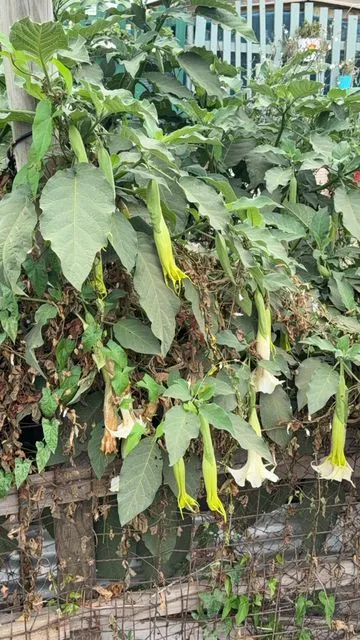
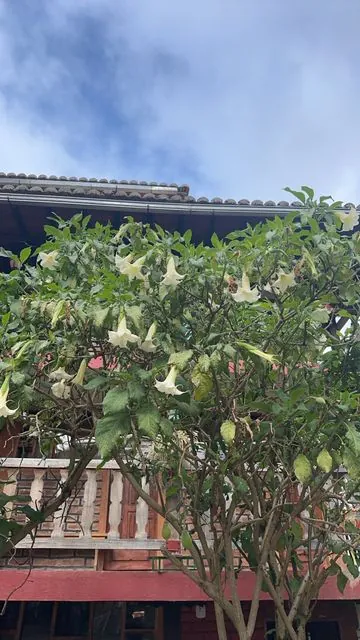
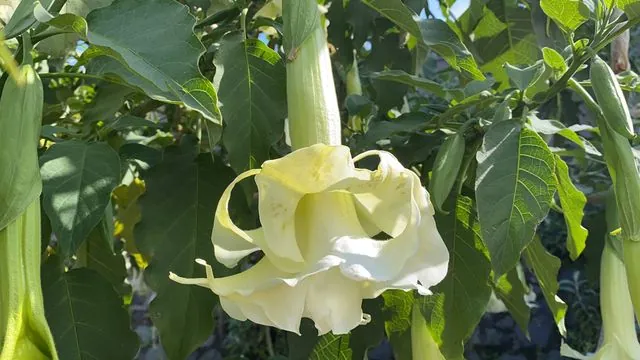
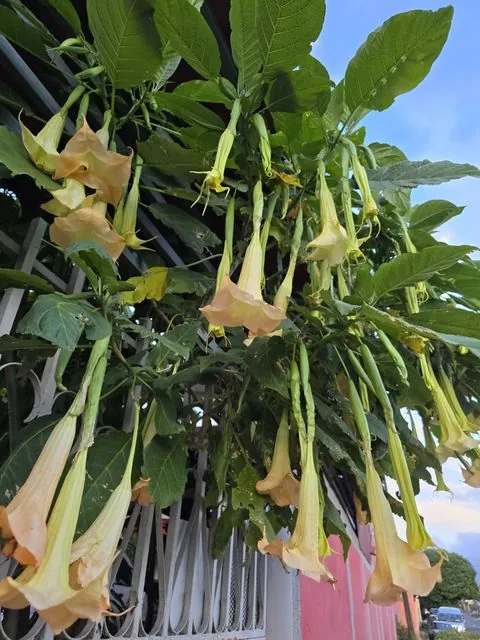
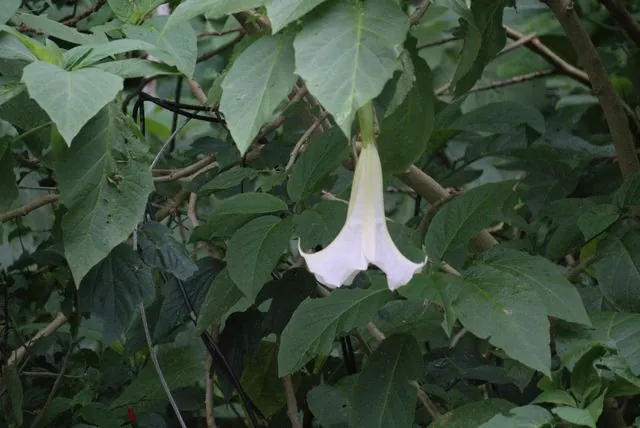
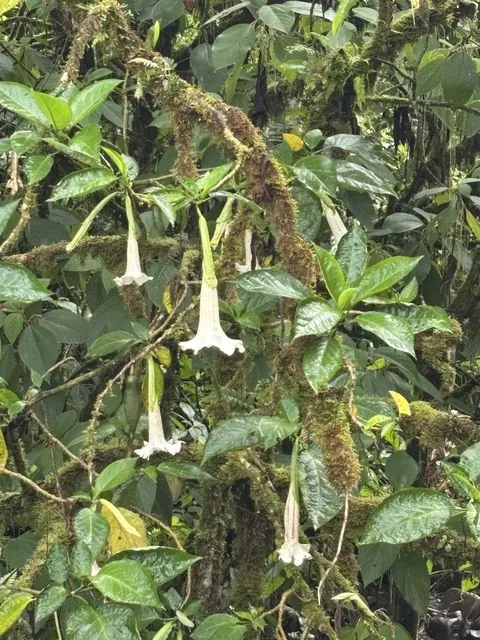
Brugmansia arborea
Authorship: The author or authors credited with publishing the scientific name. It is written after the name, sometimes with the year, for example L. (Linnaeus) in Zea mays L. An author in parentheses first published the name in another genus or rank. — The author or authors credited with publishing the scientific name. It is written after the name, sometimes with the year, for example L. (Linnaeus) in Zea mays L. An author in parentheses first published the name in another genus or rank.
(L.) Steud.
Common names
Angel's TrumpetNames in other languages (19)Aukštoji brugmansija, Borrachero, Brugmansia en arbre, Cornucopia, Dama de noche, Floripondio sudamericano, Floripondio; Angel's trumpet, Stramoine en arbre, Trompette des anges, brugmansja krzewiasta, durmanec stromovitý, durmanovec stromovitý, maikoa, trompeter, tuoksupasuuna, Бругмансия древовидная, แตรนางฟ้าต้น, ピンクダチュラ, 木本曼陀羅
Kingdom: One of the broadest ranks of biological classification. It groups organisms that share very basic features, for example plants (Plantae), animals (Animalia) or fungi (Fungi). — One of the broadest ranks of biological classification. It groups organisms that share very basic features, for example plants (Plantae), animals (Animalia) or fungi (Fungi).
Plantae
Phylum: Rank below kingdom that groups organisms with a shared general body plan, for example chordates (Chordata), arthropods (Arthropoda) or vascular plants (Tracheophyta). In botany the same rank is also called division. — Rank below kingdom that groups organisms with a shared general body plan, for example chordates (Chordata), arthropods (Arthropoda) or vascular plants (Tracheophyta). In botany the same rank is also called division.
Tracheophyta
Class: Rank below phylum, for example mammals (Mammalia), birds (Aves), insects (Insecta) or monocot plants such as grasses and orchids (Liliopsida). — Rank below phylum, for example mammals (Mammalia), birds (Aves), insects (Insecta) or monocot plants such as grasses and orchids (Liliopsida).
Magnoliopsida
Order: Rank below class that groups related families, for example grasses and their relatives (Poales) or bats (Chiroptera). — Rank below class that groups related families, for example grasses and their relatives (Poales) or bats (Chiroptera).
Solanales
Family: Rank below order that groups related genera. Family names usually end in -aceae in botany (for example Poaceae, the grass family) and in -idae in zoology (for example Felidae, the cat family). — Rank below order that groups related genera. Family names usually end in -aceae in botany (for example Poaceae, the grass family) and in -idae in zoology (for example Felidae, the cat family).
Solanaceae
Genus: Rank that groups closely related species. Its name is the first word of a species' scientific name and starts with a capital letter, for example Zea in Zea mays. — Rank that groups closely related species. Its name is the first word of a species' scientific name and starts with a capital letter, for example Zea in Zea mays.
Brugmansia
Specific epithet: The second word of a species' scientific name. On its own it does not name the species: it always goes with the genus, for example mays in Zea mays. — The second word of a species' scientific name. On its own it does not name the species: it always goes with the genus, for example mays in Zea mays.
arborea
Taxonomic rank: The level a name occupies in the hierarchy of biological classification, such as kingdom, family, genus, species or subspecies. — The level a name occupies in the hierarchy of biological classification, such as kingdom, family, genus, species or subspecies.
species
Reference species
Brugmansia arborea
Taxonomic status: Whether the taxonomic catalogue the record comes from currently accepts this name for the organism, or treats it as a synonym of another accepted name or as doubtful. — Whether the taxonomic catalogue the record comes from currently accepts this name for the organism, or treats it as a synonym of another accepted name or as doubtful.
accepted name
Photos and conservation status
IUCN Red List category: The extinction-risk category that the International Union for Conservation of Nature (IUCN) assigns to a species on its Red List. EX Extinct: there is no reasonable doubt that the last individual has died. EW Extinct in the wild: it survives only in cultivation, in captivity or as a population far outside its past range. CR Critically endangered, EN Endangered and VU Vulnerable: the three threatened categories, from an extremely high to a high risk of extinction in the wild. NT Near threatened: close to qualifying as threatened. LC Least concern: evaluated and not threatened. DD Data deficient: there is not enough information to assess its risk. NE Not evaluated: not yet assessed against the criteria. It describes the risk of the species worldwide, not its situation in a project's area. — The extinction-risk category that the International Union for Conservation of Nature (IUCN) assigns to a species on its Red List. EX Extinct: there is no reasonable doubt that the last individual has died. EW Extinct in the wild: it survives only in cultivation, in captivity or as a population far outside its past range. CR Critically endangered, EN Endangered and VU Vulnerable: the three threatened categories, from an extremely high to a high risk of extinction in the wild. NT Near threatened: close to qualifying as threatened. LC Least concern: evaluated and not threatened. DD Data deficient: there is not enough information to assess its risk. NE Not evaluated: not yet assessed against the criteria. It describes the risk of the species worldwide, not its situation in a project's area.
Not evaluated (NE)
Source: IUCN Red List via GBIF, queried on 2026-10-09 06:56.
Research-grade iNaturalist observations via GBIF, CC0 or CC BY licences only, queried on 2026-10-09 06:56.
Interacciones documentadas
GloBI says it is documented somewhere in the world. Biolitica answers whether it could happen here.
A documented interaction means it was recorded somewhere in the world. It does not mean it occurs here.
Types shown: 6 of 6
is a host of
×
is eaten by
×
is pollinated by
×
interacts with
×
is visited by
×
has its flowers visited by
×
Blocks that do not sit under a navigation concept heading keep the source's own term: no navigation concept has been assigned to them yet.
is a host of
13 organisms
The authority declares no effect on this species for this term: neither that it harms it nor that it benefits it. In the source ontology symbiosis covers mutualism, commensalism and parasitism alike, so this block holds attackers and allies side by side.
Organism
Reads as
Studies
Where it was documented
Actions
Lysimnia TigerwingMechanitis lysimniaNymphalidae
is a host of
2
no location
2 sources · 3 records
Gaden S. Robinson; Phillip R. Ackery; Ian Kitching; George W Beccaloni; Luis M. Hernández (2023). HOSTS (from HOSTS - a Database of the World's Lepidopteran Hostplants) [Data set resource]. Natural History Museum. https://data.nhm.ac.uk/dataset/hosts/resource/877f387a-36a3-486c-…
Published in globalbioticinteractions/HOSTS
Record contexts (sample): Brazil · no date published; Ecuador · no date published
Claim type
Published relationship between two taxa
Version
GloBI 0.11
Reuse
This release publishes no reuse terms for this record.
Brazil · no date publishedWhere it is: line:hash://sha256/021a206a1459bcca7e251c73f5bd180fc3ac342a09c499855fe42e21fc09edcf!/interactions.tsv.gz!/L6624372
Ecuador · no date publishedWhere it is: line:hash://sha256/021a206a1459bcca7e251c73f5bd180fc3ac342a09c499855fe42e21fc09edcf!/interactions.tsv.gz!/L6625017
Published in globalbioticinteractions/ferrer-paris
Context: no place published · no date published
Claim type
Published relationship between two taxa
Version
GloBI 0.11
Reuse
This release publishes no reuse terms for this record.
no place published · no date publishedWhere it is: line:hash://sha256/021a206a1459bcca7e251c73f5bd180fc3ac342a09c499855fe42e21fc09edcf!/interactions.tsv.gz!/L12108715
No public URL for this record
A published relationship says these two taxa were documented interacting. It does not say how often, or that it happens in this project's region.
Disturbed TigerwingMechanitis polymniaNymphalidae
is a host of
2
no location
2 sources · 2 records
HOSTS DB
Published in globalbioticinteractions/ferrer-paris
Context: no place published · no date published
Claim type
Published relationship between two taxa
Version
GloBI 0.11
Reuse
This release publishes no reuse terms for this record.
no place published · no date publishedWhere it is: line:hash://sha256/021a206a1459bcca7e251c73f5bd180fc3ac342a09c499855fe42e21fc09edcf!/interactions.tsv.gz!/L12108730
No public URL for this record
Gaden S. Robinson; Phillip R. Ackery; Ian Kitching; George W Beccaloni; Luis M. Hernández (2023). HOSTS (from HOSTS - a Database of the World's Lepidopteran Hostplants) [Data set resource]. Natural History Museum. https://data.nhm.ac.uk/dataset/hosts/resource/877f387a-36a3-486c-…
Published in globalbioticinteractions/HOSTS
Context: Brazil · no date published
Claim type
Published relationship between two taxa
Version
GloBI 0.11
Reuse
This release publishes no reuse terms for this record.
Brazil · no date publishedWhere it is: line:hash://sha256/021a206a1459bcca7e251c73f5bd180fc3ac342a09c499855fe42e21fc09edcf!/interactions.tsv.gz!/L6625895
A published relationship says these two taxa were documented interacting. It does not say how often, or that it happens in this project's region.
Placidina euryanassa
is a host of
1
no location
1 source · 1 record
HOSTS DB
Published in globalbioticinteractions/ferrer-paris
Context: no place published · no date published
Claim type
Published relationship between two taxa
Version
GloBI 0.11
Reuse
This release publishes no reuse terms for this record.
no place published · no date publishedWhere it is: line:hash://sha256/021a206a1459bcca7e251c73f5bd180fc3ac342a09c499855fe42e21fc09edcf!/interactions.tsv.gz!/L12109506
No public URL for this record
A published relationship says these two taxa were documented interacting. It does not say how often, or that it happens in this project's region.
Manduca diffissa petuniaeSphingidae
is a host of
1
no location
1 source · 1 record
Gaden S. Robinson; Phillip R. Ackery; Ian Kitching; George W Beccaloni; Luis M. Hernández (2023). HOSTS (from HOSTS - a Database of the World's Lepidopteran Hostplants) [Data set resource]. Natural History Museum. https://data.nhm.ac.uk/dataset/hosts/resource/877f387a-36a3-486c-…
Published in globalbioticinteractions/HOSTS
Context: Brazil · no date published
Claim type
Published relationship between two taxa
Version
GloBI 0.11
Reuse
This release publishes no reuse terms for this record.
Brazil · no date publishedWhere it is: line:hash://sha256/021a206a1459bcca7e251c73f5bd180fc3ac342a09c499855fe42e21fc09edcf!/interactions.tsv.gz!/L6589932
This term does declare that the organism harms this species.
Organism
Reads as
Studies
Where it was documented
Actions
Carolina SphinxManduca sextaSphingidae
is eaten by
1
no location
1 source · 1 record
Edward Baker; Ian Kitching; George W Beccaloni; Amoret Whitaker; Steen Dupont; Vincent Smith; John S Noyes (2017). NHM Interactions Bank. https://doi.org/10.5519/0060767. Accessed at <https://data.nhm.ac.uk/dataset/82e807f0-6273-4f19-be0a-7f7558442a25/resource/f84ad9f1-bd0c-4811…
Published in globalbioticinteractions/natural-history-museum-london-interactions-bank
Context: no place published · no date published
Claim type
Published relationship between two taxa
Version
GloBI 0.11
Reuse
This release publishes no reuse terms for this record.
no place published · no date publishedWhere it is: line:hash://sha256/021a206a1459bcca7e251c73f5bd180fc3ac342a09c499855fe42e21fc09edcf!/interactions.tsv.gz!/L18751294
A published relationship says these two taxa were documented interacting. It does not say how often, or that it happens in this project's region.
Paracles fuscaErebidae
is eaten by
1
no location
1 source · 1 record
Edward Baker; Ian Kitching; George W Beccaloni; Amoret Whitaker; Steen Dupont; Vincent Smith; John S Noyes (2017). NHM Interactions Bank. https://doi.org/10.5519/0060767. Accessed at <https://data.nhm.ac.uk/dataset/82e807f0-6273-4f19-be0a-7f7558442a25/resource/f84ad9f1-bd0c-4811…
Published in globalbioticinteractions/natural-history-museum-london-interactions-bank
Context: no place published · no date published
Claim type
Published relationship between two taxa
Version
GloBI 0.11
Reuse
This release publishes no reuse terms for this record.
no place published · no date publishedWhere it is: line:hash://sha256/021a206a1459bcca7e251c73f5bd180fc3ac342a09c499855fe42e21fc09edcf!/interactions.tsv.gz!/L18700978
A published relationship says these two taxa were documented interacting. It does not say how often, or that it happens in this project's region.
Red-spotted HairstreakTmolus echionLycaenidae
is eaten by
1
no location
1 source · 1 record
Edward Baker; Ian Kitching; George W Beccaloni; Amoret Whitaker; Steen Dupont; Vincent Smith; John S Noyes (2017). NHM Interactions Bank. https://doi.org/10.5519/0060767. Accessed at <https://data.nhm.ac.uk/dataset/82e807f0-6273-4f19-be0a-7f7558442a25/resource/f84ad9f1-bd0c-4811…
Published in globalbioticinteractions/natural-history-museum-london-interactions-bank
Context: no place published · no date published
Claim type
Published relationship between two taxa
Version
GloBI 0.11
Reuse
This release publishes no reuse terms for this record.
no place published · no date publishedWhere it is: line:hash://sha256/021a206a1459bcca7e251c73f5bd180fc3ac342a09c499855fe42e21fc09edcf!/interactions.tsv.gz!/L18717972
A published relationship says these two taxa were documented interacting. It does not say how often, or that it happens in this project's region.
European Honey BeeApis melliferaApidae
is eaten by
1
not compared
1 source · 1 record
Salamanca-Grosso, G., Hernández, J., Borja, F., (2011) Relaciones planta insecto de un ecosistema en bosque de cliserie para el beneficio de polen corbicular colectado por Apis mellifera l (hymenoptera: apidae) en zona altoandina de boyaca. XLVII Congreso Nacional de Ciencias …
Published in globalbioticinteractions/delrisco2021
Context: Bogotá, Colombia · no date published
Claim type
Published relationship between two taxa
Version
GloBI 0.11
Reuse
This release publishes no reuse terms for this record.
Bogotá, Colombia · no date publishedWhere it is: line:hash://sha256/021a206a1459bcca7e251c73f5bd180fc3ac342a09c499855fe42e21fc09edcf!/interactions.tsv.gz!/L18977584
No public URL for this record
A published relationship says these two taxa were documented interacting. It does not say how often, or that it happens in this project's region.
This term declares that the organism benefits this species. «Visits the flowers of» is a different term and a different block: a visitor is not a pollinator, and merging the two is the measured defect that turned ~88 shared «pollinators» into birds and primates.
Walther, B. A. and Brieschke, H. (2001). Hummingbird-flower relationships in a mid-elevation rainforest near Mindo, northwestern Ecuador. Internal. J. Ornithol., 4, 115–135.
Published in globalbioticinteractions/web-of-life
Context: no place published · no date published
Claim type
Published relationship between two taxa
Version
GloBI 0.11
Reuse
This release publishes no reuse terms for this record.
no place published · no date publishedWhere it is: line:hash://sha256/021a206a1459bcca7e251c73f5bd180fc3ac342a09c499855fe42e21fc09edcf!/interactions.tsv.gz!/L11451692
No public URL for this record
A published relationship says these two taxa were documented interacting. It does not say how often, or that it happens in this project's region.
Showing 3 of 3, by number of studies
interacts with
1 organism
The authority declares no effect on this species for this term: neither that it harms it nor that it benefits it.
Context: no place published · Dec. 26, 2022 · Human observation
Claim type
Published relationship between two taxa
Version
GloBI 0.11
Reuse
This release publishes no reuse terms for this record.
no place published · Dec. 26, 2022 · Human observationAs published: 2022-12-26T00:00:00Z · HumanObservationWhere it is: line:hash://sha256/021a206a1459bcca7e251c73f5bd180fc3ac342a09c499855fe42e21fc09edcf!/interactions.tsv.gz!/L5251325
Pellón, J. J., et al. 2021. Exotic Cultivated Plants in the Diet of the Nectar-Feeding Bat Glossophaga soricina (Phyllostomidae: Glossophaginae) in the City of Lima, Peru. Acta Chiropterologica 23 (1): 107-117.
Published in globalbioticinteractions/batbase
Context: Universidad Nacional Agraria La Molina · no date published
Claim type
Published relationship between two taxa
Version
GloBI 0.11
Reuse
This release publishes no reuse terms for this record.
Universidad Nacional Agraria La Molina · no date publishedWhere it is: line:hash://sha256/021a206a1459bcca7e251c73f5bd180fc3ac342a09c499855fe42e21fc09edcf!/interactions.tsv.gz!/L12452995
No public URL for this record
A published relationship says these two taxa were documented interacting. It does not say how often, or that it happens in this project's region.
Showing 1 of 1, by number of studies
Flower visit
has its flowers visited by
1 organism
The authority declares no effect on this species for this term: neither that it harms it nor that it benefits it. Visiting a flower is not pollinating it. «Pollinates» is a different term and a different block, and merging the two is the measured defect that turned ~88 shared «pollinators» into birds and primates.
Context: no place published · Dec. 26, 2022 · Human observation
Claim type
Published relationship between two taxa
Version
GloBI 0.11
Reuse
This release publishes no reuse terms for this record.
no place published · Dec. 26, 2022 · Human observationAs published: 2022-12-26T00:00:00Z · HumanObservationWhere it is: line:hash://sha256/021a206a1459bcca7e251c73f5bd180fc3ac342a09c499855fe42e21fc09edcf!/interactions.tsv.gz!/L5251326
A published relationship says these two taxa were documented interacting. It does not say how often, or that it happens in this project's region.
Showing 1 of 1, by number of studies
Acompañantes documentados
This agronomic reading comes from a source reserved for internal use, so it is not shown here.
Documented uses and recommendations
Uses and recommendations that a source documents for this species beside a crop, each in its own context. They are the source's statements, not traits of the species and not Biolítica's recommendations, and none of them is a relation between two species.
Among the sources you can read, none documents a use or recommendation of this species beside a crop.