Canonical name: The scientific name without its authorship or date, for example Zea mays instead of Zea mays L. — The scientific name without its authorship or date, for example Zea mays instead of Zea mays L.
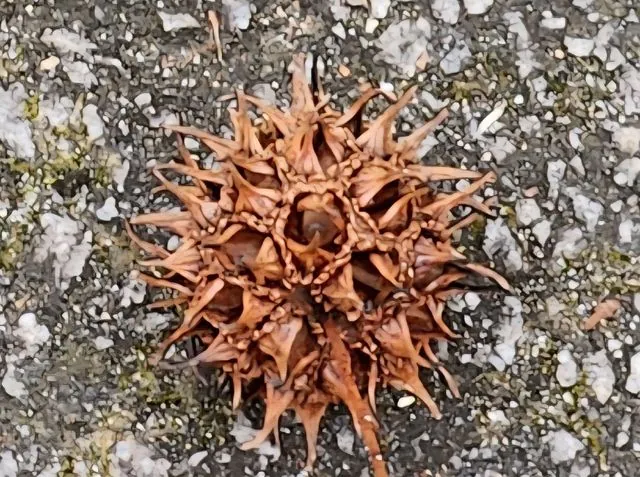
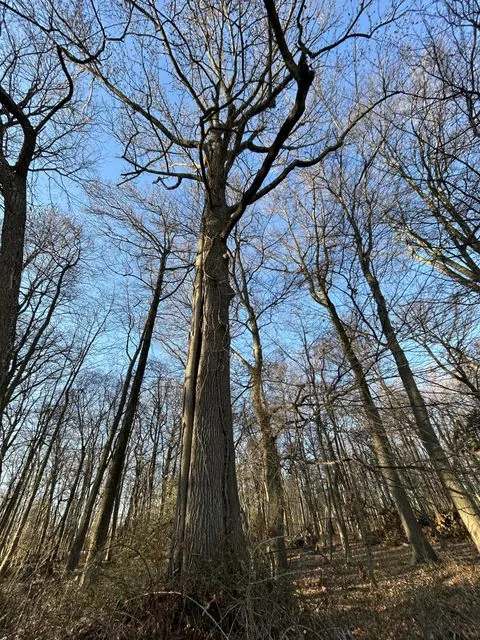
Liquidambar styraciflua
Authorship: The author or authors credited with publishing the scientific name. It is written after the name, sometimes with the year, for example L. (Linnaeus) in Zea mays L. An author in parentheses first published the name in another genus or rank. — The author or authors credited with publishing the scientific name. It is written after the name, sometimes with the year, for example L. (Linnaeus) in Zea mays L. An author in parentheses first published the name in another genus or rank.
Kingdom: One of the broadest ranks of biological classification. It groups organisms that share very basic features, for example plants (Plantae), animals (Animalia) or fungi (Fungi). — One of the broadest ranks of biological classification. It groups organisms that share very basic features, for example plants (Plantae), animals (Animalia) or fungi (Fungi).
Plantae
Phylum: Rank below kingdom that groups organisms with a shared general body plan, for example chordates (Chordata), arthropods (Arthropoda) or vascular plants (Tracheophyta). In botany the same rank is also called division. — Rank below kingdom that groups organisms with a shared general body plan, for example chordates (Chordata), arthropods (Arthropoda) or vascular plants (Tracheophyta). In botany the same rank is also called division.
Tracheophyta
Class: Rank below phylum, for example mammals (Mammalia), birds (Aves), insects (Insecta) or monocot plants such as grasses and orchids (Liliopsida). — Rank below phylum, for example mammals (Mammalia), birds (Aves), insects (Insecta) or monocot plants such as grasses and orchids (Liliopsida).
Magnoliopsida
Order: Rank below class that groups related families, for example grasses and their relatives (Poales) or bats (Chiroptera). — Rank below class that groups related families, for example grasses and their relatives (Poales) or bats (Chiroptera).
Saxifragales
Family: Rank below order that groups related genera. Family names usually end in -aceae in botany (for example Poaceae, the grass family) and in -idae in zoology (for example Felidae, the cat family). — Rank below order that groups related genera. Family names usually end in -aceae in botany (for example Poaceae, the grass family) and in -idae in zoology (for example Felidae, the cat family).
Altingiaceae
Genus: Rank that groups closely related species. Its name is the first word of a species' scientific name and starts with a capital letter, for example Zea in Zea mays. — Rank that groups closely related species. Its name is the first word of a species' scientific name and starts with a capital letter, for example Zea in Zea mays.
Liquidambar
Specific epithet: The second word of a species' scientific name. On its own it does not name the species: it always goes with the genus, for example mays in Zea mays. — The second word of a species' scientific name. On its own it does not name the species: it always goes with the genus, for example mays in Zea mays.
styraciflua
Taxonomic rank: The level a name occupies in the hierarchy of biological classification, such as kingdom, family, genus, species or subspecies. — The level a name occupies in the hierarchy of biological classification, such as kingdom, family, genus, species or subspecies.
species
Reference species
Liquidambar styraciflua
Taxonomic status: Whether the taxonomic catalogue the record comes from currently accepts this name for the organism, or treats it as a synonym of another accepted name or as doubtful. — Whether the taxonomic catalogue the record comes from currently accepts this name for the organism, or treats it as a synonym of another accepted name or as doubtful.
accepted name
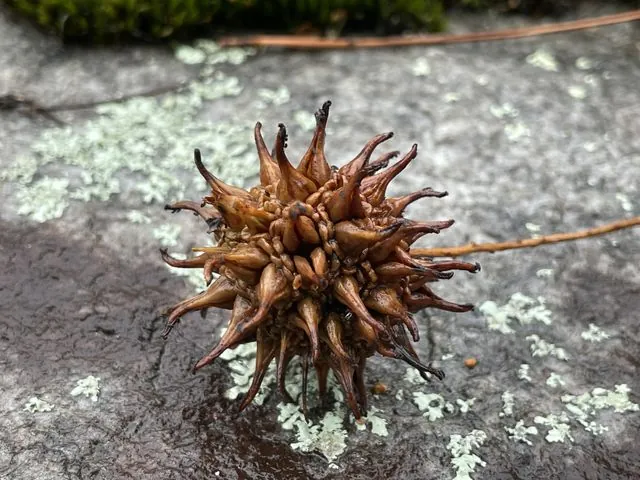
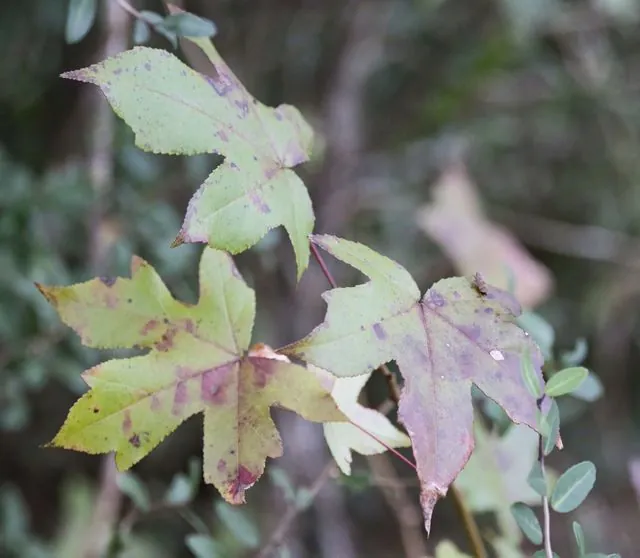
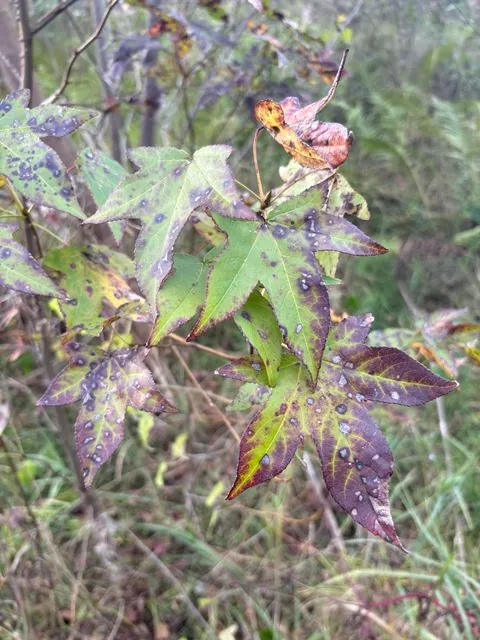
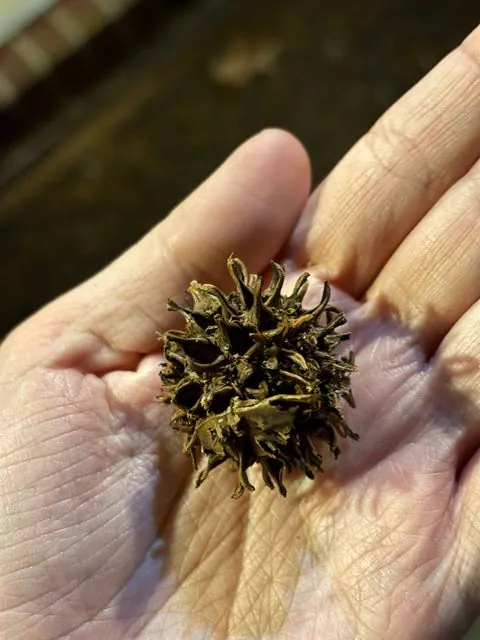
Photos and conservation status
IUCN Red List category: The extinction-risk category that the International Union for Conservation of Nature (IUCN) assigns to a species on its Red List. EX Extinct: there is no reasonable doubt that the last individual has died. EW Extinct in the wild: it survives only in cultivation, in captivity or as a population far outside its past range. CR Critically endangered, EN Endangered and VU Vulnerable: the three threatened categories, from an extremely high to a high risk of extinction in the wild. NT Near threatened: close to qualifying as threatened. LC Least concern: evaluated and not threatened. DD Data deficient: there is not enough information to assess its risk. NE Not evaluated: not yet assessed against the criteria. It describes the risk of the species worldwide, not its situation in a project's area. — The extinction-risk category that the International Union for Conservation of Nature (IUCN) assigns to a species on its Red List. EX Extinct: there is no reasonable doubt that the last individual has died. EW Extinct in the wild: it survives only in cultivation, in captivity or as a population far outside its past range. CR Critically endangered, EN Endangered and VU Vulnerable: the three threatened categories, from an extremely high to a high risk of extinction in the wild. NT Near threatened: close to qualifying as threatened. LC Least concern: evaluated and not threatened. DD Data deficient: there is not enough information to assess its risk. NE Not evaluated: not yet assessed against the criteria. It describes the risk of the species worldwide, not its situation in a project's area.
Least concern (LC)
Source: IUCN Red List via GBIF, queried on 2026-10-12 18:02.
Research-grade iNaturalist observations via GBIF, CC0 or CC BY licences only, queried on 2026-10-12 18:02.
Interacciones documentadas
GloBI says it is documented somewhere in the world. Biolitica answers whether it could happen here.
A documented interaction means it was recorded somewhere in the world. It does not mean it occurs here.
Types shown: 12 of 14
is a host of
×
interacts with (this species is the record's destination)
×
is a symbiont of
×
interacts with (this species is the record's origin)
×
is eaten by
×
is adjacent to
×
is visited by
×
has as a parasite
×
is an arbuscular mycorrhizal host of
×
co-occurs ecologically with
×
creates habitat for
×
has as a host
×
2 more types with data for this species
Blocks that do not sit under a navigation concept heading keep the source's own term: no navigation concept has been assigned to them yet.
is a host of
431 organisms
The authority declares no effect on this species for this term: neither that it harms it nor that it benefits it. In the source ontology symbiosis covers mutualism, commensalism and parasitism alike, so this block holds attackers and allies side by side.
Organism
Reads as
Studies
Where it was documented
Actions
Pseudocercospora tuberculansMycosphaerellaceae
is a host of
34
not compared
34 sources · 37 records
Anonymous. 1960. Index of Plant Diseases in the United States. U.S.D.A. Agric. Handb. 165:1-531
Published in globalbioticinteractions/usda-fungus-host
Record contexts (sample): United States · no date published; United States · no date published
Claim type
Published relationship between two taxa
Version
GloBI 0.11
Reuse
This release publishes no reuse terms for this record.
United States · no date publishedWhere it is: line:hash://sha256/021a206a1459bcca7e251c73f5bd180fc3ac342a09c499855fe42e21fc09edcf!/interactions.tsv.gz!/L3657577
United States · no date publishedWhere it is: line:hash://sha256/021a206a1459bcca7e251c73f5bd180fc3ac342a09c499855fe42e21fc09edcf!/interactions.tsv.gz!/L3657585
United States · no date publishedWhere it is: line:hash://sha256/021a206a1459bcca7e251c73f5bd180fc3ac342a09c499855fe42e21fc09edcf!/interactions.tsv.gz!/L3657598
And 1 more record of this source, not listed here.
Context: Starkville · June 1, 1892 · Preserved specimen
Claim type
Published relationship between two taxa
Version
GloBI 0.11
Reuse
This release publishes no reuse terms for this record.
Starkville · June 1, 1892 · Preserved specimenAs published: 1892-06-01T00:00:00Z · PreservedSpecimenWhere it is: line:hash://sha256/021a206a1459bcca7e251c73f5bd180fc3ac342a09c499855fe42e21fc09edcf!/interactions.tsv.gz!/L16657393
Context: Starkville · June 1, 1888 · Preserved specimen
Claim type
Published relationship between two taxa
Version
GloBI 0.11
Reuse
This release publishes no reuse terms for this record.
Starkville · June 1, 1888 · Preserved specimenAs published: 1888-06-01T00:00:00Z · PreservedSpecimenWhere it is: line:hash://sha256/021a206a1459bcca7e251c73f5bd180fc3ac342a09c499855fe42e21fc09edcf!/interactions.tsv.gz!/L16673443
Context: Starkville · June 27, 1888 · Preserved specimen
Claim type
Published relationship between two taxa
Version
GloBI 0.11
Reuse
This release publishes no reuse terms for this record.
Starkville · June 27, 1888 · Preserved specimenAs published: 1888-06-27T00:00:00Z · PreservedSpecimenWhere it is: line:hash://sha256/021a206a1459bcca7e251c73f5bd180fc3ac342a09c499855fe42e21fc09edcf!/interactions.tsv.gz!/L16869503
Context: Starkville · June 27, 1888 · Preserved specimen
Claim type
Published relationship between two taxa
Version
GloBI 0.11
Reuse
This release publishes no reuse terms for this record.
Starkville · June 27, 1888 · Preserved specimenAs published: 1888-06-27T00:00:00Z · PreservedSpecimenWhere it is: line:hash://sha256/021a206a1459bcca7e251c73f5bd180fc3ac342a09c499855fe42e21fc09edcf!/interactions.tsv.gz!/L17214623
Context: Starkville · June 1, 1888 · Preserved specimen
Claim type
Published relationship between two taxa
Version
GloBI 0.11
Reuse
This release publishes no reuse terms for this record.
Starkville · June 1, 1888 · Preserved specimenAs published: 1888-06-01T00:00:00Z · PreservedSpecimenWhere it is: line:hash://sha256/021a206a1459bcca7e251c73f5bd180fc3ac342a09c499855fe42e21fc09edcf!/interactions.tsv.gz!/L17214624
Context: Starkville · June 10, 1893 · Preserved specimen
Claim type
Published relationship between two taxa
Version
GloBI 0.11
Reuse
This release publishes no reuse terms for this record.
Starkville · June 10, 1893 · Preserved specimenAs published: 1893-06-10T00:00:00Z · PreservedSpecimenWhere it is: line:hash://sha256/021a206a1459bcca7e251c73f5bd180fc3ac342a09c499855fe42e21fc09edcf!/interactions.tsv.gz!/L17214625
Context: Starkville · June 27, 1888 · Preserved specimen
Claim type
Published relationship between two taxa
Version
GloBI 0.11
Reuse
This release publishes no reuse terms for this record.
Starkville · June 27, 1888 · Preserved specimenAs published: 1888-06-27T00:00:00Z · PreservedSpecimenWhere it is: line:hash://sha256/021a206a1459bcca7e251c73f5bd180fc3ac342a09c499855fe42e21fc09edcf!/interactions.tsv.gz!/L17214626
Context: Lake City, Columbia Co. · July 11, 1895 · Preserved specimen
Claim type
Published relationship between two taxa
Version
GloBI 0.11
Reuse
This release publishes no reuse terms for this record.
Lake City, Columbia Co. · July 11, 1895 · Preserved specimenAs published: 1895-07-11T00:00:00Z · PreservedSpecimenWhere it is: line:hash://sha256/021a206a1459bcca7e251c73f5bd180fc3ac342a09c499855fe42e21fc09edcf!/interactions.tsv.gz!/L17210277
Context: St. Gabriel · Jan. 1, 1886 · Preserved specimen
Claim type
Published relationship between two taxa
Version
GloBI 0.11
Reuse
This release publishes no reuse terms for this record.
St. Gabriel · Jan. 1, 1886 · Preserved specimenAs published: 1886-01-01T00:00:00Z · PreservedSpecimenWhere it is: line:hash://sha256/021a206a1459bcca7e251c73f5bd180fc3ac342a09c499855fe42e21fc09edcf!/interactions.tsv.gz!/L17210279
Context: Martin · Sept. 12, 1891 · Preserved specimen
Claim type
Published relationship between two taxa
Version
GloBI 0.11
Reuse
This release publishes no reuse terms for this record.
Martin · Sept. 12, 1891 · Preserved specimenAs published: 1891-09-12T00:00:00Z · PreservedSpecimenWhere it is: line:hash://sha256/021a206a1459bcca7e251c73f5bd180fc3ac342a09c499855fe42e21fc09edcf!/interactions.tsv.gz!/L17210281
Context: Duke Forest, near Durham · no date published · Preserved specimen
Claim type
Published relationship between two taxa
Version
GloBI 0.11
Reuse
This release publishes no reuse terms for this record.
Duke Forest, near Durham · no date published · Preserved specimenAs published: PreservedSpecimenWhere it is: line:hash://sha256/021a206a1459bcca7e251c73f5bd180fc3ac342a09c499855fe42e21fc09edcf!/interactions.tsv.gz!/L17210282
Context: Lake City, Columbia Co. · July 11, 1895 · Preserved specimen
Claim type
Published relationship between two taxa
Version
GloBI 0.11
Reuse
This release publishes no reuse terms for this record.
Lake City, Columbia Co. · July 11, 1895 · Preserved specimenAs published: 1895-07-11T00:00:00Z · PreservedSpecimenWhere it is: line:hash://sha256/021a206a1459bcca7e251c73f5bd180fc3ac342a09c499855fe42e21fc09edcf!/interactions.tsv.gz!/L17210283
Context: Buzzard's Roost, W of Gainesville · Sept. 5, 1954 · Preserved specimen
Claim type
Published relationship between two taxa
Version
GloBI 0.11
Reuse
This release publishes no reuse terms for this record.
Buzzard's Roost, W of Gainesville · Sept. 5, 1954 · Preserved specimenAs published: 1954-09-05T00:00:00Z · PreservedSpecimenWhere it is: line:hash://sha256/021a206a1459bcca7e251c73f5bd180fc3ac342a09c499855fe42e21fc09edcf!/interactions.tsv.gz!/L16620814
Context: Conway · April 18, 1931 · Preserved specimen
Claim type
Published relationship between two taxa
Version
GloBI 0.11
Reuse
This release publishes no reuse terms for this record.
Conway · April 18, 1931 · Preserved specimenAs published: 1931-04-18T00:00:00Z · PreservedSpecimenWhere it is: line:hash://sha256/021a206a1459bcca7e251c73f5bd180fc3ac342a09c499855fe42e21fc09edcf!/interactions.tsv.gz!/L17046891
Context: Magnesia Springs, Alachua Co. · March 19, 1944 · Preserved specimen
Claim type
Published relationship between two taxa
Version
GloBI 0.11
Reuse
This release publishes no reuse terms for this record.
Magnesia Springs, Alachua Co. · March 19, 1944 · Preserved specimenAs published: 1944-03-19T00:00:00Z · PreservedSpecimenWhere it is: line:hash://sha256/021a206a1459bcca7e251c73f5bd180fc3ac342a09c499855fe42e21fc09edcf!/interactions.tsv.gz!/L17046893
Context: Worthington Springs, Union Co. River Bottom · Jan. 30, 1944 · Preserved specimen
Claim type
Published relationship between two taxa
Version
GloBI 0.11
Reuse
This release publishes no reuse terms for this record.
Worthington Springs, Union Co. River Bottom · Jan. 30, 1944 · Preserved specimenAs published: 1944-01-30T00:00:00Z · PreservedSpecimenWhere it is: line:hash://sha256/021a206a1459bcca7e251c73f5bd180fc3ac342a09c499855fe42e21fc09edcf!/interactions.tsv.gz!/L17046894
Context: Levy Lake at Kirkwood, Alachua Co. · May 7, 1944 · Preserved specimen
Claim type
Published relationship between two taxa
Version
GloBI 0.11
Reuse
This release publishes no reuse terms for this record.
Levy Lake at Kirkwood, Alachua Co. · May 7, 1944 · Preserved specimenAs published: 1944-05-07T00:00:00Z · PreservedSpecimenWhere it is: line:hash://sha256/021a206a1459bcca7e251c73f5bd180fc3ac342a09c499855fe42e21fc09edcf!/interactions.tsv.gz!/L17046895
Context: Jacksonville · July 3, 1947 · Preserved specimen
Claim type
Published relationship between two taxa
Version
GloBI 0.11
Reuse
This release publishes no reuse terms for this record.
Jacksonville · July 3, 1947 · Preserved specimenAs published: 1947-07-03T00:00:00Z · PreservedSpecimenWhere it is: line:hash://sha256/021a206a1459bcca7e251c73f5bd180fc3ac342a09c499855fe42e21fc09edcf!/interactions.tsv.gz!/L17047511
Context: Middleburg S. of · Dec. 28, 1949 · Preserved specimen
Claim type
Published relationship between two taxa
Version
GloBI 0.11
Reuse
This release publishes no reuse terms for this record.
Middleburg S. of · Dec. 28, 1949 · Preserved specimenAs published: 1949-12-28T00:00:00Z · PreservedSpecimenWhere it is: line:hash://sha256/021a206a1459bcca7e251c73f5bd180fc3ac342a09c499855fe42e21fc09edcf!/interactions.tsv.gz!/L17047512
Context: York, Sumter Co. 3 miles E. of · July 11, 1944 · Preserved specimen
Claim type
Published relationship between two taxa
Version
GloBI 0.11
Reuse
This release publishes no reuse terms for this record.
York, Sumter Co. 3 miles E. of · July 11, 1944 · Preserved specimenAs published: 1944-07-11T00:00:00Z · PreservedSpecimenWhere it is: line:hash://sha256/021a206a1459bcca7e251c73f5bd180fc3ac342a09c499855fe42e21fc09edcf!/interactions.tsv.gz!/L17047515
Context: Jacksonville N. of · Dec. 25, 1948 · Preserved specimen
Claim type
Published relationship between two taxa
Version
GloBI 0.11
Reuse
This release publishes no reuse terms for this record.
Jacksonville N. of · Dec. 25, 1948 · Preserved specimenAs published: 1948-12-25T00:00:00Z · PreservedSpecimenWhere it is: line:hash://sha256/021a206a1459bcca7e251c73f5bd180fc3ac342a09c499855fe42e21fc09edcf!/interactions.tsv.gz!/L17047516
Context: Lake Bradford, S. W. of Tallahassee near · June 29, 1952 · Preserved specimen
Claim type
Published relationship between two taxa
Version
GloBI 0.11
Reuse
This release publishes no reuse terms for this record.
Lake Bradford, S. W. of Tallahassee near · June 29, 1952 · Preserved specimenAs published: 1952-06-29T00:00:00Z · PreservedSpecimenWhere it is: line:hash://sha256/021a206a1459bcca7e251c73f5bd180fc3ac342a09c499855fe42e21fc09edcf!/interactions.tsv.gz!/L17047517
Record contexts (sample): no place published · June 22, 2023 · Human observation; no place published · June 22, 2023 · Human observation
Claim type
Published relationship between two taxa
Version
GloBI 0.11
Reuse
This release publishes no reuse terms for this record.
no place published · June 22, 2023 · Human observationAs published: 2023-06-22T14:07:00Z · HumanObservationWhere it is: line:hash://sha256/021a206a1459bcca7e251c73f5bd180fc3ac342a09c499855fe42e21fc09edcf!/interactions.tsv.gz!/L5529309
no place published · June 22, 2023 · Human observationAs published: 2023-06-22T14:07:00Z · HumanObservationWhere it is: line:hash://sha256/021a206a1459bcca7e251c73f5bd180fc3ac342a09c499855fe42e21fc09edcf!/interactions.tsv.gz!/L5529310
no place published · June 22, 2023 · Human observationAs published: 2023-06-22T14:07:00Z · HumanObservationWhere it is: line:hash://sha256/021a206a1459bcca7e251c73f5bd180fc3ac342a09c499855fe42e21fc09edcf!/interactions.tsv.gz!/L5529311
Record contexts (sample): no place published · July 5, 2025 · Human observation; no place published · July 5, 2025 · Human observation
Claim type
Published relationship between two taxa
Version
GloBI 0.11
Reuse
This release publishes no reuse terms for this record.
no place published · July 5, 2025 · Human observationAs published: 2025-07-05T17:28:00Z · HumanObservationWhere it is: line:hash://sha256/021a206a1459bcca7e251c73f5bd180fc3ac342a09c499855fe42e21fc09edcf!/interactions.tsv.gz!/L4436298
no place published · July 5, 2025 · Human observationAs published: 2025-07-05T17:28:00Z · HumanObservationWhere it is: line:hash://sha256/021a206a1459bcca7e251c73f5bd180fc3ac342a09c499855fe42e21fc09edcf!/interactions.tsv.gz!/L4436299
Record contexts (sample): no place published · July 14, 2025 · Human observation; no place published · July 14, 2025 · Human observation
Claim type
Published relationship between two taxa
Version
GloBI 0.11
Reuse
This release publishes no reuse terms for this record.
no place published · July 14, 2025 · Human observationAs published: 2025-07-14T17:23:00Z · HumanObservationWhere it is: line:hash://sha256/021a206a1459bcca7e251c73f5bd180fc3ac342a09c499855fe42e21fc09edcf!/interactions.tsv.gz!/L4475344
no place published · July 14, 2025 · Human observationAs published: 2025-07-14T17:23:00Z · HumanObservationWhere it is: line:hash://sha256/021a206a1459bcca7e251c73f5bd180fc3ac342a09c499855fe42e21fc09edcf!/interactions.tsv.gz!/L4475345
Record contexts (sample): no place published · Aug. 3, 2025 · Human observation; no place published · Aug. 3, 2025 · Human observation
Claim type
Published relationship between two taxa
Version
GloBI 0.11
Reuse
This release publishes no reuse terms for this record.
no place published · Aug. 3, 2025 · Human observationAs published: 2025-08-03T16:58:00Z · HumanObservationWhere it is: line:hash://sha256/021a206a1459bcca7e251c73f5bd180fc3ac342a09c499855fe42e21fc09edcf!/interactions.tsv.gz!/L4578689
no place published · Aug. 3, 2025 · Human observationAs published: 2025-08-03T16:58:00Z · HumanObservationWhere it is: line:hash://sha256/021a206a1459bcca7e251c73f5bd180fc3ac342a09c499855fe42e21fc09edcf!/interactions.tsv.gz!/L4578690
Record contexts (sample): no place published · Sept. 3, 2025 · Human observation; no place published · Sept. 3, 2025 · Human observation
Claim type
Published relationship between two taxa
Version
GloBI 0.11
Reuse
This release publishes no reuse terms for this record.
no place published · Sept. 3, 2025 · Human observationAs published: 2025-09-03T19:08:00Z · HumanObservationWhere it is: line:hash://sha256/021a206a1459bcca7e251c73f5bd180fc3ac342a09c499855fe42e21fc09edcf!/interactions.tsv.gz!/L4674513
no place published · Sept. 3, 2025 · Human observationAs published: 2025-09-03T19:08:00Z · HumanObservationWhere it is: line:hash://sha256/021a206a1459bcca7e251c73f5bd180fc3ac342a09c499855fe42e21fc09edcf!/interactions.tsv.gz!/L4674515
Record contexts (sample): no place published · Aug. 31, 2025 · Human observation; no place published · Aug. 31, 2025 · Human observation
Claim type
Published relationship between two taxa
Version
GloBI 0.11
Reuse
This release publishes no reuse terms for this record.
no place published · Aug. 31, 2025 · Human observationAs published: 2025-08-31T15:48:00Z · HumanObservationWhere it is: line:hash://sha256/021a206a1459bcca7e251c73f5bd180fc3ac342a09c499855fe42e21fc09edcf!/interactions.tsv.gz!/L4683268
no place published · Aug. 31, 2025 · Human observationAs published: 2025-08-31T15:48:00Z · HumanObservationWhere it is: line:hash://sha256/021a206a1459bcca7e251c73f5bd180fc3ac342a09c499855fe42e21fc09edcf!/interactions.tsv.gz!/L4683269
Record contexts (sample): no place published · June 18, 2024 · Human observation; no place published · June 18, 2024 · Human observation
Claim type
Published relationship between two taxa
Version
GloBI 0.11
Reuse
This release publishes no reuse terms for this record.
no place published · June 18, 2024 · Human observationAs published: 2024-06-18T20:08:00Z · HumanObservationWhere it is: line:hash://sha256/021a206a1459bcca7e251c73f5bd180fc3ac342a09c499855fe42e21fc09edcf!/interactions.tsv.gz!/L4778069
no place published · June 18, 2024 · Human observationAs published: 2024-06-18T20:08:00Z · HumanObservationWhere it is: line:hash://sha256/021a206a1459bcca7e251c73f5bd180fc3ac342a09c499855fe42e21fc09edcf!/interactions.tsv.gz!/L4778071
Record contexts (sample): no place published · July 2, 2024 · Human observation; no place published · July 2, 2024 · Human observation
Claim type
Published relationship between two taxa
Version
GloBI 0.11
Reuse
This release publishes no reuse terms for this record.
no place published · July 2, 2024 · Human observationAs published: 2024-07-02T17:54:00Z · HumanObservationWhere it is: line:hash://sha256/021a206a1459bcca7e251c73f5bd180fc3ac342a09c499855fe42e21fc09edcf!/interactions.tsv.gz!/L4841716
no place published · July 2, 2024 · Human observationAs published: 2024-07-02T17:54:00Z · HumanObservationWhere it is: line:hash://sha256/021a206a1459bcca7e251c73f5bd180fc3ac342a09c499855fe42e21fc09edcf!/interactions.tsv.gz!/L4841717
Context: no place published · Sept. 4, 2025 · Human observation
Claim type
Published relationship between two taxa
Version
GloBI 0.11
Reuse
This release publishes no reuse terms for this record.
no place published · Sept. 4, 2025 · Human observationAs published: 2025-09-04T07:12:00Z · HumanObservationWhere it is: line:hash://sha256/021a206a1459bcca7e251c73f5bd180fc3ac342a09c499855fe42e21fc09edcf!/interactions.tsv.gz!/L4669438
Context: no place published · Aug. 21, 2018 · Human observation
Claim type
Published relationship between two taxa
Version
GloBI 0.11
Reuse
This release publishes no reuse terms for this record.
no place published · Aug. 21, 2018 · Human observationAs published: 2018-08-21T15:33:06Z · HumanObservationWhere it is: line:hash://sha256/021a206a1459bcca7e251c73f5bd180fc3ac342a09c499855fe42e21fc09edcf!/interactions.tsv.gz!/L4856369
Context: no place published · Sept. 15, 2025 · Human observation
Claim type
Published relationship between two taxa
Version
GloBI 0.11
Reuse
This release publishes no reuse terms for this record.
no place published · Sept. 15, 2025 · Human observationAs published: 2025-09-15T01:25:00Z · HumanObservationWhere it is: line:hash://sha256/021a206a1459bcca7e251c73f5bd180fc3ac342a09c499855fe42e21fc09edcf!/interactions.tsv.gz!/L4973049
Context: no place published · Aug. 15, 2024 · Human observation
Claim type
Published relationship between two taxa
Version
GloBI 0.11
Reuse
This release publishes no reuse terms for this record.
no place published · Aug. 15, 2024 · Human observationAs published: 2024-08-15T18:10:53Z · HumanObservationWhere it is: line:hash://sha256/021a206a1459bcca7e251c73f5bd180fc3ac342a09c499855fe42e21fc09edcf!/interactions.tsv.gz!/L5007166
Context: no place published · Aug. 24, 2024 · Human observation
Claim type
Published relationship between two taxa
Version
GloBI 0.11
Reuse
This release publishes no reuse terms for this record.
no place published · Aug. 24, 2024 · Human observationAs published: 2024-08-24T16:29:49Z · HumanObservationWhere it is: line:hash://sha256/021a206a1459bcca7e251c73f5bd180fc3ac342a09c499855fe42e21fc09edcf!/interactions.tsv.gz!/L5042298
Context: no place published · Aug. 24, 2024 · Human observation
Claim type
Published relationship between two taxa
Version
GloBI 0.11
Reuse
This release publishes no reuse terms for this record.
no place published · Aug. 24, 2024 · Human observationAs published: 2024-08-24T21:34:33Z · HumanObservationWhere it is: line:hash://sha256/021a206a1459bcca7e251c73f5bd180fc3ac342a09c499855fe42e21fc09edcf!/interactions.tsv.gz!/L5042931
Context: no place published · Aug. 27, 2024 · Human observation
Claim type
Published relationship between two taxa
Version
GloBI 0.11
Reuse
This release publishes no reuse terms for this record.
no place published · Aug. 27, 2024 · Human observationAs published: 2024-08-27T12:45:02Z · HumanObservationWhere it is: line:hash://sha256/021a206a1459bcca7e251c73f5bd180fc3ac342a09c499855fe42e21fc09edcf!/interactions.tsv.gz!/L5054549
Context: no place published · Sept. 8, 2024 · Human observation
Claim type
Published relationship between two taxa
Version
GloBI 0.11
Reuse
This release publishes no reuse terms for this record.
no place published · Sept. 8, 2024 · Human observationAs published: 2024-09-08T00:48:00Z · HumanObservationWhere it is: line:hash://sha256/021a206a1459bcca7e251c73f5bd180fc3ac342a09c499855fe42e21fc09edcf!/interactions.tsv.gz!/L5105568
Published in globalbioticinteractions/arthropodEasyCaptureAMNH
Record contexts (sample): Columbus, OSU · June 18, 1968 · Preserved specimen; Columbus, OSU · June 18, 1968 · LabelObservation
Claim type
Published relationship between two taxa
Version
GloBI 0.11
Reuse
This release publishes no reuse terms for this record.
Columbus, OSU · June 18, 1968 · Preserved specimenAs published: 1968-06-18T00:00:00Z · PreservedSpecimenWhere it is: line:hash://sha256/021a206a1459bcca7e251c73f5bd180fc3ac342a09c499855fe42e21fc09edcf!/interactions.tsv.gz!/L15905534
Columbus, OSU · June 18, 1968 · LabelObservationAs published: 1968-06-18T00:00:00Z · LabelObservationWhere it is: line:hash://sha256/021a206a1459bcca7e251c73f5bd180fc3ac342a09c499855fe42e21fc09edcf!/interactions.tsv.gz!/L15905535
Columbus, OSU · June 18, 1968 · Preserved specimenAs published: 1968-06-18T00:00:00Z · PreservedSpecimenWhere it is: line:hash://sha256/021a206a1459bcca7e251c73f5bd180fc3ac342a09c499855fe42e21fc09edcf!/interactions.tsv.gz!/L15905536
And 59 more records of this source, not listed here.
Record contexts (sample): no place published · June 8, 2024 · Human observation; no place published · June 8, 2024 · Human observation
Claim type
Published relationship between two taxa
Version
GloBI 0.11
Reuse
This release publishes no reuse terms for this record.
no place published · June 8, 2024 · Human observationAs published: 2024-06-08T12:08:00Z · HumanObservationWhere it is: line:hash://sha256/021a206a1459bcca7e251c73f5bd180fc3ac342a09c499855fe42e21fc09edcf!/interactions.tsv.gz!/L4735994
no place published · June 8, 2024 · Human observationAs published: 2024-06-08T12:08:00Z · HumanObservationWhere it is: line:hash://sha256/021a206a1459bcca7e251c73f5bd180fc3ac342a09c499855fe42e21fc09edcf!/interactions.tsv.gz!/L4735995
Record contexts (sample): no place published · May 5, 2021 · Human observation; no place published · May 5, 2021 · Human observation
Claim type
Published relationship between two taxa
Version
GloBI 0.11
Reuse
This release publishes no reuse terms for this record.
no place published · May 5, 2021 · Human observationAs published: 2021-05-05T13:58:00Z · HumanObservationWhere it is: line:hash://sha256/021a206a1459bcca7e251c73f5bd180fc3ac342a09c499855fe42e21fc09edcf!/interactions.tsv.gz!/L5758354
no place published · May 5, 2021 · Human observationAs published: 2021-05-05T13:58:00Z · HumanObservationWhere it is: line:hash://sha256/021a206a1459bcca7e251c73f5bd180fc3ac342a09c499855fe42e21fc09edcf!/interactions.tsv.gz!/L5758355
Context: no place published · April 9, 2022 · Human observation
Claim type
Published relationship between two taxa
Version
GloBI 0.11
Reuse
This release publishes no reuse terms for this record.
no place published · April 9, 2022 · Human observationAs published: 2022-04-09T15:06:56Z · HumanObservationWhere it is: line:hash://sha256/021a206a1459bcca7e251c73f5bd180fc3ac342a09c499855fe42e21fc09edcf!/interactions.tsv.gz!/L4629726
Context: no place published · April 10, 2022 · Human observation
Claim type
Published relationship between two taxa
Version
GloBI 0.11
Reuse
This release publishes no reuse terms for this record.
no place published · April 10, 2022 · Human observationAs published: 2022-04-10T23:59:03Z · HumanObservationWhere it is: line:hash://sha256/021a206a1459bcca7e251c73f5bd180fc3ac342a09c499855fe42e21fc09edcf!/interactions.tsv.gz!/L4634698
Context: no place published · April 22, 2022 · Human observation
Claim type
Published relationship between two taxa
Version
GloBI 0.11
Reuse
This release publishes no reuse terms for this record.
no place published · April 22, 2022 · Human observationAs published: 2022-04-22T18:58:08Z · HumanObservationWhere it is: line:hash://sha256/021a206a1459bcca7e251c73f5bd180fc3ac342a09c499855fe42e21fc09edcf!/interactions.tsv.gz!/L4649760
Context: no place published · May 19, 2024 · Human observation
Claim type
Published relationship between two taxa
Version
GloBI 0.11
Reuse
This release publishes no reuse terms for this record.
no place published · May 19, 2024 · Human observationAs published: 2024-05-19T17:40:34Z · HumanObservationWhere it is: line:hash://sha256/021a206a1459bcca7e251c73f5bd180fc3ac342a09c499855fe42e21fc09edcf!/interactions.tsv.gz!/L4662939
Context: no place published · May 3, 2022 · Human observation
Claim type
Published relationship between two taxa
Version
GloBI 0.11
Reuse
This release publishes no reuse terms for this record.
no place published · May 3, 2022 · Human observationAs published: 2022-05-03T13:44:48Z · HumanObservationWhere it is: line:hash://sha256/021a206a1459bcca7e251c73f5bd180fc3ac342a09c499855fe42e21fc09edcf!/interactions.tsv.gz!/L4673995
Context: Patuxent Wildlife Refuge, Bowie, Prince George's Co., MD, U.S.A. · April 15, 1961
Claim type
Published relationship between two taxa
Version
GloBI 0.11
Reuse
This release publishes no reuse terms for this record.
Patuxent Wildlife Refuge, Bowie, Prince George's Co., MD, U.S.A. · April 15, 1961As published: 1961-04-15T00:00:00ZWhere it is: line:hash://sha256/021a206a1459bcca7e251c73f5bd180fc3ac342a09c499855fe42e21fc09edcf!/interactions.tsv.gz!/L11345419
Context: Patuxent Wildlife Refuge, Bowie, Prince George's Co., MD, U.S.A. · March 25, 1961
Claim type
Published relationship between two taxa
Version
GloBI 0.11
Reuse
This release publishes no reuse terms for this record.
Patuxent Wildlife Refuge, Bowie, Prince George's Co., MD, U.S.A. · March 25, 1961As published: 1961-03-25T00:00:00ZWhere it is: line:hash://sha256/021a206a1459bcca7e251c73f5bd180fc3ac342a09c499855fe42e21fc09edcf!/interactions.tsv.gz!/L11345897
Context: Patuxent Wildlife Refuge, Bowie, Prince George's Co., MD, U.S.A. · April 15, 1961
Claim type
Published relationship between two taxa
Version
GloBI 0.11
Reuse
This release publishes no reuse terms for this record.
Patuxent Wildlife Refuge, Bowie, Prince George's Co., MD, U.S.A. · April 15, 1961As published: 1961-04-15T00:00:00ZWhere it is: line:hash://sha256/021a206a1459bcca7e251c73f5bd180fc3ac342a09c499855fe42e21fc09edcf!/interactions.tsv.gz!/L11345900
Context: Patuxent Wildlife Refuge, Bowie, Prince George's Co., MD, U.S.A. · April 15, 1961
Claim type
Published relationship between two taxa
Version
GloBI 0.11
Reuse
This release publishes no reuse terms for this record.
Patuxent Wildlife Refuge, Bowie, Prince George's Co., MD, U.S.A. · April 15, 1961As published: 1961-04-15T00:00:00ZWhere it is: line:hash://sha256/021a206a1459bcca7e251c73f5bd180fc3ac342a09c499855fe42e21fc09edcf!/interactions.tsv.gz!/L11345902
Context: Patuxent Wildlife Refuge, Bowie, Prince George's Co., MD, U.S.A. · April 15, 1961
Claim type
Published relationship between two taxa
Version
GloBI 0.11
Reuse
This release publishes no reuse terms for this record.
Patuxent Wildlife Refuge, Bowie, Prince George's Co., MD, U.S.A. · April 15, 1961As published: 1961-04-15T00:00:00ZWhere it is: line:hash://sha256/021a206a1459bcca7e251c73f5bd180fc3ac342a09c499855fe42e21fc09edcf!/interactions.tsv.gz!/L11345904
Context: Patuxent Wildlife Refuge, Bowie, Prince George's Co., MD, U.S.A. · April 15, 1961
Claim type
Published relationship between two taxa
Version
GloBI 0.11
Reuse
This release publishes no reuse terms for this record.
Patuxent Wildlife Refuge, Bowie, Prince George's Co., MD, U.S.A. · April 15, 1961As published: 1961-04-15T00:00:00ZWhere it is: line:hash://sha256/021a206a1459bcca7e251c73f5bd180fc3ac342a09c499855fe42e21fc09edcf!/interactions.tsv.gz!/L11345906
The authority declares no effect on this species for this term: neither that it harms it nor that it benefits it. In the source ontology symbiosis covers mutualism, commensalism and parasitism alike, so this block holds attackers and allies side by side.
Organism
Reads as
Studies
Where it was documented
Actions
Fungi Including LichensFungi
is a symbiont of
6
not compared
Not a modelling unit: the source publishes it at kingdom level.
6 sources · 174 records
Iversen CM, Ledford J, Norby RJ. 2008. CO2 enrichment increases carbon and nitrogen input from fine roots in a deciduous forest. New Phytologist 179: 837-847.
Published in globalbioticinteractions/fred
Record contexts (sample): no place published · Jan. 1, 1999; no place published · Jan. 1, 2005
Claim type
Published relationship between two taxa
Version
GloBI 0.11
Reuse
This release publishes no reuse terms for this record.
no place published · Jan. 1, 1999As published: 1999-01-01T00:00:00ZWhere it is: line:hash://sha256/021a206a1459bcca7e251c73f5bd180fc3ac342a09c499855fe42e21fc09edcf!/interactions.tsv.gz!/L24406675
no place published · Jan. 1, 2005As published: 2005-01-01T00:00:00ZWhere it is: line:hash://sha256/021a206a1459bcca7e251c73f5bd180fc3ac342a09c499855fe42e21fc09edcf!/interactions.tsv.gz!/L24406676
no place published · Jan. 1, 2006As published: 2006-01-01T00:00:00ZWhere it is: line:hash://sha256/021a206a1459bcca7e251c73f5bd180fc3ac342a09c499855fe42e21fc09edcf!/interactions.tsv.gz!/L24406677
And 87 more records of this source, not listed here.
Coleman MD. 2007. Spatial and temporal patterns of root distribution in developing stands of four woody crop species grown with drip irrigation and fertilization. Plant Soil 299: 195-213.
Published in globalbioticinteractions/fred
Record contexts (sample): no place published · no date published; no place published · Jan. 1, 2001
Claim type
Published relationship between two taxa
Version
GloBI 0.11
Reuse
This release publishes no reuse terms for this record.
no place published · no date publishedWhere it is: line:hash://sha256/021a206a1459bcca7e251c73f5bd180fc3ac342a09c499855fe42e21fc09edcf!/interactions.tsv.gz!/L24407336
no place published · Jan. 1, 2001As published: 2001-01-01T00:00:00ZWhere it is: line:hash://sha256/021a206a1459bcca7e251c73f5bd180fc3ac342a09c499855fe42e21fc09edcf!/interactions.tsv.gz!/L24407340
no place published · no date publishedWhere it is: line:hash://sha256/021a206a1459bcca7e251c73f5bd180fc3ac342a09c499855fe42e21fc09edcf!/interactions.tsv.gz!/L24407344
And 29 more records of this source, not listed here.
Aubrey, D., D. Coyle and M. Coleman. 2012. Functional groups show distinct differences in nitrogen cycling during early stand development: Implications for forest management. Plant and Soil. 351:219-236.
Published in globalbioticinteractions/fred
Record contexts (sample): no place published · Jan. 1, 2003; no place published · Jan. 1, 2002
Claim type
Published relationship between two taxa
Version
GloBI 0.11
Reuse
This release publishes no reuse terms for this record.
no place published · Jan. 1, 2003As published: 2003-01-01T00:00:00ZWhere it is: line:hash://sha256/021a206a1459bcca7e251c73f5bd180fc3ac342a09c499855fe42e21fc09edcf!/interactions.tsv.gz!/L24407608
no place published · Jan. 1, 2002As published: 2002-01-01T00:00:00ZWhere it is: line:hash://sha256/021a206a1459bcca7e251c73f5bd180fc3ac342a09c499855fe42e21fc09edcf!/interactions.tsv.gz!/L24407617
no place published · Jan. 1, 2000As published: 2000-01-01T00:00:00ZWhere it is: line:hash://sha256/021a206a1459bcca7e251c73f5bd180fc3ac342a09c499855fe42e21fc09edcf!/interactions.tsv.gz!/L24407623
And 17 more records of this source, not listed here.
Coyle DR, Coleman MD, Aubrey DP. 2007. Above- and below-ground biomass accumulation, production, and distribution of sweetgum and loblolly pine grown with irrigation and fertilization. Canadian Journal of Forest Research 38:1335-1348.
Published in globalbioticinteractions/fred
Record contexts (sample): no place published · Jan. 1, 2003; no place published · no date published
Claim type
Published relationship between two taxa
Version
GloBI 0.11
Reuse
This release publishes no reuse terms for this record.
no place published · Jan. 1, 2003As published: 2003-01-01T00:00:00ZWhere it is: line:hash://sha256/021a206a1459bcca7e251c73f5bd180fc3ac342a09c499855fe42e21fc09edcf!/interactions.tsv.gz!/L24407705
no place published · no date publishedWhere it is: line:hash://sha256/021a206a1459bcca7e251c73f5bd180fc3ac342a09c499855fe42e21fc09edcf!/interactions.tsv.gz!/L24407706
no place published · no date publishedWhere it is: line:hash://sha256/021a206a1459bcca7e251c73f5bd180fc3ac342a09c499855fe42e21fc09edcf!/interactions.tsv.gz!/L24407708
And 14 more records of this source, not listed here.
Iversen CM, Keller JK, Garten CT, Jr, Norby RJ. 2012. Soil carbon and nitrogen cycling and storage throughout the soil profile in a sweetgum plantation after 11 years of CO2-enrichment. Global Change Biology 18: 1684-1697.
Published in globalbioticinteractions/fred
Record contexts (sample): no place published · Jan. 1, 2009; no place published · Jan. 1, 2009
Claim type
Published relationship between two taxa
Version
GloBI 0.11
Reuse
This release publishes no reuse terms for this record.
no place published · Jan. 1, 2009As published: 2009-01-01T00:00:00ZWhere it is: line:hash://sha256/021a206a1459bcca7e251c73f5bd180fc3ac342a09c499855fe42e21fc09edcf!/interactions.tsv.gz!/L24429295
no place published · Jan. 1, 2009As published: 2009-01-01T00:00:00ZWhere it is: line:hash://sha256/021a206a1459bcca7e251c73f5bd180fc3ac342a09c499855fe42e21fc09edcf!/interactions.tsv.gz!/L24429296
no place published · Jan. 1, 2009As published: 2009-01-01T00:00:00ZWhere it is: line:hash://sha256/021a206a1459bcca7e251c73f5bd180fc3ac342a09c499855fe42e21fc09edcf!/interactions.tsv.gz!/L24429297
And 11 more records of this source, not listed here.
This release publishes no reuse terms for this record.
no place published · no date publishedWhere it is: line:hash://sha256/021a206a1459bcca7e251c73f5bd180fc3ac342a09c499855fe42e21fc09edcf!/interactions.tsv.gz!/L24444258
No public URL for this record
A published relationship says these two taxa were documented interacting. It does not say how often, or that it happens in this project's region.
Narcissus White Mould DiseaseRamularia vallisumbrosaeMycosphaerellaceae
is a symbiont of
1
not compared
1 source · 3 records
Griffin, E. A., Harrison, J. G., McCormick, M. K., Burghardt, K. T. and Parker, J. D., 2019. Tree Diversity Reduces Fungal Endophyte Richness and Diversity in a Large-Scale Temperate Forest Experiment.. Diversity. doi:10.3390/d11120234
Published in globalbioticinteractions/globalfungi
Record contexts (sample): BiodiversiTREE experiment site, Edgewater, Maryland · no date published; BiodiversiTREE experiment site, Edgewater, Maryland · no date published
Claim type
Published relationship between two taxa
Version
GloBI 0.11
Reuse
This release publishes no reuse terms for this record.
BiodiversiTREE experiment site, Edgewater, Maryland · no date publishedWhere it is: line:hash://sha256/021a206a1459bcca7e251c73f5bd180fc3ac342a09c499855fe42e21fc09edcf!/interactions.tsv.gz!/L19842043
BiodiversiTREE experiment site, Edgewater, Maryland · no date publishedWhere it is: line:hash://sha256/021a206a1459bcca7e251c73f5bd180fc3ac342a09c499855fe42e21fc09edcf!/interactions.tsv.gz!/L19842153
BiodiversiTREE experiment site, Edgewater, Maryland · no date publishedWhere it is: line:hash://sha256/021a206a1459bcca7e251c73f5bd180fc3ac342a09c499855fe42e21fc09edcf!/interactions.tsv.gz!/L19842277
A published relationship says these two taxa were documented interacting. It does not say how often, or that it happens in this project's region.
Rhodotorula dairenensisSporidiobolaceae
is a symbiont of
1
not compared
1 source · 1 record
Griffin, E. A., Harrison, J. G., McCormick, M. K., Burghardt, K. T. and Parker, J. D., 2019. Tree Diversity Reduces Fungal Endophyte Richness and Diversity in a Large-Scale Temperate Forest Experiment.. Diversity. doi:10.3390/d11120234
Published in globalbioticinteractions/globalfungi
Context: BiodiversiTREE experiment site, Edgewater, Maryland · no date published
Claim type
Published relationship between two taxa
Version
GloBI 0.11
Reuse
This release publishes no reuse terms for this record.
BiodiversiTREE experiment site, Edgewater, Maryland · no date publishedWhere it is: line:hash://sha256/021a206a1459bcca7e251c73f5bd180fc3ac342a09c499855fe42e21fc09edcf!/interactions.tsv.gz!/L19827341
A published relationship says these two taxa were documented interacting. It does not say how often, or that it happens in this project's region.
Plane tree powdery mildewErysiphe plataniErysiphaceae
is a symbiont of
1
not compared
1 source · 9 records
Griffin, E. A., Harrison, J. G., McCormick, M. K., Burghardt, K. T. and Parker, J. D., 2019. Tree Diversity Reduces Fungal Endophyte Richness and Diversity in a Large-Scale Temperate Forest Experiment.. Diversity. doi:10.3390/d11120234
Published in globalbioticinteractions/globalfungi
Record contexts (sample): BiodiversiTREE experiment site, Edgewater, Maryland · no date published; BiodiversiTREE experiment site, Edgewater, Maryland · no date published
Claim type
Published relationship between two taxa
Version
GloBI 0.11
Reuse
This release publishes no reuse terms for this record.
BiodiversiTREE experiment site, Edgewater, Maryland · no date publishedWhere it is: line:hash://sha256/021a206a1459bcca7e251c73f5bd180fc3ac342a09c499855fe42e21fc09edcf!/interactions.tsv.gz!/L19853130
BiodiversiTREE experiment site, Edgewater, Maryland · no date publishedWhere it is: line:hash://sha256/021a206a1459bcca7e251c73f5bd180fc3ac342a09c499855fe42e21fc09edcf!/interactions.tsv.gz!/L19853231
BiodiversiTREE experiment site, Edgewater, Maryland · no date publishedWhere it is: line:hash://sha256/021a206a1459bcca7e251c73f5bd180fc3ac342a09c499855fe42e21fc09edcf!/interactions.tsv.gz!/L19853781
And 6 more records of this source, not listed here.
Context: no place published · Oct. 21, 2025 · Human observation
Claim type
Published relationship between two taxa
Version
GloBI 0.11
Reuse
This release publishes no reuse terms for this record.
no place published · Oct. 21, 2025 · Human observationAs published: 2025-10-21T21:36:06Z · HumanObservationWhere it is: line:hash://sha256/021a206a1459bcca7e251c73f5bd180fc3ac342a09c499855fe42e21fc09edcf!/interactions.tsv.gz!/L4844212
Context: no place published · Nov. 1, 2025 · Human observation
Claim type
Published relationship between two taxa
Version
GloBI 0.11
Reuse
This release publishes no reuse terms for this record.
no place published · Nov. 1, 2025 · Human observationAs published: 2025-11-01T21:58:55Z · HumanObservationWhere it is: line:hash://sha256/021a206a1459bcca7e251c73f5bd180fc3ac342a09c499855fe42e21fc09edcf!/interactions.tsv.gz!/L4871898
Published in globalbioticinteractions/neon-biorepo
Context: Domain 08, Lenoir Landing NEON, Collected at Lenoir Landing near Tombigbee River across from NEON tower entrance · Oct. 1, 2019 · Preserved…
Claim type
Published relationship between two taxa
Version
GloBI 0.11
Reuse
This release publishes no reuse terms for this record.
Domain 08, Lenoir Landing NEON, Collected at Lenoir Landing near Tombigbee River across from NEON tower entrance · Oct. 1, 2019 · Preserved specimenAs published: 2019-10-01T00:00:00Z · PreservedSpecimenWhere it is: line:hash://sha256/021a206a1459bcca7e251c73f5bd180fc3ac342a09c499855fe42e21fc09edcf!/interactions.tsv.gz!/L9492137
Context: no place published · Sept. 10, 2025 · Human observation
Claim type
Published relationship between two taxa
Version
GloBI 0.11
Reuse
This release publishes no reuse terms for this record.
no place published · Sept. 10, 2025 · Human observationAs published: 2025-09-10T21:43:00Z · HumanObservationWhere it is: line:hash://sha256/021a206a1459bcca7e251c73f5bd180fc3ac342a09c499855fe42e21fc09edcf!/interactions.tsv.gz!/L4699732
Context: no place published · Aug. 7, 2019 · Human observation
Claim type
Published relationship between two taxa
Version
GloBI 0.11
Reuse
This release publishes no reuse terms for this record.
no place published · Aug. 7, 2019 · Human observationAs published: 2019-08-07T22:14:00Z · HumanObservationWhere it is: line:hash://sha256/021a206a1459bcca7e251c73f5bd180fc3ac342a09c499855fe42e21fc09edcf!/interactions.tsv.gz!/L5111249
Context: no place published · Nov. 7, 2025 · Human observation
Claim type
Published relationship between two taxa
Version
GloBI 0.11
Reuse
This release publishes no reuse terms for this record.
no place published · Nov. 7, 2025 · Human observationAs published: 2025-11-07T21:20:52Z · HumanObservationWhere it is: line:hash://sha256/021a206a1459bcca7e251c73f5bd180fc3ac342a09c499855fe42e21fc09edcf!/interactions.tsv.gz!/L4863477
Context: no place published · Nov. 15, 2025 · Human observation
Claim type
Published relationship between two taxa
Version
GloBI 0.11
Reuse
This release publishes no reuse terms for this record.
no place published · Nov. 15, 2025 · Human observationAs published: 2025-11-15T19:57:11Z · HumanObservationWhere it is: line:hash://sha256/021a206a1459bcca7e251c73f5bd180fc3ac342a09c499855fe42e21fc09edcf!/interactions.tsv.gz!/L4876485
Published in globalbioticinteractions/neon-biorepo
Context: Domain 02, Smithsonian Environmental Research Center Site, Near Back Rd. of Smithsonian Environmental Research Center · Aug. 13, 2019 · Pre…
Claim type
Published relationship between two taxa
Version
GloBI 0.11
Reuse
This release publishes no reuse terms for this record.
Domain 02, Smithsonian Environmental Research Center Site, Near Back Rd. of Smithsonian Environmental Research Center · Aug. 13, 2019 · Preserved specimenAs published: 2019-08-13T00:00:00Z · PreservedSpecimenWhere it is: line:hash://sha256/021a206a1459bcca7e251c73f5bd180fc3ac342a09c499855fe42e21fc09edcf!/interactions.tsv.gz!/L9487839
Context: no place published · April 9, 2022 · Human observation
Claim type
Published relationship between two taxa
Version
GloBI 0.11
Reuse
This release publishes no reuse terms for this record.
no place published · April 9, 2022 · Human observationAs published: 2022-04-09T06:09:38Z · HumanObservationWhere it is: line:hash://sha256/021a206a1459bcca7e251c73f5bd180fc3ac342a09c499855fe42e21fc09edcf!/interactions.tsv.gz!/L4629554
Context: no place published · April 9, 2022 · Human observation
Claim type
Published relationship between two taxa
Version
GloBI 0.11
Reuse
This release publishes no reuse terms for this record.
no place published · April 9, 2022 · Human observationAs published: 2022-04-09T06:09:56Z · HumanObservationWhere it is: line:hash://sha256/021a206a1459bcca7e251c73f5bd180fc3ac342a09c499855fe42e21fc09edcf!/interactions.tsv.gz!/L4629555
Context: no place published · May 9, 2024 · Human observation
Claim type
Published relationship between two taxa
Version
GloBI 0.11
Reuse
This release publishes no reuse terms for this record.
no place published · May 9, 2024 · Human observationAs published: 2024-05-09T23:22:00Z · HumanObservationWhere it is: line:hash://sha256/021a206a1459bcca7e251c73f5bd180fc3ac342a09c499855fe42e21fc09edcf!/interactions.tsv.gz!/L4636967
Context: no place published · May 12, 2024 · Human observation
Claim type
Published relationship between two taxa
Version
GloBI 0.11
Reuse
This release publishes no reuse terms for this record.
no place published · May 12, 2024 · Human observationAs published: 2024-05-12T23:49:00Z · HumanObservationWhere it is: line:hash://sha256/021a206a1459bcca7e251c73f5bd180fc3ac342a09c499855fe42e21fc09edcf!/interactions.tsv.gz!/L4645243
Context: no place published · July 10, 2017 · Human observation
Claim type
Published relationship between two taxa
Version
GloBI 0.11
Reuse
This release publishes no reuse terms for this record.
no place published · July 10, 2017 · Human observationAs published: 2017-07-10T23:01:00Z · HumanObservationWhere it is: line:hash://sha256/021a206a1459bcca7e251c73f5bd180fc3ac342a09c499855fe42e21fc09edcf!/interactions.tsv.gz!/L4650067
Context: no place published · May 29, 2024 · Human observation
Claim type
Published relationship between two taxa
Version
GloBI 0.11
Reuse
This release publishes no reuse terms for this record.
no place published · May 29, 2024 · Human observationAs published: 2024-05-29T22:37:00Z · HumanObservationWhere it is: line:hash://sha256/021a206a1459bcca7e251c73f5bd180fc3ac342a09c499855fe42e21fc09edcf!/interactions.tsv.gz!/L4698590
Context: no place published · May 29, 2024 · Human observation
Claim type
Published relationship between two taxa
Version
GloBI 0.11
Reuse
This release publishes no reuse terms for this record.
no place published · May 29, 2024 · Human observationAs published: 2024-05-29T22:37:00Z · HumanObservationWhere it is: line:hash://sha256/021a206a1459bcca7e251c73f5bd180fc3ac342a09c499855fe42e21fc09edcf!/interactions.tsv.gz!/L4698591
Context: no place published · June 26, 2022 · Human observation
Claim type
Published relationship between two taxa
Version
GloBI 0.11
Reuse
This release publishes no reuse terms for this record.
no place published · June 26, 2022 · Human observationAs published: 2022-06-26T06:15:00Z · HumanObservationWhere it is: line:hash://sha256/021a206a1459bcca7e251c73f5bd180fc3ac342a09c499855fe42e21fc09edcf!/interactions.tsv.gz!/L4795709
And 22 more sources, with fewer records, not listed here.
A published relationship says these two taxa were documented interacting. It does not say how often, or that it happens in this project's region.
Eastern Tent Caterpillar MothMalacosoma americana
is eaten by
12
no location
12 sources · 13 records
Humber, R.A. 1992. Collection of entomopathogenic fungal cultures: catolog of strains, 1992. U.S. Department of Agriculture, Agriculture Research Service. ARS-110. 177pp. (Plant Protection Research Unit, U.S. Plant, Soil, and Water Laboratory, Tower Rd., Ithaca, N. Y. 14853-0331…
Published in millerse/Ecological-Database-of-the-World-s-Insect-Pathogens
Record contexts (sample): USA · no date published; USA · no date published
Claim type
Published relationship between two taxa
Version
GloBI 0.11
Reuse
This release publishes no reuse terms for this record.
USA · no date publishedWhere it is: line:hash://sha256/021a206a1459bcca7e251c73f5bd180fc3ac342a09c499855fe42e21fc09edcf!/interactions.tsv.gz!/L168199
USA · no date publishedWhere it is: line:hash://sha256/021a206a1459bcca7e251c73f5bd180fc3ac342a09c499855fe42e21fc09edcf!/interactions.tsv.gz!/L168205
No public URL for this record
Hajek, A. E.; Butler, L.; Walsh, S. R. A.; Silver, J. C.; Hain, F. P.; Hastings, F. L.; Odell, T. M.; Smitley, D. R. 1996. Host range of the gypsy moth (Lepidoptera: Lymantriidae) pathogen Entomophaga maimaiga (Zygomycetes: Entomophthorales) in the field versus laboratory. Envir…
Published in millerse/Ecological-Database-of-the-World-s-Insect-Pathogens
Context: USA · no date published
Claim type
Published relationship between two taxa
Version
GloBI 0.11
Reuse
This release publishes no reuse terms for this record.
USA · no date publishedWhere it is: line:hash://sha256/021a206a1459bcca7e251c73f5bd180fc3ac342a09c499855fe42e21fc09edcf!/interactions.tsv.gz!/L167221
No public URL for this record
Heimpel, A.M., and Angus, T.A. 1963. Diseases caused by certain sporeforming bacteria, pp. 21-74 in Steinhaus, E.A., 1963. Insect Pathology an Advanced Treatise. Academic Press, New York. 689 pp.
Published in millerse/Ecological-Database-of-the-World-s-Insect-Pathogens
Context: no place published · no date published
Claim type
Published relationship between two taxa
Version
GloBI 0.11
Reuse
This release publishes no reuse terms for this record.
no place published · no date publishedWhere it is: line:hash://sha256/021a206a1459bcca7e251c73f5bd180fc3ac342a09c499855fe42e21fc09edcf!/interactions.tsv.gz!/L167429
No public URL for this record
Kaya, H.K., 1973. Pathogenicity of Pleistophora schubergi to larvae of the Orange-striped oakworm and other Lepidopterous insects. J. Invertebr. Pathol. 22: 356-358.
Published in millerse/Ecological-Database-of-the-World-s-Insect-Pathogens
Context: USA · no date published
Claim type
Published relationship between two taxa
Version
GloBI 0.11
Reuse
This release publishes no reuse terms for this record.
USA · no date publishedWhere it is: line:hash://sha256/021a206a1459bcca7e251c73f5bd180fc3ac342a09c499855fe42e21fc09edcf!/interactions.tsv.gz!/L172900
No public URL for this record
Maddox, J. 1993. Protozoa and virus germplasm collection. Illinois Natural History Survey, 607 East Peabody Dr., Champaign, IL 61820
Published in millerse/Ecological-Database-of-the-World-s-Insect-Pathogens
Context: USA · no date published
Claim type
Published relationship between two taxa
Version
GloBI 0.11
Reuse
This release publishes no reuse terms for this record.
USA · no date publishedWhere it is: line:hash://sha256/021a206a1459bcca7e251c73f5bd180fc3ac342a09c499855fe42e21fc09edcf!/interactions.tsv.gz!/L176281
No public URL for this record
Onstad, D.W. EDWIP: Ecological Database of the World's Insect Pathogens. Champaign, Illinois: Illinois Natural History Survey, [23/11/2016]. http://insectweb.inhs.uiuc.edu/Pathogens/EDWIP
Published in millerse/Ecological-Database-of-the-World-s-Insect-Pathogens
Context: USA · no date published
Claim type
Published relationship between two taxa
Version
GloBI 0.11
Reuse
This release publishes no reuse terms for this record.
USA · no date publishedWhere it is: line:hash://sha256/021a206a1459bcca7e251c73f5bd180fc3ac342a09c499855fe42e21fc09edcf!/interactions.tsv.gz!/L177117
Sprague, V. 1977. Annotated List of Species of Microsporidia. pp. 31-334. In Bulla, L.A. and Cheng, T.C. [eds.], Comparative Pathobiology V. 2; Systematics of the Microsporidia. Plenum Press, New York; Smirnoff, W.A., 1975. Histological studies on the development of the microspo…
Published in millerse/Ecological-Database-of-the-World-s-Insect-Pathogens
Context: Canada · no date published
Claim type
Published relationship between two taxa
Version
GloBI 0.11
Reuse
This release publishes no reuse terms for this record.
Canada · no date publishedWhere it is: line:hash://sha256/021a206a1459bcca7e251c73f5bd180fc3ac342a09c499855fe42e21fc09edcf!/interactions.tsv.gz!/L180769
No public URL for this record
Wilson, G.G., 1972. Studies on Nosema fumiferanae a Microsporidian parasite of Choristoneura fumiferana (Clem.) (Lepidoptera: Tortricidae). Ph.D. thesis, Cornell University, Ithaca, N.Y.
Published in millerse/Ecological-Database-of-the-World-s-Insect-Pathogens
Context: USA · no date published
Claim type
Published relationship between two taxa
Version
GloBI 0.11
Reuse
This release publishes no reuse terms for this record.
USA · no date publishedWhere it is: line:hash://sha256/021a206a1459bcca7e251c73f5bd180fc3ac342a09c499855fe42e21fc09edcf!/interactions.tsv.gz!/L181888
No public URL for this record
And 4 more sources, with fewer records, not listed here.
A published relationship says these two taxa were documented interacting. It does not say how often, or that it happens in this project's region.
Context: no place published · Jan. 20, 2022 · Human observation
Claim type
Published relationship between two taxa
Version
GloBI 0.11
Reuse
This release publishes no reuse terms for this record.
no place published · Jan. 20, 2022 · Human observationAs published: 2022-01-20T20:17:00Z · HumanObservationWhere it is: line:hash://sha256/021a206a1459bcca7e251c73f5bd180fc3ac342a09c499855fe42e21fc09edcf!/interactions.tsv.gz!/L4547251
Context: no place published · Dec. 29, 2018 · Human observation
Claim type
Published relationship between two taxa
Version
GloBI 0.11
Reuse
This release publishes no reuse terms for this record.
no place published · Dec. 29, 2018 · Human observationAs published: 2018-12-29T15:05:00Z · HumanObservationWhere it is: line:hash://sha256/021a206a1459bcca7e251c73f5bd180fc3ac342a09c499855fe42e21fc09edcf!/interactions.tsv.gz!/L4930659
Context: no place published · Jan. 30, 2026 · Human observation
Claim type
Published relationship between two taxa
Version
GloBI 0.11
Reuse
This release publishes no reuse terms for this record.
no place published · Jan. 30, 2026 · Human observationAs published: 2026-01-30T17:01:00Z · HumanObservationWhere it is: line:hash://sha256/021a206a1459bcca7e251c73f5bd180fc3ac342a09c499855fe42e21fc09edcf!/interactions.tsv.gz!/L4987711
Context: no place published · Dec. 18, 2022 · Human observation
Claim type
Published relationship between two taxa
Version
GloBI 0.11
Reuse
This release publishes no reuse terms for this record.
no place published · Dec. 18, 2022 · Human observationAs published: 2022-12-18T19:12:00Z · HumanObservationWhere it is: line:hash://sha256/021a206a1459bcca7e251c73f5bd180fc3ac342a09c499855fe42e21fc09edcf!/interactions.tsv.gz!/L5240666
Context: no place published · Jan. 4, 2025 · Human observation
Claim type
Published relationship between two taxa
Version
GloBI 0.11
Reuse
This release publishes no reuse terms for this record.
no place published · Jan. 4, 2025 · Human observationAs published: 2025-01-04T15:13:40Z · HumanObservationWhere it is: line:hash://sha256/021a206a1459bcca7e251c73f5bd180fc3ac342a09c499855fe42e21fc09edcf!/interactions.tsv.gz!/L5348885
Context: no place published · Nov. 20, 2020 · Human observation
Claim type
Published relationship between two taxa
Version
GloBI 0.11
Reuse
This release publishes no reuse terms for this record.
no place published · Nov. 20, 2020 · Human observationAs published: 2020-11-20T18:19:00Z · HumanObservationWhere it is: line:hash://sha256/021a206a1459bcca7e251c73f5bd180fc3ac342a09c499855fe42e21fc09edcf!/interactions.tsv.gz!/L5671172
Context: no place published · Jan. 10, 2021 · Human observation
Claim type
Published relationship between two taxa
Version
GloBI 0.11
Reuse
This release publishes no reuse terms for this record.
no place published · Jan. 10, 2021 · Human observationAs published: 2021-01-10T15:45:00Z · HumanObservationWhere it is: line:hash://sha256/021a206a1459bcca7e251c73f5bd180fc3ac342a09c499855fe42e21fc09edcf!/interactions.tsv.gz!/L5691362
Context: no place published · Dec. 31, 2023 · Human observation
Claim type
Published relationship between two taxa
Version
GloBI 0.11
Reuse
This release publishes no reuse terms for this record.
no place published · Dec. 31, 2023 · Human observationAs published: 2023-12-31T20:59:00Z · HumanObservationWhere it is: line:hash://sha256/021a206a1459bcca7e251c73f5bd180fc3ac342a09c499855fe42e21fc09edcf!/interactions.tsv.gz!/L5845977
Context: no place published · Feb. 26, 2024 · Human observation
Claim type
Published relationship between two taxa
Version
GloBI 0.11
Reuse
This release publishes no reuse terms for this record.
no place published · Feb. 26, 2024 · Human observationAs published: 2024-02-26T22:13:00Z · HumanObservationWhere it is: line:hash://sha256/021a206a1459bcca7e251c73f5bd180fc3ac342a09c499855fe42e21fc09edcf!/interactions.tsv.gz!/L4493607
Context: no place published · March 13, 2024 · Human observation
Claim type
Published relationship between two taxa
Version
GloBI 0.11
Reuse
This release publishes no reuse terms for this record.
no place published · March 13, 2024 · Human observationAs published: 2024-03-13T21:56:00Z · HumanObservationWhere it is: line:hash://sha256/021a206a1459bcca7e251c73f5bd180fc3ac342a09c499855fe42e21fc09edcf!/interactions.tsv.gz!/L4509606
Context: no place published · Feb. 20, 2022 · Human observation
Claim type
Published relationship between two taxa
Version
GloBI 0.11
Reuse
This release publishes no reuse terms for this record.
no place published · Feb. 20, 2022 · Human observationAs published: 2022-02-20T22:32:00Z · HumanObservationWhere it is: line:hash://sha256/021a206a1459bcca7e251c73f5bd180fc3ac342a09c499855fe42e21fc09edcf!/interactions.tsv.gz!/L4577229
Context: no place published · Feb. 21, 2022 · Human observation
Claim type
Published relationship between two taxa
Version
GloBI 0.11
Reuse
This release publishes no reuse terms for this record.
no place published · Feb. 21, 2022 · Human observationAs published: 2022-02-21T22:08:00Z · HumanObservationWhere it is: line:hash://sha256/021a206a1459bcca7e251c73f5bd180fc3ac342a09c499855fe42e21fc09edcf!/interactions.tsv.gz!/L4577626
Context: no place published · March 3, 2022 · Human observation
Claim type
Published relationship between two taxa
Version
GloBI 0.11
Reuse
This release publishes no reuse terms for this record.
no place published · March 3, 2022 · Human observationAs published: 2022-03-03T07:18:00Z · HumanObservationWhere it is: line:hash://sha256/021a206a1459bcca7e251c73f5bd180fc3ac342a09c499855fe42e21fc09edcf!/interactions.tsv.gz!/L4586355
Context: no place published · March 29, 2022 · Human observation
Claim type
Published relationship between two taxa
Version
GloBI 0.11
Reuse
This release publishes no reuse terms for this record.
no place published · March 29, 2022 · Human observationAs published: 2022-03-29T22:22:00Z · HumanObservationWhere it is: line:hash://sha256/021a206a1459bcca7e251c73f5bd180fc3ac342a09c499855fe42e21fc09edcf!/interactions.tsv.gz!/L4615054
Context: no place published · May 26, 2024 · Human observation
Claim type
Published relationship between two taxa
Version
GloBI 0.11
Reuse
This release publishes no reuse terms for this record.
no place published · May 26, 2024 · Human observationAs published: 2024-05-26T22:38:00Z · HumanObservationWhere it is: line:hash://sha256/021a206a1459bcca7e251c73f5bd180fc3ac342a09c499855fe42e21fc09edcf!/interactions.tsv.gz!/L4685553
Context: no place published · April 4, 2026 · Human observation
Claim type
Published relationship between two taxa
Version
GloBI 0.11
Reuse
This release publishes no reuse terms for this record.
no place published · April 4, 2026 · Human observationAs published: 2026-04-04T22:48:00Z · HumanObservationWhere it is: line:hash://sha256/021a206a1459bcca7e251c73f5bd180fc3ac342a09c499855fe42e21fc09edcf!/interactions.tsv.gz!/L5084763
Context: Jacksonville, near Jax · March 11, 1932 · Preserved specimen
Claim type
Published relationship between two taxa
Version
GloBI 0.11
Reuse
This release publishes no reuse terms for this record.
Jacksonville, near Jax · March 11, 1932 · Preserved specimenAs published: 1932-03-11T00:00:00Z · PreservedSpecimenWhere it is: line:hash://sha256/021a206a1459bcca7e251c73f5bd180fc3ac342a09c499855fe42e21fc09edcf!/interactions.tsv.gz!/L17810365
Context: no place published · March 11, 1932 · Preserved specimen
Claim type
Published relationship between two taxa
Version
GloBI 0.11
Reuse
This release publishes no reuse terms for this record.
no place published · March 11, 1932 · Preserved specimenAs published: 1932-03-11T00:00:00Z · PreservedSpecimenWhere it is: line:hash://sha256/021a206a1459bcca7e251c73f5bd180fc3ac342a09c499855fe42e21fc09edcf!/interactions.tsv.gz!/L17922109
Context: Jacksonville, near · March 11, 1932 · Preserved specimen
Claim type
Published relationship between two taxa
Version
GloBI 0.11
Reuse
This release publishes no reuse terms for this record.
Jacksonville, near · March 11, 1932 · Preserved specimenAs published: 1932-03-11T00:00:00Z · PreservedSpecimenWhere it is: line:hash://sha256/021a206a1459bcca7e251c73f5bd180fc3ac342a09c499855fe42e21fc09edcf!/interactions.tsv.gz!/L17932303
Context: no place published · July 1, 1895 · Preserved specimen
Claim type
Published relationship between two taxa
Version
GloBI 0.11
Reuse
This release publishes no reuse terms for this record.
no place published · July 1, 1895 · Preserved specimenAs published: 1895-07-01T00:00:00Z · PreservedSpecimenWhere it is: line:hash://sha256/021a206a1459bcca7e251c73f5bd180fc3ac342a09c499855fe42e21fc09edcf!/interactions.tsv.gz!/L18002797
Context: Starkville · May 10, 1895 · Preserved specimen
Claim type
Published relationship between two taxa
Version
GloBI 0.11
Reuse
This release publishes no reuse terms for this record.
Starkville · May 10, 1895 · Preserved specimenAs published: 1895-05-10T00:00:00Z · PreservedSpecimenWhere it is: line:hash://sha256/021a206a1459bcca7e251c73f5bd180fc3ac342a09c499855fe42e21fc09edcf!/interactions.tsv.gz!/L18332346
Context: Lake City · July 1, 1902 · Preserved specimen
Claim type
Published relationship between two taxa
Version
GloBI 0.11
Reuse
This release publishes no reuse terms for this record.
Lake City · July 1, 1902 · Preserved specimenAs published: 1902-07-01T00:00:00Z · PreservedSpecimenWhere it is: line:hash://sha256/021a206a1459bcca7e251c73f5bd180fc3ac342a09c499855fe42e21fc09edcf!/interactions.tsv.gz!/L18332394
Context: Kirby · July 1, 1905 · Preserved specimen
Claim type
Published relationship between two taxa
Version
GloBI 0.11
Reuse
This release publishes no reuse terms for this record.
Kirby · July 1, 1905 · Preserved specimenAs published: 1905-07-01T00:00:00Z · PreservedSpecimenWhere it is: line:hash://sha256/021a206a1459bcca7e251c73f5bd180fc3ac342a09c499855fe42e21fc09edcf!/interactions.tsv.gz!/L17931265
Context: Kirby · July 1, 1905 · Preserved specimen
Claim type
Published relationship between two taxa
Version
GloBI 0.11
Reuse
This release publishes no reuse terms for this record.
Kirby · July 1, 1905 · Preserved specimenAs published: 1905-07-01T00:00:00Z · PreservedSpecimenWhere it is: line:hash://sha256/021a206a1459bcca7e251c73f5bd180fc3ac342a09c499855fe42e21fc09edcf!/interactions.tsv.gz!/L18322868
Context: 10 mi E of Jacksonboro · March 20, 1930 · Preserved specimen
Claim type
Published relationship between two taxa
Version
GloBI 0.11
Reuse
This release publishes no reuse terms for this record.
10 mi E of Jacksonboro · March 20, 1930 · Preserved specimenAs published: 1930-03-20T00:00:00Z · PreservedSpecimenWhere it is: line:hash://sha256/021a206a1459bcca7e251c73f5bd180fc3ac342a09c499855fe42e21fc09edcf!/interactions.tsv.gz!/L17810380
Context: 10 mi E of Jacksonboro · March 20, 1930 · Preserved specimen
Claim type
Published relationship between two taxa
Version
GloBI 0.11
Reuse
This release publishes no reuse terms for this record.
10 mi E of Jacksonboro · March 20, 1930 · Preserved specimenAs published: 1930-03-20T00:00:00Z · PreservedSpecimenWhere it is: line:hash://sha256/021a206a1459bcca7e251c73f5bd180fc3ac342a09c499855fe42e21fc09edcf!/interactions.tsv.gz!/L17922615
Context: 10 mi E of Jacksonboro · March 20, 1930 · Preserved specimen
Claim type
Published relationship between two taxa
Version
GloBI 0.11
Reuse
This release publishes no reuse terms for this record.
10 mi E of Jacksonboro · March 20, 1930 · Preserved specimenAs published: 1930-03-20T00:00:00Z · PreservedSpecimenWhere it is: line:hash://sha256/021a206a1459bcca7e251c73f5bd180fc3ac342a09c499855fe42e21fc09edcf!/interactions.tsv.gz!/L17932307
Context: no place published · April 11, 2024 · Human observation
Claim type
Published relationship between two taxa
Version
GloBI 0.11
Reuse
This release publishes no reuse terms for this record.
no place published · April 11, 2024 · Human observationAs published: 2024-04-11T02:33:03Z · HumanObservationWhere it is: line:hash://sha256/021a206a1459bcca7e251c73f5bd180fc3ac342a09c499855fe42e21fc09edcf!/interactions.tsv.gz!/L4559732
Context: no place published · June 7, 2022 · Human observation
Claim type
Published relationship between two taxa
Version
GloBI 0.11
Reuse
This release publishes no reuse terms for this record.
no place published · June 7, 2022 · Human observationAs published: 2022-06-07T01:50:33Z · HumanObservationWhere it is: line:hash://sha256/021a206a1459bcca7e251c73f5bd180fc3ac342a09c499855fe42e21fc09edcf!/interactions.tsv.gz!/L4748790
Context: no place published · June 7, 2022 · Human observation
Claim type
Published relationship between two taxa
Version
GloBI 0.11
Reuse
This release publishes no reuse terms for this record.
no place published · June 7, 2022 · Human observationAs published: 2022-06-07T02:23:08Z · HumanObservationWhere it is: line:hash://sha256/021a206a1459bcca7e251c73f5bd180fc3ac342a09c499855fe42e21fc09edcf!/interactions.tsv.gz!/L4748792
Context: no place published · June 9, 2022 · Human observation
Claim type
Published relationship between two taxa
Version
GloBI 0.11
Reuse
This release publishes no reuse terms for this record.
no place published · June 9, 2022 · Human observationAs published: 2022-06-09T00:12:53Z · HumanObservationWhere it is: line:hash://sha256/021a206a1459bcca7e251c73f5bd180fc3ac342a09c499855fe42e21fc09edcf!/interactions.tsv.gz!/L4753059
Context: no place published · June 9, 2022 · Human observation
Claim type
Published relationship between two taxa
Version
GloBI 0.11
Reuse
This release publishes no reuse terms for this record.
no place published · June 9, 2022 · Human observationAs published: 2022-06-09T00:33:42Z · HumanObservationWhere it is: line:hash://sha256/021a206a1459bcca7e251c73f5bd180fc3ac342a09c499855fe42e21fc09edcf!/interactions.tsv.gz!/L4753060
Context: no place published · June 19, 2024 · Human observation
Claim type
Published relationship between two taxa
Version
GloBI 0.11
Reuse
This release publishes no reuse terms for this record.
no place published · June 19, 2024 · Human observationAs published: 2024-06-19T02:18:47Z · HumanObservationWhere it is: line:hash://sha256/021a206a1459bcca7e251c73f5bd180fc3ac342a09c499855fe42e21fc09edcf!/interactions.tsv.gz!/L4768758
Context: no place published · June 19, 2024 · Human observation
Claim type
Published relationship between two taxa
Version
GloBI 0.11
Reuse
This release publishes no reuse terms for this record.
no place published · June 19, 2024 · Human observationAs published: 2024-06-19T02:18:47Z · HumanObservationWhere it is: line:hash://sha256/021a206a1459bcca7e251c73f5bd180fc3ac342a09c499855fe42e21fc09edcf!/interactions.tsv.gz!/L4768759
Context: no place published · June 24, 2022 · Human observation
Claim type
Published relationship between two taxa
Version
GloBI 0.11
Reuse
This release publishes no reuse terms for this record.
no place published · June 24, 2022 · Human observationAs published: 2022-06-24T01:48:12Z · HumanObservationWhere it is: line:hash://sha256/021a206a1459bcca7e251c73f5bd180fc3ac342a09c499855fe42e21fc09edcf!/interactions.tsv.gz!/L4791763
Context: no place published · July 24, 2023 · Human observation
Claim type
Published relationship between two taxa
Version
GloBI 0.11
Reuse
This release publishes no reuse terms for this record.
no place published · July 24, 2023 · Human observationAs published: 2023-07-24T18:59:11Z · HumanObservationWhere it is: line:hash://sha256/021a206a1459bcca7e251c73f5bd180fc3ac342a09c499855fe42e21fc09edcf!/interactions.tsv.gz!/L5621274
Context: no place published · July 29, 2023 · Human observation
Claim type
Published relationship between two taxa
Version
GloBI 0.11
Reuse
This release publishes no reuse terms for this record.
no place published · July 29, 2023 · Human observationAs published: 2023-07-29T01:59:24Z · HumanObservationWhere it is: line:hash://sha256/021a206a1459bcca7e251c73f5bd180fc3ac342a09c499855fe42e21fc09edcf!/interactions.tsv.gz!/L5637704
Context: no place published · June 17, 2021 · Human observation
Claim type
Published relationship between two taxa
Version
GloBI 0.11
Reuse
This release publishes no reuse terms for this record.
no place published · June 17, 2021 · Human observationAs published: 2021-06-17T01:53:29Z · HumanObservationWhere it is: line:hash://sha256/021a206a1459bcca7e251c73f5bd180fc3ac342a09c499855fe42e21fc09edcf!/interactions.tsv.gz!/L5799435
Context: no place published · June 20, 2021 · Human observation
Claim type
Published relationship between two taxa
Version
GloBI 0.11
Reuse
This release publishes no reuse terms for this record.
no place published · June 20, 2021 · Human observationAs published: 2021-06-20T03:48:24Z · HumanObservationWhere it is: line:hash://sha256/021a206a1459bcca7e251c73f5bd180fc3ac342a09c499855fe42e21fc09edcf!/interactions.tsv.gz!/L5803890
Context: no place published · Dec. 17, 2025 · Human observation
Claim type
Published relationship between two taxa
Version
GloBI 0.11
Reuse
This release publishes no reuse terms for this record.
no place published · Dec. 17, 2025 · Human observationAs published: 2025-12-17T20:40:25Z · HumanObservationWhere it is: line:hash://sha256/021a206a1459bcca7e251c73f5bd180fc3ac342a09c499855fe42e21fc09edcf!/interactions.tsv.gz!/L4929194
Context: no place published · Jan. 4, 2024 · Human observation
Claim type
Published relationship between two taxa
Version
GloBI 0.11
Reuse
This release publishes no reuse terms for this record.
no place published · Jan. 4, 2024 · Human observationAs published: 2024-01-04T18:29:30Z · HumanObservationWhere it is: line:hash://sha256/021a206a1459bcca7e251c73f5bd180fc3ac342a09c499855fe42e21fc09edcf!/interactions.tsv.gz!/L5846661
Context: no place published · May 11, 2024 · Human observation
Claim type
Published relationship between two taxa
Version
GloBI 0.11
Reuse
This release publishes no reuse terms for this record.
no place published · May 11, 2024 · Human observationAs published: 2024-05-11T20:05:20Z · HumanObservationWhere it is: line:hash://sha256/021a206a1459bcca7e251c73f5bd180fc3ac342a09c499855fe42e21fc09edcf!/interactions.tsv.gz!/L4641155
Context: no place published · Oct. 19, 2025 · Human observation
Claim type
Published relationship between two taxa
Version
GloBI 0.11
Reuse
This release publishes no reuse terms for this record.
no place published · Oct. 19, 2025 · Human observationAs published: 2025-10-19T16:07:00Z · HumanObservationWhere it is: line:hash://sha256/021a206a1459bcca7e251c73f5bd180fc3ac342a09c499855fe42e21fc09edcf!/interactions.tsv.gz!/L4824237
This term does declare that the organism harms this species.
Organism
Reads as
Studies
Where it was documented
Actions
Pteroptrix bicolorAphelinidae
has as a parasite
2
no location
2 sources · 2 records
Gordh979 via Universal Chalcidoidea Database
Published in globalbioticinteractions/natural-history-museum-london-interactions-bank
Context: no place published · no date published
Claim type
Published relationship between two taxa
Version
GloBI 0.11
Reuse
This release publishes no reuse terms for this record.
no place published · no date publishedWhere it is: line:hash://sha256/021a206a1459bcca7e251c73f5bd180fc3ac342a09c499855fe42e21fc09edcf!/interactions.tsv.gz!/L18787417
No public URL for this record
Peck963 via Universal Chalcidoidea Database
Published in globalbioticinteractions/natural-history-museum-london-interactions-bank
Context: no place published · no date published
Claim type
Published relationship between two taxa
Version
GloBI 0.11
Reuse
This release publishes no reuse terms for this record.
no place published · no date publishedWhere it is: line:hash://sha256/021a206a1459bcca7e251c73f5bd180fc3ac342a09c499855fe42e21fc09edcf!/interactions.tsv.gz!/L18799218
No public URL for this record
A published relationship says these two taxa were documented interacting. It does not say how often, or that it happens in this project's region.
Sarocladium kiliense
has as a parasite
1
not compared
1 source · 1 record
Posada, R.H. (2006) Hongos fitopatógenos de cuatro especies arbóreas en el contexto urbano. Pérez Arbelaezia 17, 127-140.
Published in globalbioticinteractions/delrisco2021
Context: Bogotá, Colombia · no date published
Claim type
Published relationship between two taxa
Version
GloBI 0.11
Reuse
This release publishes no reuse terms for this record.
Bogotá, Colombia · no date publishedWhere it is: line:hash://sha256/021a206a1459bcca7e251c73f5bd180fc3ac342a09c499855fe42e21fc09edcf!/interactions.tsv.gz!/L18977016
No public URL for this record
A published relationship says these two taxa were documented interacting. It does not say how often, or that it happens in this project's region.
Rhodotorula sp.Sporidiobolaceae
has as a parasite
1
not compared
Not a modelling unit: the source did not resolve a species — the name carries an open-nomenclature qualifier.
1 source · 1 record
Posada, R.H. (2006) Hongos fitopatógenos de cuatro especies arbóreas en el contexto urbano. Pérez Arbelaezia 17, 127-140.
Published in globalbioticinteractions/delrisco2021
Context: Bogotá, Colombia · no date published
Claim type
Published relationship between two taxa
Version
GloBI 0.11
Reuse
This release publishes no reuse terms for this record.
Bogotá, Colombia · no date publishedWhere it is: line:hash://sha256/021a206a1459bcca7e251c73f5bd180fc3ac342a09c499855fe42e21fc09edcf!/interactions.tsv.gz!/L18977028
No public URL for this record
A published relationship says these two taxa were documented interacting. It does not say how often, or that it happens in this project's region.
Monocillium mucidum
has as a parasite
1
not compared
1 source · 1 record
Posada, R.H. (2006) Hongos fitopatógenos de cuatro especies arbóreas en el contexto urbano. Pérez Arbelaezia 17, 127-140.
Published in globalbioticinteractions/delrisco2021
Context: Bogotá, Colombia · no date published
Claim type
Published relationship between two taxa
Version
GloBI 0.11
Reuse
This release publishes no reuse terms for this record.
Bogotá, Colombia · no date publishedWhere it is: line:hash://sha256/021a206a1459bcca7e251c73f5bd180fc3ac342a09c499855fe42e21fc09edcf!/interactions.tsv.gz!/L18977015
No public URL for this record
A published relationship says these two taxa were documented interacting. It does not say how often, or that it happens in this project's region.
The authority declares no effect on this species for this term: neither that it harms it nor that it benefits it.
Organism
Reads as
Studies
Where it was documented
Actions
Glomus heterosporumGlomeraceae
is an arbuscular mycorrhizal host of
1
not compared
1 source · 1 record
S. Pehim Limbu, S.L. Stürmer, G. Zahn, C.A. Aguilar-Trigueros, N. Rogers, & V.B. Chaudhary, Climate-linked biogeography of mycorrhizal fungal spore traits, Proc. Natl. Acad. Sci. U.S.A. 122 (29) e2505059122, https://doi.org/10.1073/pnas.2505059122 (2025). Accessed at <https://gi…
Published in globalbioticinteractions/limbu2025
Context: no place published · no date published
Claim type
Published relationship between two taxa
Version
GloBI 0.11
Reuse
This release publishes no reuse terms for this record.
no place published · no date publishedWhere it is: line:hash://sha256/021a206a1459bcca7e251c73f5bd180fc3ac342a09c499855fe42e21fc09edcf!/interactions.tsv.gz!/L13432327
A published relationship says these two taxa were documented interacting. It does not say how often, or that it happens in this project's region.
Sclerocystis clavisporaGlomeraceae
is an arbuscular mycorrhizal host of
1
not compared
1 source · 1 record
S. Pehim Limbu, S.L. Stürmer, G. Zahn, C.A. Aguilar-Trigueros, N. Rogers, & V.B. Chaudhary, Climate-linked biogeography of mycorrhizal fungal spore traits, Proc. Natl. Acad. Sci. U.S.A. 122 (29) e2505059122, https://doi.org/10.1073/pnas.2505059122 (2025). Accessed at <https://gi…
Published in globalbioticinteractions/limbu2025
Context: no place published · no date published
Claim type
Published relationship between two taxa
Version
GloBI 0.11
Reuse
This release publishes no reuse terms for this record.
no place published · no date publishedWhere it is: line:hash://sha256/021a206a1459bcca7e251c73f5bd180fc3ac342a09c499855fe42e21fc09edcf!/interactions.tsv.gz!/L13427469
A published relationship says these two taxa were documented interacting. It does not say how often, or that it happens in this project's region.
Acaulospora scrobiculataAcaulosporaceae
is an arbuscular mycorrhizal host of
1
not compared
1 source · 1 record
S. Pehim Limbu, S.L. Stürmer, G. Zahn, C.A. Aguilar-Trigueros, N. Rogers, & V.B. Chaudhary, Climate-linked biogeography of mycorrhizal fungal spore traits, Proc. Natl. Acad. Sci. U.S.A. 122 (29) e2505059122, https://doi.org/10.1073/pnas.2505059122 (2025). Accessed at <https://gi…
Published in globalbioticinteractions/limbu2025
Context: no place published · no date published
Claim type
Published relationship between two taxa
Version
GloBI 0.11
Reuse
This release publishes no reuse terms for this record.
no place published · no date publishedWhere it is: line:hash://sha256/021a206a1459bcca7e251c73f5bd180fc3ac342a09c499855fe42e21fc09edcf!/interactions.tsv.gz!/L13440310
A published relationship says these two taxa were documented interacting. It does not say how often, or that it happens in this project's region.
Rhizophagus aggregatusGlomeraceae
is an arbuscular mycorrhizal host of
1
not compared
1 source · 1 record
S. Pehim Limbu, S.L. Stürmer, G. Zahn, C.A. Aguilar-Trigueros, N. Rogers, & V.B. Chaudhary, Climate-linked biogeography of mycorrhizal fungal spore traits, Proc. Natl. Acad. Sci. U.S.A. 122 (29) e2505059122, https://doi.org/10.1073/pnas.2505059122 (2025). Accessed at <https://gi…
Published in globalbioticinteractions/limbu2025
Context: no place published · no date published
Claim type
Published relationship between two taxa
Version
GloBI 0.11
Reuse
This release publishes no reuse terms for this record.
no place published · no date publishedWhere it is: line:hash://sha256/021a206a1459bcca7e251c73f5bd180fc3ac342a09c499855fe42e21fc09edcf!/interactions.tsv.gz!/L13429033
The authority declares no effect on this species for this term: neither that it harms it nor that it benefits it.
Organism
Reads as
Studies
Where it was documented
Actions
Monalonion velezangeliMiridae
co-occurs ecologically with
1
not compared
1 source · 1 record
Ocampo-Flórez, V., Durán-Prieto, J., Albornoz, M., Forero, D. (2018) New plant associations for Monalonion velezangeli (Hemiptera: Miridae) in green urban areas of Bogotá (Colombia). Acta Biológica Colombiana 23, 205-208.
Published in globalbioticinteractions/delrisco2021
Context: Bogotá, Colombia · no date published
Claim type
Published relationship between two taxa
Version
GloBI 0.11
Reuse
This release publishes no reuse terms for this record.
Bogotá, Colombia · no date publishedWhere it is: line:hash://sha256/021a206a1459bcca7e251c73f5bd180fc3ac342a09c499855fe42e21fc09edcf!/interactions.tsv.gz!/L18977049
No public URL for this record
A published relationship says these two taxa were documented interacting. It does not say how often, or that it happens in this project's region.
Showing 1 of 1, by number of studies
creates habitat for
1 organism
The authority declares no effect on this species for this term: neither that it harms it nor that it benefits it.
Organism
Reads as
Studies
Where it was documented
Actions
Brown Long-eared BatPlecotus auritusVespertilionidae
creates habitat for
1
no location
1 source · 1 record
Bat Tree Habitat Key. 2021. Accessed in June 2021 at: http://battreehabitatkey.co.uk/?page_id=18. Accessed at <https://github.com/globalbioticinteractions/bthk-database/archive/f36178cc019853b74f617d0f79574b05148d1f96.zip> on 04 Sep 2026.
Published in globalbioticinteractions/bthk-database
Context: England · Jan. 1, 2016
Claim type
Published relationship between two taxa
Version
GloBI 0.11
Reuse
This release publishes no reuse terms for this record.
England · Jan. 1, 2016As published: 2016-01-01T00:00:00ZWhere it is: line:hash://sha256/021a206a1459bcca7e251c73f5bd180fc3ac342a09c499855fe42e21fc09edcf!/interactions.tsv.gz!/L7065808
A published relationship says these two taxa were documented interacting. It does not say how often, or that it happens in this project's region.
Showing 1 of 1, by number of studies
has as a host
1 organism
The authority declares no effect on this species for this term: neither that it harms it nor that it benefits it. In the source ontology symbiosis covers mutualism, commensalism and parasitism alike, so this block holds attackers and allies side by side.
Organism
Reads as
Studies
Where it was documented
Actions
American Sweet GumLiquidambar styracifluaAltingiaceae
Context: no place published · Sept. 10, 2025 · Human observation
Claim type
Published relationship between two taxa
Version
GloBI 0.11
Reuse
This release publishes no reuse terms for this record.
no place published · Sept. 10, 2025 · Human observationAs published: 2025-09-10T21:43:00Z · HumanObservationWhere it is: line:hash://sha256/021a206a1459bcca7e251c73f5bd180fc3ac342a09c499855fe42e21fc09edcf!/interactions.tsv.gz!/L4699733
A published relationship says these two taxa were documented interacting. It does not say how often, or that it happens in this project's region.
Showing 1 of 1, by number of studies
Acompañantes documentados
This agronomic reading comes from a source reserved for internal use, so it is not shown here.
Documented uses and recommendations
Uses and recommendations that a source documents for this species beside a crop, each in its own context. They are the source's statements, not traits of the species and not Biolítica's recommendations, and none of them is a relation between two species.
Not grouped under a navigation concept
What the source states
Claim type
Context
Source
Actions
Árbol nativo candidato de paisaje
Recommendation of a guideRecommended
coffee · Veracruz, México
Biolítica · compilación de café de CIE-10 sha256:e376ce4d636a
1 source · 1 record
Flores-Ortiz et al. 2025
Context: coffee · Veracruz, México
Claim type
Recommendation of a guide
Version
Biolítica · compilación de café de CIE-10 sha256:e376ce4d636a
Reuse
This release publishes no reuse terms for this record.
coffee · Veracruz, MéxicoWhere it is: record:hash://sha256/e376ce4d636a2ad69fd1f35c0c597ef582332fe836e256097909ac8cc8b1081a!/Evidencias!/ID evidencia=E-0512