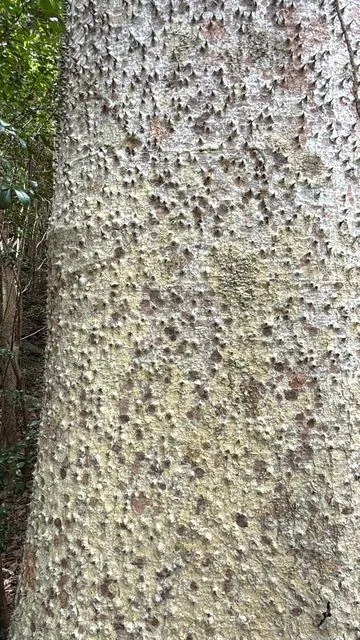
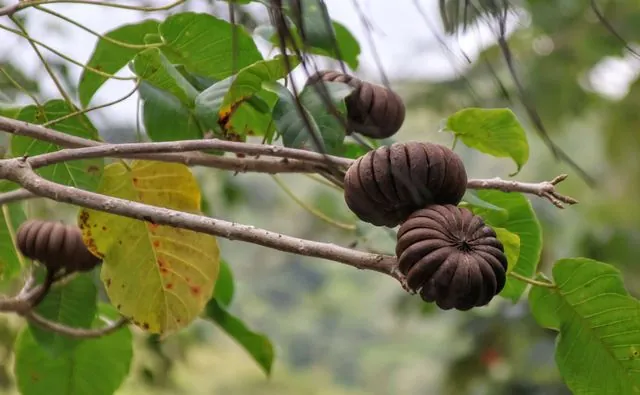
Canonical name: The scientific name without its authorship or date, for example Zea mays instead of Zea mays L. — The scientific name without its authorship or date, for example Zea mays instead of Zea mays L.
Hura crepitans
Authorship: The author or authors credited with publishing the scientific name. It is written after the name, sometimes with the year, for example L. (Linnaeus) in Zea mays L. An author in parentheses first published the name in another genus or rank. — The author or authors credited with publishing the scientific name. It is written after the name, sometimes with the year, for example L. (Linnaeus) in Zea mays L. An author in parentheses first published the name in another genus or rank.
L.
Common names
Sandbox Tree, Dynamite Tree, monkey-no-climb, sandboxtreeNames in other languages (46)Acaçu, Assacu, Assacu-preto, Assacuzeiro, Assacú, Assacú-vermelho, Açacu, Barbasco, Ba̱chöl, Bàchöl, Böchö́l, Ceiba amarilla, Ceiba blanca, Ceiba de leche, Ceiba tronadora, Jabilla, Jabillo, Javilla, Monkey Pistol, Porzófa, Roda, Sablier, Sabliyé, Sandbüchsenbaum, Ussacu, Zandkokerboom, asiwakalan, kumakalan, bois diable, pet du diable, sablier, bwa-dyab, catahua, hura chřestivá, hura rachotivá, inupupu, javillo, lauttahurapuu, mutata, posenti, postii, sanddoseträd, sandstrooierboom, tenway, wasaku, Хура трескающаяся, โพศรี, サルノトウナス, 沙盒樹, 砂箱の木
Kingdom: One of the broadest ranks of biological classification. It groups organisms that share very basic features, for example plants (Plantae), animals (Animalia) or fungi (Fungi). — One of the broadest ranks of biological classification. It groups organisms that share very basic features, for example plants (Plantae), animals (Animalia) or fungi (Fungi).
Plantae
Phylum: Rank below kingdom that groups organisms with a shared general body plan, for example chordates (Chordata), arthropods (Arthropoda) or vascular plants (Tracheophyta). In botany the same rank is also called division. — Rank below kingdom that groups organisms with a shared general body plan, for example chordates (Chordata), arthropods (Arthropoda) or vascular plants (Tracheophyta). In botany the same rank is also called division.
Tracheophyta
Class: Rank below phylum, for example mammals (Mammalia), birds (Aves), insects (Insecta) or monocot plants such as grasses and orchids (Liliopsida). — Rank below phylum, for example mammals (Mammalia), birds (Aves), insects (Insecta) or monocot plants such as grasses and orchids (Liliopsida).
Magnoliopsida
Order: Rank below class that groups related families, for example grasses and their relatives (Poales) or bats (Chiroptera). — Rank below class that groups related families, for example grasses and their relatives (Poales) or bats (Chiroptera).
Malpighiales
Family: Rank below order that groups related genera. Family names usually end in -aceae in botany (for example Poaceae, the grass family) and in -idae in zoology (for example Felidae, the cat family). — Rank below order that groups related genera. Family names usually end in -aceae in botany (for example Poaceae, the grass family) and in -idae in zoology (for example Felidae, the cat family).
Euphorbiaceae
Genus: Rank that groups closely related species. Its name is the first word of a species' scientific name and starts with a capital letter, for example Zea in Zea mays. — Rank that groups closely related species. Its name is the first word of a species' scientific name and starts with a capital letter, for example Zea in Zea mays.
Hura
Specific epithet: The second word of a species' scientific name. On its own it does not name the species: it always goes with the genus, for example mays in Zea mays. — The second word of a species' scientific name. On its own it does not name the species: it always goes with the genus, for example mays in Zea mays.
crepitans
Taxonomic rank: The level a name occupies in the hierarchy of biological classification, such as kingdom, family, genus, species or subspecies. — The level a name occupies in the hierarchy of biological classification, such as kingdom, family, genus, species or subspecies.
species
Reference species
Hura crepitans
Taxonomic status: Whether the taxonomic catalogue the record comes from currently accepts this name for the organism, or treats it as a synonym of another accepted name or as doubtful. — Whether the taxonomic catalogue the record comes from currently accepts this name for the organism, or treats it as a synonym of another accepted name or as doubtful.
accepted name
Photos and conservation status
IUCN Red List category: The extinction-risk category that the International Union for Conservation of Nature (IUCN) assigns to a species on its Red List. EX Extinct: there is no reasonable doubt that the last individual has died. EW Extinct in the wild: it survives only in cultivation, in captivity or as a population far outside its past range. CR Critically endangered, EN Endangered and VU Vulnerable: the three threatened categories, from an extremely high to a high risk of extinction in the wild. NT Near threatened: close to qualifying as threatened. LC Least concern: evaluated and not threatened. DD Data deficient: there is not enough information to assess its risk. NE Not evaluated: not yet assessed against the criteria. It describes the risk of the species worldwide, not its situation in a project's area. — The extinction-risk category that the International Union for Conservation of Nature (IUCN) assigns to a species on its Red List. EX Extinct: there is no reasonable doubt that the last individual has died. EW Extinct in the wild: it survives only in cultivation, in captivity or as a population far outside its past range. CR Critically endangered, EN Endangered and VU Vulnerable: the three threatened categories, from an extremely high to a high risk of extinction in the wild. NT Near threatened: close to qualifying as threatened. LC Least concern: evaluated and not threatened. DD Data deficient: there is not enough information to assess its risk. NE Not evaluated: not yet assessed against the criteria. It describes the risk of the species worldwide, not its situation in a project's area.
Least concern (LC)
Source: IUCN Red List via GBIF, queried on 2026-10-12 18:02.
Research-grade iNaturalist observations via GBIF, CC0 or CC BY licences only, queried on 2026-10-12 18:02.
Interacciones documentadas
GloBI says it is documented somewhere in the world. Biolitica answers whether it could happen here.
A documented interaction means it was recorded somewhere in the world. It does not mean it occurs here.
Types shown: 7 of 7
is a host of
×
interacts with
×
is eaten by
×
is adjacent to
×
has as a parasite
×
is preyed upon by
×
is a symbiont of
×
Blocks that do not sit under a navigation concept heading keep the source's own term: no navigation concept has been assigned to them yet.
is a host of
66 organisms
The authority declares no effect on this species for this term: neither that it harms it nor that it benefits it. In the source ontology symbiosis covers mutualism, commensalism and parasitism alike, so this block holds attackers and allies side by side.
Organism
Reads as
Studies
Where it was documented
Actions
Pseudocercospora huraeMycosphaerellaceae
is a host of
34
not compared
34 sources · 37 records
Spaulding, P.. 1961. Foreign Diseases of Forest Trees of the World. U.S.D.A. Agric. Handb. 197:1-361
Published in globalbioticinteractions/usda-fungus-host
Record contexts (sample): Venezuela · no date published; Barbados · no date published
Claim type
Published relationship between two taxa
Version
GloBI 0.11
Reuse
This release publishes no reuse terms for this record.
Venezuela · no date publishedWhere it is: line:hash://sha256/021a206a1459bcca7e251c73f5bd180fc3ac342a09c499855fe42e21fc09edcf!/interactions.tsv.gz!/L4110877
Barbados · no date publishedWhere it is: line:hash://sha256/021a206a1459bcca7e251c73f5bd180fc3ac342a09c499855fe42e21fc09edcf!/interactions.tsv.gz!/L4110879
Puerto Rico · no date publishedWhere it is: line:hash://sha256/021a206a1459bcca7e251c73f5bd180fc3ac342a09c499855fe42e21fc09edcf!/interactions.tsv.gz!/L4110880
No public URL for this record
Stevenson, J.A.. 1975. Fungi of Puerto Rico and the American Virgin Islands. Contr. Reed Herb. 23:743
Published in globalbioticinteractions/usda-fungus-host
Record contexts (sample): Virgin Islands · no date published; Puerto Rico · no date published
Claim type
Published relationship between two taxa
Version
GloBI 0.11
Reuse
This release publishes no reuse terms for this record.
Virgin Islands · no date publishedWhere it is: line:hash://sha256/021a206a1459bcca7e251c73f5bd180fc3ac342a09c499855fe42e21fc09edcf!/interactions.tsv.gz!/L3941137
Puerto Rico · no date publishedWhere it is: line:hash://sha256/021a206a1459bcca7e251c73f5bd180fc3ac342a09c499855fe42e21fc09edcf!/interactions.tsv.gz!/L3941143
Context: no place published · Aug. 9, 1945 · Preserved specimen
Claim type
Published relationship between two taxa
Version
GloBI 0.11
Reuse
This release publishes no reuse terms for this record.
no place published · Aug. 9, 1945 · Preserved specimenAs published: 1945-08-09T00:00:00Z · PreservedSpecimenWhere it is: line:hash://sha256/021a206a1459bcca7e251c73f5bd180fc3ac342a09c499855fe42e21fc09edcf!/interactions.tsv.gz!/L17209727
Context: Mayaguez · March 9, 1913 · Preserved specimen
Claim type
Published relationship between two taxa
Version
GloBI 0.11
Reuse
This release publishes no reuse terms for this record.
Mayaguez · March 9, 1913 · Preserved specimenAs published: 1913-03-09T00:00:00Z · PreservedSpecimenWhere it is: line:hash://sha256/021a206a1459bcca7e251c73f5bd180fc3ac342a09c499855fe42e21fc09edcf!/interactions.tsv.gz!/L17209731
Context: Mayaguez · March 9, 1913 · Preserved specimen
Claim type
Published relationship between two taxa
Version
GloBI 0.11
Reuse
This release publishes no reuse terms for this record.
Mayaguez · March 9, 1913 · Preserved specimenAs published: 1913-03-09T00:00:00Z · PreservedSpecimenWhere it is: line:hash://sha256/021a206a1459bcca7e251c73f5bd180fc3ac342a09c499855fe42e21fc09edcf!/interactions.tsv.gz!/L17209732
Context: San Jose de Las Matas · Nov. 12, 1931 · Preserved specimen
Claim type
Published relationship between two taxa
Version
GloBI 0.11
Reuse
This release publishes no reuse terms for this record.
San Jose de Las Matas · Nov. 12, 1931 · Preserved specimenAs published: 1931-11-12T00:00:00Z · PreservedSpecimenWhere it is: line:hash://sha256/021a206a1459bcca7e251c73f5bd180fc3ac342a09c499855fe42e21fc09edcf!/interactions.tsv.gz!/L16463305
Context: Santiago Prov., San Jose de Las Matas · Nov. 12, 1931 · Preserved specimen
Claim type
Published relationship between two taxa
Version
GloBI 0.11
Reuse
This release publishes no reuse terms for this record.
Santiago Prov., San Jose de Las Matas · Nov. 12, 1931 · Preserved specimenAs published: 1931-11-12T00:00:00Z · PreservedSpecimenWhere it is: line:hash://sha256/021a206a1459bcca7e251c73f5bd180fc3ac342a09c499855fe42e21fc09edcf!/interactions.tsv.gz!/L16880696
Context: Santiago, San Jose de Las Metas · Nov. 1, 1931 · Preserved specimen
Claim type
Published relationship between two taxa
Version
GloBI 0.11
Reuse
This release publishes no reuse terms for this record.
Santiago, San Jose de Las Metas · Nov. 1, 1931 · Preserved specimenAs published: 1931-11-01T00:00:00Z · PreservedSpecimenWhere it is: line:hash://sha256/021a206a1459bcca7e251c73f5bd180fc3ac342a09c499855fe42e21fc09edcf!/interactions.tsv.gz!/L17199913
Context: Valle del Cibao, Espaillat Prov., Moca National Agronomy Station, in Fields · March 6, 1930 · Preserved specimen
Claim type
Published relationship between two taxa
Version
GloBI 0.11
Reuse
This release publishes no reuse terms for this record.
Valle del Cibao, Espaillat Prov., Moca National Agronomy Station, in Fields · March 6, 1930 · Preserved specimenAs published: 1930-03-06T00:00:00Z · PreservedSpecimenWhere it is: line:hash://sha256/021a206a1459bcca7e251c73f5bd180fc3ac342a09c499855fe42e21fc09edcf!/interactions.tsv.gz!/L17199914
Context: Hato del Yaque · June 6, 1931 · Preserved specimen
Claim type
Published relationship between two taxa
Version
GloBI 0.11
Reuse
This release publishes no reuse terms for this record.
Hato del Yaque · June 6, 1931 · Preserved specimenAs published: 1931-06-06T00:00:00Z · PreservedSpecimenWhere it is: line:hash://sha256/021a206a1459bcca7e251c73f5bd180fc3ac342a09c499855fe42e21fc09edcf!/interactions.tsv.gz!/L17201162
Context: no place published · no date published · Material sample
Claim type
Published relationship between two taxa
Version
GloBI 0.11
Reuse
This release publishes no reuse terms for this record.
no place published · no date published · Material sampleAs published: MATERIAL_SAMPLEWhere it is: line:hash://sha256/021a206a1459bcca7e251c73f5bd180fc3ac342a09c499855fe42e21fc09edcf!/interactions.tsv.gz!/L12818144
Context: no place published · no date published · Material sample
Claim type
Published relationship between two taxa
Version
GloBI 0.11
Reuse
This release publishes no reuse terms for this record.
no place published · no date published · Material sampleAs published: MATERIAL_SAMPLEWhere it is: line:hash://sha256/021a206a1459bcca7e251c73f5bd180fc3ac342a09c499855fe42e21fc09edcf!/interactions.tsv.gz!/L12818145
Context: no place published · no date published · Material sample
Claim type
Published relationship between two taxa
Version
GloBI 0.11
Reuse
This release publishes no reuse terms for this record.
no place published · no date published · Material sampleAs published: MATERIAL_SAMPLEWhere it is: line:hash://sha256/021a206a1459bcca7e251c73f5bd180fc3ac342a09c499855fe42e21fc09edcf!/interactions.tsv.gz!/L12818154
Context: no place published · no date published · Material sample
Claim type
Published relationship between two taxa
Version
GloBI 0.11
Reuse
This release publishes no reuse terms for this record.
no place published · no date published · Material sampleAs published: MATERIAL_SAMPLEWhere it is: line:hash://sha256/021a206a1459bcca7e251c73f5bd180fc3ac342a09c499855fe42e21fc09edcf!/interactions.tsv.gz!/L12818155
Context: Area de Conservacion Guanacaste, Sector Mundo Nuevo, Estacion La Perla · Sept. 2, 2005 · Material sample
Claim type
Published relationship between two taxa
Version
GloBI 0.11
Reuse
This release publishes no reuse terms for this record.
Area de Conservacion Guanacaste, Sector Mundo Nuevo, Estacion La Perla · Sept. 2, 2005 · Material sampleAs published: 2005-09-02T00:00:00Z · MATERIAL_SAMPLEWhere it is: line:hash://sha256/021a206a1459bcca7e251c73f5bd180fc3ac342a09c499855fe42e21fc09edcf!/interactions.tsv.gz!/L12924092
Context: Area de Conservacion Guanacaste, Sector Cacao, Estacion Gongora · Oct. 20, 1995 · Material sample
Claim type
Published relationship between two taxa
Version
GloBI 0.11
Reuse
This release publishes no reuse terms for this record.
Area de Conservacion Guanacaste, Sector Cacao, Estacion Gongora · Oct. 20, 1995 · Material sampleAs published: 1995-10-20T00:00:00Z · MATERIAL_SAMPLEWhere it is: line:hash://sha256/021a206a1459bcca7e251c73f5bd180fc3ac342a09c499855fe42e21fc09edcf!/interactions.tsv.gz!/L12924116
Context: Area de Conservacion Guanacaste, Sector Cacao, Estacion Gongora · Nov. 5, 1995 · Material sample
Claim type
Published relationship between two taxa
Version
GloBI 0.11
Reuse
This release publishes no reuse terms for this record.
Area de Conservacion Guanacaste, Sector Cacao, Estacion Gongora · Nov. 5, 1995 · Material sampleAs published: 1995-11-05T00:00:00Z · MATERIAL_SAMPLEWhere it is: line:hash://sha256/021a206a1459bcca7e251c73f5bd180fc3ac342a09c499855fe42e21fc09edcf!/interactions.tsv.gz!/L12924118
Context: Area de Conservacion Guanacaste, Sector Cacao, Estacion Gongora · no date published · Material sample
Claim type
Published relationship between two taxa
Version
GloBI 0.11
Reuse
This release publishes no reuse terms for this record.
Area de Conservacion Guanacaste, Sector Cacao, Estacion Gongora · no date published · Material sampleAs published: MATERIAL_SAMPLEWhere it is: line:hash://sha256/021a206a1459bcca7e251c73f5bd180fc3ac342a09c499855fe42e21fc09edcf!/interactions.tsv.gz!/L12924119
Context: Canal Zone, nr. Las Cascades · Dec. 5, 1939 · Preserved specimen
Claim type
Published relationship between two taxa
Version
GloBI 0.11
Reuse
This release publishes no reuse terms for this record.
Canal Zone, nr. Las Cascades · Dec. 5, 1939 · Preserved specimenAs published: 1939-12-05T00:00:00Z · PreservedSpecimenWhere it is: line:hash://sha256/021a206a1459bcca7e251c73f5bd180fc3ac342a09c499855fe42e21fc09edcf!/interactions.tsv.gz!/L16606574
Context: Maraval Valley, Port of Spain · Jan. 1, 1913 · Preserved specimen
Claim type
Published relationship between two taxa
Version
GloBI 0.11
Reuse
This release publishes no reuse terms for this record.
Maraval Valley, Port of Spain · Jan. 1, 1913 · Preserved specimenAs published: 1913-01-01T00:00:00Z · PreservedSpecimenWhere it is: line:hash://sha256/021a206a1459bcca7e251c73f5bd180fc3ac342a09c499855fe42e21fc09edcf!/interactions.tsv.gz!/L16648886
Context: Rovalo River, Chiriqui Lagoon · Aug. 24, 1940 · Preserved specimen
Claim type
Published relationship between two taxa
Version
GloBI 0.11
Reuse
This release publishes no reuse terms for this record.
Rovalo River, Chiriqui Lagoon · Aug. 24, 1940 · Preserved specimenAs published: 1940-08-24T00:00:00Z · PreservedSpecimenWhere it is: line:hash://sha256/021a206a1459bcca7e251c73f5bd180fc3ac342a09c499855fe42e21fc09edcf!/interactions.tsv.gz!/L17304169
Context: MACORIS · March 10, 1926 · Preserved specimen
Claim type
Published relationship between two taxa
Version
GloBI 0.11
Reuse
This release publishes no reuse terms for this record.
MACORIS · March 10, 1926 · Preserved specimenAs published: 1926-03-10T00:00:00Z · PreservedSpecimenWhere it is: line:hash://sha256/021a206a1459bcca7e251c73f5bd180fc3ac342a09c499855fe42e21fc09edcf!/interactions.tsv.gz!/L17304170
Context: Barnstorm Canada Farm, United Fruit Co. · Sept. 15, 1940 · Preserved specimen
Claim type
Published relationship between two taxa
Version
GloBI 0.11
Reuse
This release publishes no reuse terms for this record.
Barnstorm Canada Farm, United Fruit Co. · Sept. 15, 1940 · Preserved specimenAs published: 1940-09-15T00:00:00Z · PreservedSpecimenWhere it is: line:hash://sha256/021a206a1459bcca7e251c73f5bd180fc3ac342a09c499855fe42e21fc09edcf!/interactions.tsv.gz!/L17304171
Context: Las Cascades, Canal Zone near · Dec. 5, 1939 · Preserved specimen
Claim type
Published relationship between two taxa
Version
GloBI 0.11
Reuse
This release publishes no reuse terms for this record.
Las Cascades, Canal Zone near · Dec. 5, 1939 · Preserved specimenAs published: 1939-12-05T00:00:00Z · PreservedSpecimenWhere it is: line:hash://sha256/021a206a1459bcca7e251c73f5bd180fc3ac342a09c499855fe42e21fc09edcf!/interactions.tsv.gz!/L17304172
Context: Bocas del Torro, Chiriqui Lagoon Region, Punta Rovalo to Rovalo River · Aug. 24, 1940 · Preserved specimen
Claim type
Published relationship between two taxa
Version
GloBI 0.11
Reuse
This release publishes no reuse terms for this record.
Bocas del Torro, Chiriqui Lagoon Region, Punta Rovalo to Rovalo River · Aug. 24, 1940 · Preserved specimenAs published: 1940-08-24T00:00:00Z · PreservedSpecimenWhere it is: line:hash://sha256/021a206a1459bcca7e251c73f5bd180fc3ac342a09c499855fe42e21fc09edcf!/interactions.tsv.gz!/L17304173
Context: Las Cascadas Plantation, near Summit, Canal Zone · Jan. 4, 1924 · Preserved specimen
Claim type
Published relationship between two taxa
Version
GloBI 0.11
Reuse
This release publishes no reuse terms for this record.
Las Cascadas Plantation, near Summit, Canal Zone · Jan. 4, 1924 · Preserved specimenAs published: 1924-01-04T00:00:00Z · PreservedSpecimenWhere it is: line:hash://sha256/021a206a1459bcca7e251c73f5bd180fc3ac342a09c499855fe42e21fc09edcf!/interactions.tsv.gz!/L17304174
The authority declares no effect on this species for this term: neither that it harms it nor that it benefits it.
Organism
Reads as
Studies
Where it was documented
Actions
Encarsia larensisAphelinidae
interacts with
2
no location
2 sources · 2 records
Chavez, T.A. (1996) A new species of <i>Dirphys</i> Howard (Hymenoptera: Aphelinidae). <i>Boletín de Entomologia Venezolana</i>, 11(1), 11–17.
Published in urn:lsid:checklistbank.org:dataset:124661
Context: no place published · no date published
Claim type
Published relationship between two taxa
Version
GloBI 0.11
Reuse
This release publishes no reuse terms for this record.
no place published · no date publishedWhere it is: line:hash://sha256/021a206a1459bcca7e251c73f5bd180fc3ac342a09c499855fe42e21fc09edcf!/interactions.tsv.gz!/L1237299
No public URL for this record
@article{57663, author = {Chavez, T.A.}, booktitle = {Boletín de Entomologia Venezolana}, journal = {Boletín de Entomología Venezolana}, month = {sep}, day = {30}, pages = {11-17}, title = {A new species of <i>Dirphys</i> Howard (Hymenoptera: Aphelinidae).}, volu…
Published in globalbioticinteractions/taxonworks
Context: no place published · no date published
Claim type
Published relationship between two taxa
Version
GloBI 0.11
Reuse
This release publishes no reuse terms for this record.
no place published · no date publishedWhere it is: line:hash://sha256/021a206a1459bcca7e251c73f5bd180fc3ac342a09c499855fe42e21fc09edcf!/interactions.tsv.gz!/L6074309
No public URL for this record
A published relationship says these two taxa were documented interacting. It does not say how often, or that it happens in this project's region.
Context: Njala · June 28, 1969 · Preserved specimen
Claim type
Published relationship between two taxa
Version
GloBI 0.11
Reuse
This release publishes no reuse terms for this record.
Njala · June 28, 1969 · Preserved specimenAs published: 1969-06-28T00:00:00Z · PreservedSpecimenWhere it is: line:hash://sha256/021a206a1459bcca7e251c73f5bd180fc3ac342a09c499855fe42e21fc09edcf!/interactions.tsv.gz!/L17040448
Context: Njala · June 28, 1949 · Preserved specimen
Claim type
Published relationship between two taxa
Version
GloBI 0.11
Reuse
This release publishes no reuse terms for this record.
Njala · June 28, 1949 · Preserved specimenAs published: 1949-06-28T00:00:00Z · PreservedSpecimenWhere it is: line:hash://sha256/021a206a1459bcca7e251c73f5bd180fc3ac342a09c499855fe42e21fc09edcf!/interactions.tsv.gz!/L17040451
This release publishes no reuse terms for this record.
Barquisimeto · Oct. 1, 2006 · Preserved specimenAs published: 2006-10-01T00:00:00Z · PreservedSpecimenWhere it is: line:hash://sha256/021a206a1459bcca7e251c73f5bd180fc3ac342a09c499855fe42e21fc09edcf!/interactions.tsv.gz!/L15894144
Barquisimeto · Oct. 1, 2006 · LabelObservationAs published: 2006-10-01T00:00:00Z · LabelObservationWhere it is: line:hash://sha256/021a206a1459bcca7e251c73f5bd180fc3ac342a09c499855fe42e21fc09edcf!/interactions.tsv.gz!/L15894146
Parque Zoológico y Botánico Bararida, Barquisimeto · July 1, 1990 · Preserved specimenAs published: 1990-07-01T00:00:00Z · PreservedSpecimenWhere it is: line:hash://sha256/021a206a1459bcca7e251c73f5bd180fc3ac342a09c499855fe42e21fc09edcf!/interactions.tsv.gz!/L15894150
A published relationship says these two taxa were documented interacting. It does not say how often, or that it happens in this project's region.
Parasitoid waspEncarsia dispersa
interacts with
1
no location
1 source · 1 record
Polaszek, A., Manzari, S. & Quicke, D.L.J. (2004) Morphological and molecular taxonomic analysis of the <i>Encarsia meritoria</i> species-complex (Hymenoptera, Aphelinidae), parasitoids of whiteflies (Hemiptera, Aleyrodidae) of economic importance. <i>Zoologica Scripta</i>, …
Published in urn:lsid:checklistbank.org:dataset:124661
Context: no place published · no date published
Claim type
Published relationship between two taxa
Version
GloBI 0.11
Reuse
This release publishes no reuse terms for this record.
no place published · no date publishedWhere it is: line:hash://sha256/021a206a1459bcca7e251c73f5bd180fc3ac342a09c499855fe42e21fc09edcf!/interactions.tsv.gz!/L1239390
No public URL for this record
A published relationship says these two taxa were documented interacting. It does not say how often, or that it happens in this project's region.
This term does declare that the organism harms this species.
Organism
Reads as
Studies
Where it was documented
Actions
Calloconophora pinguisMembracidae
is eaten by
2
no location
2 sources · 4 records
@article{212255, author = {Flynn, Dawn J.}, journal = {Zootaxa}, month = {feb}, day = {20}, number = {1}, pages = {1-55}, publisher = {Magnolia Press}, title = {Updated checklist of treehoppers of Panama (Hemiptera: Membracidae) with plant associations}, volume…
Published in globalbioticinteractions/taxonworks
Record contexts (sample): no place published · no date published; no place published · no date published
Claim type
Published relationship between two taxa
Version
GloBI 0.11
Reuse
This release publishes no reuse terms for this record.
no place published · no date publishedWhere it is: line:hash://sha256/021a206a1459bcca7e251c73f5bd180fc3ac342a09c499855fe42e21fc09edcf!/interactions.tsv.gz!/L5990430
no place published · no date publishedWhere it is: line:hash://sha256/021a206a1459bcca7e251c73f5bd180fc3ac342a09c499855fe42e21fc09edcf!/interactions.tsv.gz!/L5990470
no place published · no date publishedWhere it is: line:hash://sha256/021a206a1459bcca7e251c73f5bd180fc3ac342a09c499855fe42e21fc09edcf!/interactions.tsv.gz!/L5990521
Flynn, D.J. (2024) Updated checklist of treehoppers of Panama (Hemiptera: Membracidae) with plant associations. <i>Zootaxa</i>, 5415(1), 1–55. https://doi.org/10.11646/zootaxa.5415.1.1
Published in urn:lsid:checklistbank.org:dataset:2317
Context: no place published · no date published
Claim type
Published relationship between two taxa
Version
GloBI 0.11
Reuse
This release publishes no reuse terms for this record.
no place published · no date publishedWhere it is: line:hash://sha256/021a206a1459bcca7e251c73f5bd180fc3ac342a09c499855fe42e21fc09edcf!/interactions.tsv.gz!/L1303895
A published relationship says these two taxa were documented interacting. It does not say how often, or that it happens in this project's region.
Alconeura pistolaCicadellidae
is eaten by
2
no location
2 sources · 3 records
@article{15374, author = {Caldwell, John Stein and Martorell, Luis F.}, journal = {The Journal of the Department of Agriculture Puerto Rico}, number = {1}, pages = {1-132, i-viii}, title = {Review of the Auchenorynchous Homoptera of Puerto Rico. Part 1. Cicadellidae.},…
Published in globalbioticinteractions/taxonworks
Record contexts (sample): no place published · no date published; no place published · no date published
Claim type
Published relationship between two taxa
Version
GloBI 0.11
Reuse
This release publishes no reuse terms for this record.
no place published · no date publishedWhere it is: line:hash://sha256/021a206a1459bcca7e251c73f5bd180fc3ac342a09c499855fe42e21fc09edcf!/interactions.tsv.gz!/L5922725
no place published · no date publishedWhere it is: line:hash://sha256/021a206a1459bcca7e251c73f5bd180fc3ac342a09c499855fe42e21fc09edcf!/interactions.tsv.gz!/L5922743
No public URL for this record
Caldwell, J.S. & Martorell, L.F. (1952a) Review of the Auchenorynchous Homoptera of Puerto Rico. Part I. Cicadellidae. <i>The Journal of the Department of Agriculture of Puerto Rico</i>, 34(1), 1–132, i-viii. [1950]
Published in urn:lsid:checklistbank.org:dataset:2317
Context: no place published · no date published
Claim type
Published relationship between two taxa
Version
GloBI 0.11
Reuse
This release publishes no reuse terms for this record.
no place published · no date publishedWhere it is: line:hash://sha256/021a206a1459bcca7e251c73f5bd180fc3ac342a09c499855fe42e21fc09edcf!/interactions.tsv.gz!/L1288661
No public URL for this record
A published relationship says these two taxa were documented interacting. It does not say how often, or that it happens in this project's region.
Lowland PacaCuniculus pacaCuniculidae
is eaten by
1
no location
1 source · 1 record
Beck–King H, von Helversen O, Beck–King R, 1997. Home Range, Population Density, and Food Resources of Agouti paca (Rodentia: Agoutidae) in Costa Rica: A Study Using Alternative Methods.
Published in globalbioticinteractions/neofrugivory
Context: Costa Rica · no date published
Claim type
Published relationship between two taxa
Version
GloBI 0.11
Reuse
This release publishes no reuse terms for this record.
Costa Rica · no date publishedWhere it is: line:hash://sha256/021a206a1459bcca7e251c73f5bd180fc3ac342a09c499855fe42e21fc09edcf!/interactions.tsv.gz!/L3097105
No public URL for this record
A published relationship says these two taxa were documented interacting. It does not say how often, or that it happens in this project's region.
Sibine geyeriLimacodidae
is eaten by
1
no location
1 source · 1 record
Edward Baker; Ian Kitching; George W Beccaloni; Amoret Whitaker; Steen Dupont; Vincent Smith; John S Noyes (2017). NHM Interactions Bank. https://doi.org/10.5519/0060767. Accessed at <https://data.nhm.ac.uk/dataset/82e807f0-6273-4f19-be0a-7f7558442a25/resource/f84ad9f1-bd0c-4811…
Published in globalbioticinteractions/natural-history-museum-london-interactions-bank
Context: no place published · no date published
Claim type
Published relationship between two taxa
Version
GloBI 0.11
Reuse
This release publishes no reuse terms for this record.
no place published · no date publishedWhere it is: line:hash://sha256/021a206a1459bcca7e251c73f5bd180fc3ac342a09c499855fe42e21fc09edcf!/interactions.tsv.gz!/L18698306
Context: Nr. Las Cascades, Canal Zone · Dec. 5, 1939 · Preserved specimen
Claim type
Published relationship between two taxa
Version
GloBI 0.11
Reuse
This release publishes no reuse terms for this record.
Nr. Las Cascades, Canal Zone · Dec. 5, 1939 · Preserved specimenAs published: 1939-12-05T00:00:00Z · PreservedSpecimenWhere it is: line:hash://sha256/021a206a1459bcca7e251c73f5bd180fc3ac342a09c499855fe42e21fc09edcf!/interactions.tsv.gz!/L16685300
Context: no place published · Jan. 1, 1920 · Preserved specimen
Claim type
Published relationship between two taxa
Version
GloBI 0.11
Reuse
This release publishes no reuse terms for this record.
no place published · Jan. 1, 1920 · Preserved specimenAs published: 1920-01-01T00:00:00Z · PreservedSpecimenWhere it is: line:hash://sha256/021a206a1459bcca7e251c73f5bd180fc3ac342a09c499855fe42e21fc09edcf!/interactions.tsv.gz!/L17924094
Context: Near Las Cascades. · Dec. 1, 1939 · Preserved specimen
Claim type
Published relationship between two taxa
Version
GloBI 0.11
Reuse
This release publishes no reuse terms for this record.
Near Las Cascades. · Dec. 1, 1939 · Preserved specimenAs published: 1939-12-01T00:00:00Z · PreservedSpecimenWhere it is: line:hash://sha256/021a206a1459bcca7e251c73f5bd180fc3ac342a09c499855fe42e21fc09edcf!/interactions.tsv.gz!/L18256296
Context: Santiago, Valle del Cibao, at Rio Yaque. · March 12, 1931 · Preserved specimen
Claim type
Published relationship between two taxa
Version
GloBI 0.11
Reuse
This release publishes no reuse terms for this record.
Santiago, Valle del Cibao, at Rio Yaque. · March 12, 1931 · Preserved specimenAs published: 1931-03-12T00:00:00Z · PreservedSpecimenWhere it is: line:hash://sha256/021a206a1459bcca7e251c73f5bd180fc3ac342a09c499855fe42e21fc09edcf!/interactions.tsv.gz!/L17986926
Context: Mayaguez · March 9, 1913 · Preserved specimen
Claim type
Published relationship between two taxa
Version
GloBI 0.11
Reuse
This release publishes no reuse terms for this record.
Mayaguez · March 9, 1913 · Preserved specimenAs published: 1913-03-09T00:00:00Z · PreservedSpecimenWhere it is: line:hash://sha256/021a206a1459bcca7e251c73f5bd180fc3ac342a09c499855fe42e21fc09edcf!/interactions.tsv.gz!/L18329801
A published relationship says these two taxa were documented interacting. It does not say how often, or that it happens in this project's region.
Showing 4 of 4, by number of studies
has as a parasite
2 organisms
This term does declare that the organism harms this species.
Organism
Reads as
Studies
Where it was documented
Actions
Parasitoid waspEncarsia dispersaAphelinidae
has as a parasite
1
no location
1 source · 1 record
PolaszMaQu2004 via Universal Chalcidoidea Database
Published in globalbioticinteractions/natural-history-museum-london-interactions-bank
Context: no place published · no date published
Claim type
Published relationship between two taxa
Version
GloBI 0.11
Reuse
This release publishes no reuse terms for this record.
no place published · no date publishedWhere it is: line:hash://sha256/021a206a1459bcca7e251c73f5bd180fc3ac342a09c499855fe42e21fc09edcf!/interactions.tsv.gz!/L18890763
No public URL for this record
A published relationship says these two taxa were documented interacting. It does not say how often, or that it happens in this project's region.
Encarsia larensisAphelinidae
has as a parasite
1
no location
1 source · 1 record
Chavez996 via Universal Chalcidoidea Database
Published in globalbioticinteractions/natural-history-museum-london-interactions-bank
Context: no place published · no date published
Claim type
Published relationship between two taxa
Version
GloBI 0.11
Reuse
This release publishes no reuse terms for this record.
no place published · no date publishedWhere it is: line:hash://sha256/021a206a1459bcca7e251c73f5bd180fc3ac342a09c499855fe42e21fc09edcf!/interactions.tsv.gz!/L18922331
No public URL for this record
A published relationship says these two taxa were documented interacting. It does not say how often, or that it happens in this project's region.
Showing 2 of 2, by number of studies
is preyed upon by
1 organism
This term does declare that the organism harms this species.
Organism
Reads as
Studies
Where it was documented
Actions
PseudomyrmexFormicidae
is preyed upon by
1
no location
Not a modelling unit: the source publishes it at genus level.
1 source · 1 record
Gripenberg, S. et al., 2019. A highly resolved food web for insect seed predators in a species‐rich tropical forest F. Jordan, ed. Ecology Letters, 22(10), pp.1638–1649. Available at: https://doi.org/10.1111/ele.13359. Accessed at <https://github.com/globalbioticinteractions/BCI…
Published in globalbioticinteractions/BCI_Seed_Predator
Context: no place published · no date published
Claim type
Published relationship between two taxa
Version
GloBI 0.11
Reuse
This release publishes no reuse terms for this record.
no place published · no date publishedWhere it is: line:hash://sha256/021a206a1459bcca7e251c73f5bd180fc3ac342a09c499855fe42e21fc09edcf!/interactions.tsv.gz!/L2892912
A published relationship says these two taxa were documented interacting. It does not say how often, or that it happens in this project's region.
Showing 1 of 1, by number of studies
is a symbiont of
1 organism
The authority declares no effect on this species for this term: neither that it harms it nor that it benefits it. In the source ontology symbiosis covers mutualism, commensalism and parasitism alike, so this block holds attackers and allies side by side.
Organism
Reads as
Studies
Where it was documented
Actions
Fungi Including LichensFungi
is a symbiont of
1
not compared
Not a modelling unit: the source publishes it at kingdom level.
1 source · 18 records
Markesteijn L and Poorter L (2009). 'Seedling root morphology and biomass allocation of 62 tropical tree species in relation to drought- and shade-tolerance.' Journal of Ecology, 97(2), pp. 311-325.
Published in globalbioticinteractions/fred
Record contexts (sample): no place published · Jan. 1, 2006; no place published · Jan. 1, 2006
Claim type
Published relationship between two taxa
Version
GloBI 0.11
Reuse
This release publishes no reuse terms for this record.
no place published · Jan. 1, 2006As published: 2006-01-01T00:00:00ZWhere it is: line:hash://sha256/021a206a1459bcca7e251c73f5bd180fc3ac342a09c499855fe42e21fc09edcf!/interactions.tsv.gz!/L24419585
no place published · Jan. 1, 2006As published: 2006-01-01T00:00:00ZWhere it is: line:hash://sha256/021a206a1459bcca7e251c73f5bd180fc3ac342a09c499855fe42e21fc09edcf!/interactions.tsv.gz!/L24419625
no place published · Jan. 1, 2006As published: 2006-01-01T00:00:00ZWhere it is: line:hash://sha256/021a206a1459bcca7e251c73f5bd180fc3ac342a09c499855fe42e21fc09edcf!/interactions.tsv.gz!/L24419701
And 15 more records of this source, not listed here.
A published relationship says these two taxa were documented interacting. It does not say how often, or that it happens in this project's region.
Showing 1 of 1, by number of studies
Acompañantes documentados
This agronomic reading comes from a source reserved for internal use, so it is not shown here.
Documented uses and recommendations
Uses and recommendations that a source documents for this species beside a crop, each in its own context. They are the source's statements, not traits of the species and not Biolítica's recommendations, and none of them is a relation between two species.
Among the sources you can read, none documents a use or recommendation of this species beside a crop.