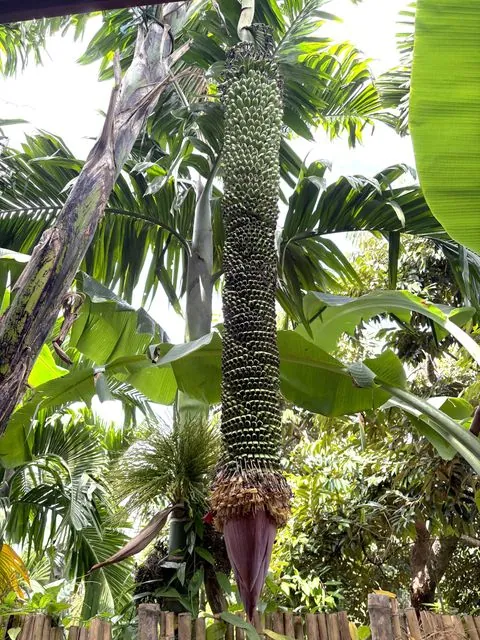
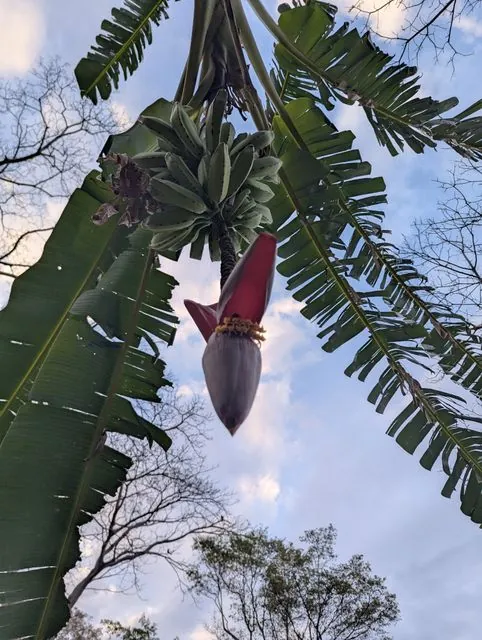
Canonical name: The scientific name without its authorship or date, for example Zea mays instead of Zea mays L. — The scientific name without its authorship or date, for example Zea mays instead of Zea mays L.
Musa paradisiaca
Authorship: The author or authors credited with publishing the scientific name. It is written after the name, sometimes with the year, for example L. (Linnaeus) in Zea mays L. An author in parentheses first published the name in another genus or rank. — The author or authors credited with publishing the scientific name. It is written after the name, sometimes with the year, for example L. (Linnaeus) in Zea mays L. An author in parentheses first published the name in another genus or rank.
Kingdom: One of the broadest ranks of biological classification. It groups organisms that share very basic features, for example plants (Plantae), animals (Animalia) or fungi (Fungi). — One of the broadest ranks of biological classification. It groups organisms that share very basic features, for example plants (Plantae), animals (Animalia) or fungi (Fungi).
Plantae
Phylum: Rank below kingdom that groups organisms with a shared general body plan, for example chordates (Chordata), arthropods (Arthropoda) or vascular plants (Tracheophyta). In botany the same rank is also called division. — Rank below kingdom that groups organisms with a shared general body plan, for example chordates (Chordata), arthropods (Arthropoda) or vascular plants (Tracheophyta). In botany the same rank is also called division.
Tracheophyta
Class: Rank below phylum, for example mammals (Mammalia), birds (Aves), insects (Insecta) or monocot plants such as grasses and orchids (Liliopsida). — Rank below phylum, for example mammals (Mammalia), birds (Aves), insects (Insecta) or monocot plants such as grasses and orchids (Liliopsida).
Liliopsida
Order: Rank below class that groups related families, for example grasses and their relatives (Poales) or bats (Chiroptera). — Rank below class that groups related families, for example grasses and their relatives (Poales) or bats (Chiroptera).
Zingiberales
Family: Rank below order that groups related genera. Family names usually end in -aceae in botany (for example Poaceae, the grass family) and in -idae in zoology (for example Felidae, the cat family). — Rank below order that groups related genera. Family names usually end in -aceae in botany (for example Poaceae, the grass family) and in -idae in zoology (for example Felidae, the cat family).
Musaceae
Genus: Rank that groups closely related species. Its name is the first word of a species' scientific name and starts with a capital letter, for example Zea in Zea mays. — Rank that groups closely related species. Its name is the first word of a species' scientific name and starts with a capital letter, for example Zea in Zea mays.
Musa
Specific epithet: The second word of a species' scientific name. On its own it does not name the species: it always goes with the genus, for example mays in Zea mays. — The second word of a species' scientific name. On its own it does not name the species: it always goes with the genus, for example mays in Zea mays.
paradisiaca
Taxonomic rank: The level a name occupies in the hierarchy of biological classification, such as kingdom, family, genus, species or subspecies. — The level a name occupies in the hierarchy of biological classification, such as kingdom, family, genus, species or subspecies.
species
Reference species
Musa paradisiaca
Taxonomic status: Whether the taxonomic catalogue the record comes from currently accepts this name for the organism, or treats it as a synonym of another accepted name or as doubtful. — Whether the taxonomic catalogue the record comes from currently accepts this name for the organism, or treats it as a synonym of another accepted name or as doubtful.
accepted name
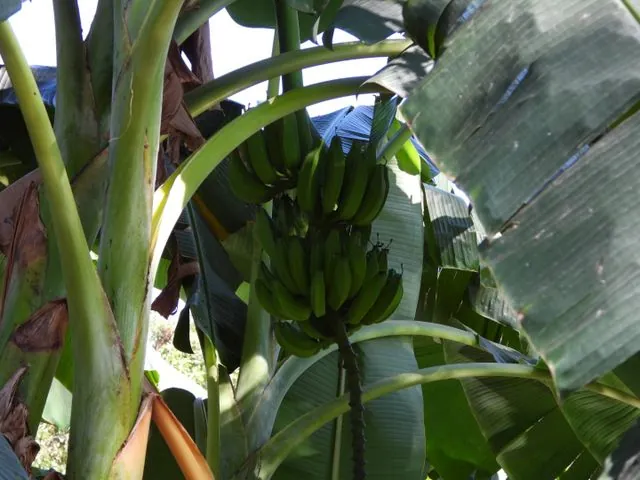
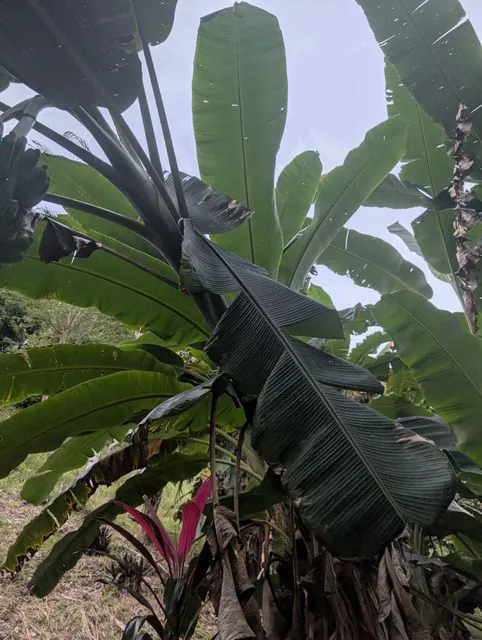
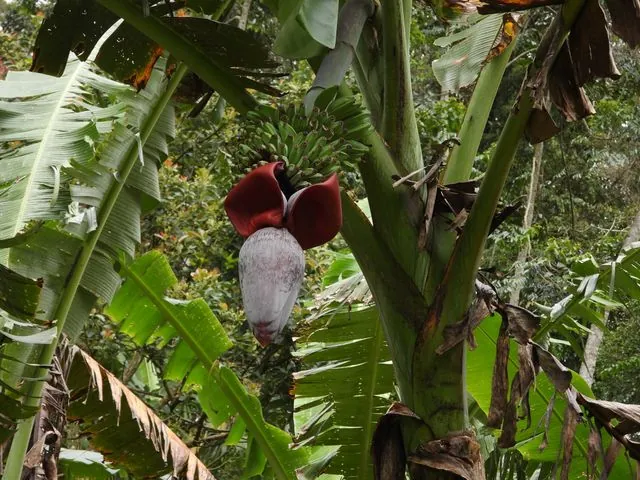
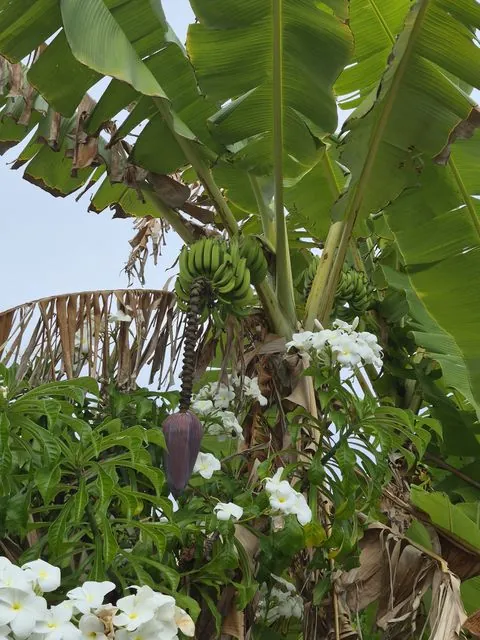
Photos and conservation status
IUCN Red List category: The extinction-risk category that the International Union for Conservation of Nature (IUCN) assigns to a species on its Red List. EX Extinct: there is no reasonable doubt that the last individual has died. EW Extinct in the wild: it survives only in cultivation, in captivity or as a population far outside its past range. CR Critically endangered, EN Endangered and VU Vulnerable: the three threatened categories, from an extremely high to a high risk of extinction in the wild. NT Near threatened: close to qualifying as threatened. LC Least concern: evaluated and not threatened. DD Data deficient: there is not enough information to assess its risk. NE Not evaluated: not yet assessed against the criteria. It describes the risk of the species worldwide, not its situation in a project's area. — The extinction-risk category that the International Union for Conservation of Nature (IUCN) assigns to a species on its Red List. EX Extinct: there is no reasonable doubt that the last individual has died. EW Extinct in the wild: it survives only in cultivation, in captivity or as a population far outside its past range. CR Critically endangered, EN Endangered and VU Vulnerable: the three threatened categories, from an extremely high to a high risk of extinction in the wild. NT Near threatened: close to qualifying as threatened. LC Least concern: evaluated and not threatened. DD Data deficient: there is not enough information to assess its risk. NE Not evaluated: not yet assessed against the criteria. It describes the risk of the species worldwide, not its situation in a project's area.
Not evaluated (NE)
Source: IUCN Red List via GBIF, queried on 2026-10-09 06:24.
Research-grade iNaturalist observations via GBIF, CC0 or CC BY licences only, queried on 2026-10-09 06:24.
Interacciones documentadas
GloBI says it is documented somewhere in the world. Biolitica answers whether it could happen here.
A documented interaction means it was recorded somewhere in the world. It does not mean it occurs here.
Types shown: 9 of 9
is a host of
×
is eaten by
×
interacts with
×
has its flowers visited by
×
is adjacent to
×
has as a vector
×
is visited by
×
is an arbuscular mycorrhizal host of
×
is pollinated by
×
Blocks that do not sit under a navigation concept heading keep the source's own term: no navigation concept has been assigned to them yet.
is a host of
149 organisms
The authority declares no effect on this species for this term: neither that it harms it nor that it benefits it. In the source ontology symbiosis covers mutualism, commensalism and parasitism alike, so this block holds attackers and allies side by side.
Context: Syracuse · July 1, 1894 · Preserved specimen
Claim type
Published relationship between two taxa
Version
GloBI 0.11
Reuse
This release publishes no reuse terms for this record.
Syracuse · July 1, 1894 · Preserved specimenAs published: 1894-07-01T00:00:00Z · PreservedSpecimenWhere it is: line:hash://sha256/021a206a1459bcca7e251c73f5bd180fc3ac342a09c499855fe42e21fc09edcf!/interactions.tsv.gz!/L16674073
Context: Syracuse · July 1, 1891 · Preserved specimen
Claim type
Published relationship between two taxa
Version
GloBI 0.11
Reuse
This release publishes no reuse terms for this record.
Syracuse · July 1, 1891 · Preserved specimenAs published: 1891-07-01T00:00:00Z · PreservedSpecimenWhere it is: line:hash://sha256/021a206a1459bcca7e251c73f5bd180fc3ac342a09c499855fe42e21fc09edcf!/interactions.tsv.gz!/L17645340
Context: no place published · July 1, 1891 · Preserved specimen
Claim type
Published relationship between two taxa
Version
GloBI 0.11
Reuse
This release publishes no reuse terms for this record.
no place published · July 1, 1891 · Preserved specimenAs published: 1891-07-01T00:00:00Z · PreservedSpecimenWhere it is: line:hash://sha256/021a206a1459bcca7e251c73f5bd180fc3ac342a09c499855fe42e21fc09edcf!/interactions.tsv.gz!/L17762534
Context: Syracuse. · July 1, 1894 · Preserved specimen
Claim type
Published relationship between two taxa
Version
GloBI 0.11
Reuse
This release publishes no reuse terms for this record.
Syracuse. · July 1, 1894 · Preserved specimenAs published: 1894-07-01T00:00:00Z · PreservedSpecimenWhere it is: line:hash://sha256/021a206a1459bcca7e251c73f5bd180fc3ac342a09c499855fe42e21fc09edcf!/interactions.tsv.gz!/L17983415
Context: Boston, Market. · no date published · Preserved specimen
Claim type
Published relationship between two taxa
Version
GloBI 0.11
Reuse
This release publishes no reuse terms for this record.
Boston, Market. · no date published · Preserved specimenAs published: PreservedSpecimenWhere it is: line:hash://sha256/021a206a1459bcca7e251c73f5bd180fc3ac342a09c499855fe42e21fc09edcf!/interactions.tsv.gz!/L17983418
Context: no place published · July 1, 1894 · Exsiccati
Claim type
Published relationship between two taxa
Version
GloBI 0.11
Reuse
This release publishes no reuse terms for this record.
no place published · July 1, 1894 · ExsiccatiAs published: 1894-07-01T00:00:00Z · ExsiccatiWhere it is: line:hash://sha256/021a206a1459bcca7e251c73f5bd180fc3ac342a09c499855fe42e21fc09edcf!/interactions.tsv.gz!/L18035851
Context: no place published · Jan. 26, 1930 · Preserved specimen
Claim type
Published relationship between two taxa
Version
GloBI 0.11
Reuse
This release publishes no reuse terms for this record.
no place published · Jan. 26, 1930 · Preserved specimenAs published: 1930-01-26T00:00:00Z · PreservedSpecimenWhere it is: line:hash://sha256/021a206a1459bcca7e251c73f5bd180fc3ac342a09c499855fe42e21fc09edcf!/interactions.tsv.gz!/L17738184
Context: no place published · Dec. 28, 1945 · Preserved specimen
Claim type
Published relationship between two taxa
Version
GloBI 0.11
Reuse
This release publishes no reuse terms for this record.
no place published · Dec. 28, 1945 · Preserved specimenAs published: 1945-12-28T00:00:00Z · PreservedSpecimenWhere it is: line:hash://sha256/021a206a1459bcca7e251c73f5bd180fc3ac342a09c499855fe42e21fc09edcf!/interactions.tsv.gz!/L17738889
Delgado, G.. 2011. Nicaraguan fungi: a checklist of hyphomycetes. Mycotaxon 115:534-
Published in globalbioticinteractions/usda-fungus-host
Context: Nicaragua · no date published
Claim type
Published relationship between two taxa
Version
GloBI 0.11
Reuse
This release publishes no reuse terms for this record.
Nicaragua · no date publishedWhere it is: line:hash://sha256/021a206a1459bcca7e251c73f5bd180fc3ac342a09c499855fe42e21fc09edcf!/interactions.tsv.gz!/L3981458
No public URL for this record
Giatgong, P.. 1980. Host Index of Plant Diseases in Thailand. Second Edition. Mycology Branch, Plant Pathology and Microbiology Division, Department of Agriculture and Cooperatives, Bangkok, Thailand -:118
Published in globalbioticinteractions/usda-fungus-host
Context: Thailand · no date published
Claim type
Published relationship between two taxa
Version
GloBI 0.11
Reuse
This release publishes no reuse terms for this record.
Thailand · no date publishedWhere it is: line:hash://sha256/021a206a1459bcca7e251c73f5bd180fc3ac342a09c499855fe42e21fc09edcf!/interactions.tsv.gz!/L4050630
No public URL for this record
Stevenson, J.A., and Wellman, F.L.. 1944. A preliminary account of the plant diseases of El Salvador. J. Wash. Acad. Sci. 34:259-268
Published in globalbioticinteractions/usda-fungus-host
Context: El Salvador · no date published
Claim type
Published relationship between two taxa
Version
GloBI 0.11
Reuse
This release publishes no reuse terms for this record.
El Salvador · no date publishedWhere it is: line:hash://sha256/021a206a1459bcca7e251c73f5bd180fc3ac342a09c499855fe42e21fc09edcf!/interactions.tsv.gz!/L4083531
No public URL for this record
And 5 more sources, with fewer records, not listed here.
A published relationship says these two taxa were documented interacting. It does not say how often, or that it happens in this project's region.
Phyllosticta musarumPhyllostictaceae
is a host of
13
not compared
13 sources · 14 records
Wong, M.-H., Crous, P.W., Henderson, J., Groenewald, J.Z., and Drenth, A.. 2012. %Phyllosticta% species associated witih freckle disease of banana. Fung. Diversity 56:173-187
Published in globalbioticinteractions/usda-fungus-host
Record contexts (sample): India · no date published; Thailand · no date published
Claim type
Published relationship between two taxa
Version
GloBI 0.11
Reuse
This release publishes no reuse terms for this record.
India · no date publishedWhere it is: line:hash://sha256/021a206a1459bcca7e251c73f5bd180fc3ac342a09c499855fe42e21fc09edcf!/interactions.tsv.gz!/L4425422
Thailand · no date publishedWhere it is: line:hash://sha256/021a206a1459bcca7e251c73f5bd180fc3ac342a09c499855fe42e21fc09edcf!/interactions.tsv.gz!/L4425424
Context: Sarawak, Kampong Beradek · Aug. 2, 1962 · Preserved specimen
Claim type
Published relationship between two taxa
Version
GloBI 0.11
Reuse
This release publishes no reuse terms for this record.
Sarawak, Kampong Beradek · Aug. 2, 1962 · Preserved specimenAs published: 1962-08-02T00:00:00Z · PreservedSpecimenWhere it is: line:hash://sha256/021a206a1459bcca7e251c73f5bd180fc3ac342a09c499855fe42e21fc09edcf!/interactions.tsv.gz!/L16513539
Context: Sarawak, Kampong Beradek · Aug. 2, 1962 · Preserved specimen
Claim type
Published relationship between two taxa
Version
GloBI 0.11
Reuse
This release publishes no reuse terms for this record.
Sarawak, Kampong Beradek · Aug. 2, 1962 · Preserved specimenAs published: 1962-08-02T00:00:00Z · PreservedSpecimenWhere it is: line:hash://sha256/021a206a1459bcca7e251c73f5bd180fc3ac342a09c499855fe42e21fc09edcf!/interactions.tsv.gz!/L16514280
Context: Manila · March 26, 1913 · Preserved specimen
Claim type
Published relationship between two taxa
Version
GloBI 0.11
Reuse
This release publishes no reuse terms for this record.
Manila · March 26, 1913 · Preserved specimenAs published: 1913-03-26T00:00:00Z · PreservedSpecimenWhere it is: line:hash://sha256/021a206a1459bcca7e251c73f5bd180fc3ac342a09c499855fe42e21fc09edcf!/interactions.tsv.gz!/L16833749
Context: Luzon · Aug. 20, 1913 · Preserved specimen
Claim type
Published relationship between two taxa
Version
GloBI 0.11
Reuse
This release publishes no reuse terms for this record.
Luzon · Aug. 20, 1913 · Preserved specimenAs published: 1913-08-20T00:00:00Z · PreservedSpecimenWhere it is: line:hash://sha256/021a206a1459bcca7e251c73f5bd180fc3ac342a09c499855fe42e21fc09edcf!/interactions.tsv.gz!/L17789188
Context: Pr. Manila · March 26, 1913 · Preserved specimen
Claim type
Published relationship between two taxa
Version
GloBI 0.11
Reuse
This release publishes no reuse terms for this record.
Pr. Manila · March 26, 1913 · Preserved specimenAs published: 1913-03-26T00:00:00Z · PreservedSpecimenWhere it is: line:hash://sha256/021a206a1459bcca7e251c73f5bd180fc3ac342a09c499855fe42e21fc09edcf!/interactions.tsv.gz!/L18389400
Context: Hakipuu · June 19, 1921 · Preserved specimen
Claim type
Published relationship between two taxa
Version
GloBI 0.11
Reuse
This release publishes no reuse terms for this record.
Hakipuu · June 19, 1921 · Preserved specimenAs published: 1921-06-19T00:00:00Z · PreservedSpecimenWhere it is: line:hash://sha256/021a206a1459bcca7e251c73f5bd180fc3ac342a09c499855fe42e21fc09edcf!/interactions.tsv.gz!/L16718920
Context: Hakipuu · June 19, 1921 · Preserved specimen
Claim type
Published relationship between two taxa
Version
GloBI 0.11
Reuse
This release publishes no reuse terms for this record.
Hakipuu · June 19, 1921 · Preserved specimenAs published: 1921-06-19T00:00:00Z · PreservedSpecimenWhere it is: line:hash://sha256/021a206a1459bcca7e251c73f5bd180fc3ac342a09c499855fe42e21fc09edcf!/interactions.tsv.gz!/L16719038
Context: Hakipuu · June 19, 1921 · Preserved specimen
Claim type
Published relationship between two taxa
Version
GloBI 0.11
Reuse
This release publishes no reuse terms for this record.
Hakipuu · June 19, 1921 · Preserved specimenAs published: 1921-06-19T00:00:00Z · PreservedSpecimenWhere it is: line:hash://sha256/021a206a1459bcca7e251c73f5bd180fc3ac342a09c499855fe42e21fc09edcf!/interactions.tsv.gz!/L18962804
No public URL for this record
c43e0554-bef6-4290-bd15-8c84292dfcda
Published in globalbioticinteractions/bpbm-ent
Context: Hakipuu · June 19, 1921 · Preserved specimen
Claim type
Published relationship between two taxa
Version
GloBI 0.11
Reuse
This release publishes no reuse terms for this record.
Hakipuu · June 19, 1921 · Preserved specimenAs published: 1921-06-19T00:00:00Z · PreservedSpecimenWhere it is: line:hash://sha256/021a206a1459bcca7e251c73f5bd180fc3ac342a09c499855fe42e21fc09edcf!/interactions.tsv.gz!/L18964597
No public URL for this record
Farr, David F.; Rossman, Amy Y.; Castlebury, Lisa A. (2021). United States National Fungus Collections Fungus-Host Dataset. Ag Data Commons. https://doi.org/10.15482/USDA.ADC/1524414. Accessed at <https://github.com/globalbioticinteractions/usda-fungus-host/archive/47a3882c0c536…
Published in globalbioticinteractions/usda-fungus-host
Context: Thailand · no date published
Claim type
Published relationship between two taxa
Version
GloBI 0.11
Reuse
This release publishes no reuse terms for this record.
Thailand · no date publishedWhere it is: line:hash://sha256/021a206a1459bcca7e251c73f5bd180fc3ac342a09c499855fe42e21fc09edcf!/interactions.tsv.gz!/L3663831
Giatgong, P.. 1980. Host Index of Plant Diseases in Thailand. Second Edition. Mycology Branch, Plant Pathology and Microbiology Division, Department of Agriculture and Cooperatives, Bangkok, Thailand -:118
Published in globalbioticinteractions/usda-fungus-host
Context: Thailand · no date published
Claim type
Published relationship between two taxa
Version
GloBI 0.11
Reuse
This release publishes no reuse terms for this record.
Thailand · no date publishedWhere it is: line:hash://sha256/021a206a1459bcca7e251c73f5bd180fc3ac342a09c499855fe42e21fc09edcf!/interactions.tsv.gz!/L4050786
No public URL for this record
A published relationship says these two taxa were documented interacting. It does not say how often, or that it happens in this project's region.
This term does declare that the organism harms this species.
Organism
Reads as
Studies
Where it was documented
Actions
Indian Flying FoxPteropus giganteusPteropodidae
is eaten by
5
not compared
5 sources · 5 records
Jeevan, E. N., et al. 2013. Studies on feeding activity of fruit eating bat (Pteropus giganteus) in Shivamogga area, Karnataka, India. Asian Journal of Microbiology, Biotechnology and Environmental Sciences 15 (3): 551-554.
Published in globalbioticinteractions/batbase
Context: Shivamogga · no date published
Claim type
Published relationship between two taxa
Version
GloBI 0.11
Reuse
This release publishes no reuse terms for this record.
Shivamogga · no date publishedWhere it is: line:hash://sha256/021a206a1459bcca7e251c73f5bd180fc3ac342a09c499855fe42e21fc09edcf!/interactions.tsv.gz!/L12445129
No public URL for this record
Sudhakaran, M. R. & P. S. Doss. 2012. Food and foraging preferences of three pteropodid bats in southern India. Journal of Threatened Taxa 4 (1): 2295-2303.
Published in globalbioticinteractions/batbase
Context: Tamil Nadu · no date published
Claim type
Published relationship between two taxa
Version
GloBI 0.11
Reuse
This release publishes no reuse terms for this record.
Tamil Nadu · no date publishedWhere it is: line:hash://sha256/021a206a1459bcca7e251c73f5bd180fc3ac342a09c499855fe42e21fc09edcf!/interactions.tsv.gz!/L12445803
No public URL for this record
Sudhakaran 2012
Published in globalbioticinteractions/fricke2020
Context: India · no date published
Claim type
Published relationship between two taxa
Version
GloBI 0.11
Reuse
This release publishes no reuse terms for this record.
India · no date publishedWhere it is: line:hash://sha256/021a206a1459bcca7e251c73f5bd180fc3ac342a09c499855fe42e21fc09edcf!/interactions.tsv.gz!/L13388074
No public URL for this record
Bates, P. J. J., and D. L. Harrison. 1997. BATS OF THE INDIAN SUBCONTINENT. Harrison Zoological Museum, Sevenoaks, Kent, UK, 258 pp. ISBN 0-9517313-1-9, price (paper), Journal of Mammalogy, Volume 79, Issue 4, 3 December 1998, Pages 1441–1443, https://doi.org/10.2307/1383036
Published in globalbioticinteractions/bat-co-roosting-database
Context: India and Sri Lanka · no date published
Claim type
Published relationship between two taxa
Version
GloBI 0.11
Reuse
This release publishes no reuse terms for this record.
India and Sri Lanka · no date publishedWhere it is: line:hash://sha256/021a206a1459bcca7e251c73f5bd180fc3ac342a09c499855fe42e21fc09edcf!/interactions.tsv.gz!/L7056865
This release publishes no reuse terms for this record.
no place published · no date publishedWhere it is: line:hash://sha256/021a206a1459bcca7e251c73f5bd180fc3ac342a09c499855fe42e21fc09edcf!/interactions.tsv.gz!/L842897
No public URL for this record
A published relationship says these two taxa were documented interacting. It does not say how often, or that it happens in this project's region.
Great Fruit-eating BatArtibeus lituratusPhyllostomidae
is eaten by
4
not compared
4 sources · 7 records
doi:10.1002/ecy.1818
Published in globalbioticinteractions/bello2017
Record contexts (sample): no place published · no date published; no place published · no date published
Claim type
Published relationship between two taxa
Version
GloBI 0.11
Reuse
This release publishes no reuse terms for this record.
no place published · no date publishedWhere it is: line:hash://sha256/021a206a1459bcca7e251c73f5bd180fc3ac342a09c499855fe42e21fc09edcf!/interactions.tsv.gz!/L7028413
no place published · no date publishedWhere it is: line:hash://sha256/021a206a1459bcca7e251c73f5bd180fc3ac342a09c499855fe42e21fc09edcf!/interactions.tsv.gz!/L7028502
no place published · no date publishedWhere it is: line:hash://sha256/021a206a1459bcca7e251c73f5bd180fc3ac342a09c499855fe42e21fc09edcf!/interactions.tsv.gz!/L7028634
And 1 more record of this source, not listed here.
Gardner, A. L. 1977. Feeding habits. In: Biology of bats of the New World family Phyllostomatidae. Part II (R. J. Baker, J. K. Jones & D. C. Carter, eds.). pp. 293-350. The Museum, Texas Tech University Press, Lubbock, USA.
Published in globalbioticinteractions/batbase
Context: Unspecified · no date published
Claim type
Published relationship between two taxa
Version
GloBI 0.11
Reuse
This release publishes no reuse terms for this record.
Unspecified · no date publishedWhere it is: line:hash://sha256/021a206a1459bcca7e251c73f5bd180fc3ac342a09c499855fe42e21fc09edcf!/interactions.tsv.gz!/L12441202
No public URL for this record
Saldana-Vasquez 2010
Published in globalbioticinteractions/fricke2020
Context: Mexico · no date published
Claim type
Published relationship between two taxa
Version
GloBI 0.11
Reuse
This release publishes no reuse terms for this record.
Mexico · no date publishedWhere it is: line:hash://sha256/021a206a1459bcca7e251c73f5bd180fc3ac342a09c499855fe42e21fc09edcf!/interactions.tsv.gz!/L13373890
No public URL for this record
Passos, J.G. & M. Passamani. 2003. Artibeus lituratus (Chiroptera, Phyllostomidae): biologia e dispers�o de sementes no Parque do Museu de Biologia Prof. Mello Leit�o, Santa Teresa (ES). Natureza on line 1(1): 1�6
Published in globalbioticinteractions/NeoBat_Interactions
Context: no place published · no date published
Claim type
Published relationship between two taxa
Version
GloBI 0.11
Reuse
This release publishes no reuse terms for this record.
no place published · no date publishedWhere it is: line:hash://sha256/021a206a1459bcca7e251c73f5bd180fc3ac342a09c499855fe42e21fc09edcf!/interactions.tsv.gz!/L24375767
No public URL for this record
A published relationship says these two taxa were documented interacting. It does not say how often, or that it happens in this project's region.
Dried Currant MothCadra cautellaPyralidae
is eaten by
3
no location
3 sources · 3 records
Levine, N.D. 1988. The Protozoan Phylum Apicomplexa. Vol. 1. CRC Press, Boca Raton, FL.; Navile, A., 1930. Recherches cytologiques sur les schizogregarines. I. Le cycle evolutif de mattesia dispora n.g., n.sp. Z. Zellforsch. Mikrosk. Anat. 11: 375.
Published in millerse/Ecological-Database-of-the-World-s-Insect-Pathogens
Context: no place published · no date published
Claim type
Published relationship between two taxa
Version
GloBI 0.11
Reuse
This release publishes no reuse terms for this record.
no place published · no date publishedWhere it is: line:hash://sha256/021a206a1459bcca7e251c73f5bd180fc3ac342a09c499855fe42e21fc09edcf!/interactions.tsv.gz!/L182715
No public URL for this record
Sprague, V. 1977. Annotated List of Species of Microsporidia. pp. 31-334. In Bulla, L.A. and Cheng, T.C. [eds.], Comparative Pathobiology V. 2; Systematics of the Microsporidia. Plenum Press, New York; Kellen, W. R. and Lindegren, J. E., 1973. Nosema invadens sp. n. (Microsporid…
Published in millerse/Ecological-Database-of-the-World-s-Insect-Pathogens
Context: USA · no date published
Claim type
Published relationship between two taxa
Version
GloBI 0.11
Reuse
This release publishes no reuse terms for this record.
USA · no date publishedWhere it is: line:hash://sha256/021a206a1459bcca7e251c73f5bd180fc3ac342a09c499855fe42e21fc09edcf!/interactions.tsv.gz!/L184506
No public URL for this record
Burges, H. D., Canning, E. U., Hurst, J. A., 1971. Morphology, development, and pathogenicity of Nosema oryzaephili n. sp. in Oryzaephilus surinamensis and its host range among granivorous insects. J. Invertebr. Pathol. 17: 419-432.
Published in millerse/Ecological-Database-of-the-World-s-Insect-Pathogens
Context: UK · no date published
Claim type
Published relationship between two taxa
Version
GloBI 0.11
Reuse
This release publishes no reuse terms for this record.
UK · no date publishedWhere it is: line:hash://sha256/021a206a1459bcca7e251c73f5bd180fc3ac342a09c499855fe42e21fc09edcf!/interactions.tsv.gz!/L187634
No public URL for this record
A published relationship says these two taxa were documented interacting. It does not say how often, or that it happens in this project's region.
Record contexts (sample): no place published · no date published; no place published · no date published
Claim type
Published relationship between two taxa
Version
GloBI 0.11
Reuse
This release publishes no reuse terms for this record.
no place published · no date publishedWhere it is: line:hash://sha256/021a206a1459bcca7e251c73f5bd180fc3ac342a09c499855fe42e21fc09edcf!/interactions.tsv.gz!/L7028356
no place published · no date publishedWhere it is: line:hash://sha256/021a206a1459bcca7e251c73f5bd180fc3ac342a09c499855fe42e21fc09edcf!/interactions.tsv.gz!/L7028679
Gardner, A. L. 1977. Feeding habits. In: Biology of bats of the New World family Phyllostomatidae. Part II (R. J. Baker, J. K. Jones & D. C. Carter, eds.). pp. 293-350. The Museum, Texas Tech University Press, Lubbock, USA.
Published in globalbioticinteractions/batbase
Context: Brazil · no date published
Claim type
Published relationship between two taxa
Version
GloBI 0.11
Reuse
This release publishes no reuse terms for this record.
Brazil · no date publishedWhere it is: line:hash://sha256/021a206a1459bcca7e251c73f5bd180fc3ac342a09c499855fe42e21fc09edcf!/interactions.tsv.gz!/L12438600
No public URL for this record
Santos, M.; Aguirre, L.F.; V‡zquez, L.B.; Ortega, J. Phyllostomus hastatus. Mamm. Species, 2003, 722, 1-6.
Published in globalbioticinteractions/bat-co-roosting-database
Context: no place published · no date published
Claim type
Published relationship between two taxa
Version
GloBI 0.11
Reuse
This release publishes no reuse terms for this record.
no place published · no date publishedWhere it is: line:hash://sha256/021a206a1459bcca7e251c73f5bd180fc3ac342a09c499855fe42e21fc09edcf!/interactions.tsv.gz!/L7064320
Context: Intercepted Hawaii #029825 · April 9, 1975 · Preserved specimen
Claim type
Published relationship between two taxa
Version
GloBI 0.11
Reuse
This release publishes no reuse terms for this record.
Intercepted Hawaii #029825 · April 9, 1975 · Preserved specimenAs published: 1975-04-09T00:00:00Z · PreservedSpecimenWhere it is: line:hash://sha256/021a206a1459bcca7e251c73f5bd180fc3ac342a09c499855fe42e21fc09edcf!/interactions.tsv.gz!/L17126370
Context: Intercepted San Francisco California #004079 · April 28, 1972 · Preserved specimen
Claim type
Published relationship between two taxa
Version
GloBI 0.11
Reuse
This release publishes no reuse terms for this record.
Intercepted San Francisco California #004079 · April 28, 1972 · Preserved specimenAs published: 1972-04-28T00:00:00Z · PreservedSpecimenWhere it is: line:hash://sha256/021a206a1459bcca7e251c73f5bd180fc3ac342a09c499855fe42e21fc09edcf!/interactions.tsv.gz!/L17126377
Context: Intercepted Hawaii #49123 · June 8, 1966 · Preserved specimen
Claim type
Published relationship between two taxa
Version
GloBI 0.11
Reuse
This release publishes no reuse terms for this record.
Intercepted Hawaii #49123 · June 8, 1966 · Preserved specimenAs published: 1966-06-08T00:00:00Z · PreservedSpecimenWhere it is: line:hash://sha256/021a206a1459bcca7e251c73f5bd180fc3ac342a09c499855fe42e21fc09edcf!/interactions.tsv.gz!/L17126382
Context: Keelung Intercepted Hawaii #27803 · May 2, 1961 · Preserved specimen
Claim type
Published relationship between two taxa
Version
GloBI 0.11
Reuse
This release publishes no reuse terms for this record.
Keelung Intercepted Hawaii #27803 · May 2, 1961 · Preserved specimenAs published: 1961-05-02T00:00:00Z · PreservedSpecimenWhere it is: line:hash://sha256/021a206a1459bcca7e251c73f5bd180fc3ac342a09c499855fe42e21fc09edcf!/interactions.tsv.gz!/L17126386
And 6 more sources, with fewer records, not listed here.
A published relationship says these two taxa were documented interacting. It does not say how often, or that it happens in this project's region.
Pacific Flying FoxPteropus tonganusPteropodidae
interacts with
3
no location
3 sources · 3 records
Pierson et al., 1996
Published in globalbioticinteractions/aziz2021
Context: Samoan archipelago · no date published
Claim type
Published relationship between two taxa
Version
GloBI 0.11
Reuse
This release publishes no reuse terms for this record.
Samoan archipelago · no date publishedWhere it is: line:hash://sha256/021a206a1459bcca7e251c73f5bd180fc3ac342a09c499855fe42e21fc09edcf!/interactions.tsv.gz!/L13007306
No public URL for this record
Banack and Grant, 2003
Published in globalbioticinteractions/aziz2021
Context: Samoan archipelago · no date published
Claim type
Published relationship between two taxa
Version
GloBI 0.11
Reuse
This release publishes no reuse terms for this record.
Samoan archipelago · no date publishedWhere it is: line:hash://sha256/021a206a1459bcca7e251c73f5bd180fc3ac342a09c499855fe42e21fc09edcf!/interactions.tsv.gz!/L13007320
No public URL for this record
Nelson et al., 2005a
Published in globalbioticinteractions/aziz2021
Context: American Samoa · no date published
Claim type
Published relationship between two taxa
Version
GloBI 0.11
Reuse
This release publishes no reuse terms for this record.
American Samoa · no date publishedWhere it is: line:hash://sha256/021a206a1459bcca7e251c73f5bd180fc3ac342a09c499855fe42e21fc09edcf!/interactions.tsv.gz!/L13007423
No public URL for this record
A published relationship says these two taxa were documented interacting. It does not say how often, or that it happens in this project's region.
Indian Flying FoxPteropus giganteusPteropodidae
interacts with
2
no location
2 sources · 2 records
Sudhakaran and Doss, 2012
Published in globalbioticinteractions/aziz2021
Context: India · no date published
Claim type
Published relationship between two taxa
Version
GloBI 0.11
Reuse
This release publishes no reuse terms for this record.
India · no date publishedWhere it is: line:hash://sha256/021a206a1459bcca7e251c73f5bd180fc3ac342a09c499855fe42e21fc09edcf!/interactions.tsv.gz!/L13004705
No public URL for this record
Aung and Htay, 2019
Published in globalbioticinteractions/aziz2021
Context: Myanmar · no date published
Claim type
Published relationship between two taxa
Version
GloBI 0.11
Reuse
This release publishes no reuse terms for this record.
Myanmar · no date publishedWhere it is: line:hash://sha256/021a206a1459bcca7e251c73f5bd180fc3ac342a09c499855fe42e21fc09edcf!/interactions.tsv.gz!/L13006438
No public URL for this record
A published relationship says these two taxa were documented interacting. It does not say how often, or that it happens in this project's region.
Context: Parque Nacional Lago Enriquillo e Isla Cabritos, por el Instituto Nacional de Recursos Hidráulicos (INDHRI) · Aug. 14, 2015 · Preserved spe…
Claim type
Published relationship between two taxa
Version
GloBI 0.11
Reuse
This release publishes no reuse terms for this record.
Parque Nacional Lago Enriquillo e Isla Cabritos, por el Instituto Nacional de Recursos Hidráulicos (INDHRI) · Aug. 14, 2015 · Preserved specimenAs published: 2015-08-14T00:00:00Z · PreservedSpecimenWhere it is: line:hash://sha256/021a206a1459bcca7e251c73f5bd180fc3ac342a09c499855fe42e21fc09edcf!/interactions.tsv.gz!/L3272571
Context: Parque Nacional Lago Enriquillo e Isla Cabritos, por el Instituto Nacional de Recursos Hidráulicos (INDHRI) · Aug. 14, 2015 · Preserved spe…
Claim type
Published relationship between two taxa
Version
GloBI 0.11
Reuse
This release publishes no reuse terms for this record.
Parque Nacional Lago Enriquillo e Isla Cabritos, por el Instituto Nacional de Recursos Hidráulicos (INDHRI) · Aug. 14, 2015 · Preserved specimenAs published: 2015-08-14T00:00:00Z · PreservedSpecimenWhere it is: line:hash://sha256/021a206a1459bcca7e251c73f5bd180fc3ac342a09c499855fe42e21fc09edcf!/interactions.tsv.gz!/L3272590
The authority declares no effect on this species for this term: neither that it harms it nor that it benefits it. Visiting a flower is not pollinating it. «Pollinates» is a different term and a different block, and merging the two is the measured defect that turned ~88 shared «pollinators» into birds and primates.
Vandame R, Mérida J, Sagot P, Madrigal González D, Bedolla García B Y, González-Vanegas P A, Cultid-Medina C A, Barrios J M (2023). Potential host plant records recovered from ECOAB wild bee collection, Mexico. Version 1.10. Comisión nacional para el conocimiento y uso de la bio…
Published in globalbioticinteractions/ecoab-host-plant
Context: Cajuil · March 2, 2010 · Preserved specimen
Claim type
Published relationship between two taxa
Version
GloBI 0.11
Reuse
This release publishes no reuse terms for this record.
Cajuil · March 2, 2010 · Preserved specimenAs published: 2010-03-02T00:00:00Z · PreservedSpecimenWhere it is: line:hash://sha256/021a206a1459bcca7e251c73f5bd180fc3ac342a09c499855fe42e21fc09edcf!/interactions.tsv.gz!/L6889256
A published relationship says these two taxa were documented interacting. It does not say how often, or that it happens in this project's region.
Cephalotrigona zexmeniaeApidae
has its flowers visited by
1
not compared
1 source · 1 record
Vandame R, Mérida J, Sagot P, Madrigal González D, Bedolla García B Y, González-Vanegas P A, Cultid-Medina C A, Barrios J M (2023). Potential host plant records recovered from ECOAB wild bee collection, Mexico. Version 1.10. Comisión nacional para el conocimiento y uso de la bio…
Published in globalbioticinteractions/ecoab-host-plant
Context: Javier López Moreno · April 9, 2010 · Preserved specimen
Claim type
Published relationship between two taxa
Version
GloBI 0.11
Reuse
This release publishes no reuse terms for this record.
Javier López Moreno · April 9, 2010 · Preserved specimenAs published: 2010-04-09T00:00:00Z · PreservedSpecimenWhere it is: line:hash://sha256/021a206a1459bcca7e251c73f5bd180fc3ac342a09c499855fe42e21fc09edcf!/interactions.tsv.gz!/L6880391
A published relationship says these two taxa were documented interacting. It does not say how often, or that it happens in this project's region.
Peracchi's Nectar BatLonchophylla peracchii
has its flowers visited by
Refuted
1
no location
1 source · 1 record
Records of organisms other than plants having flower visitors are probably errors
Published in globalbioticinteractions/refuted-biotic-interactions-by-eol
Context: no place published · no date published
Claim type
Published relationship between two taxa
Version
GloBI 0.11
Reuse
This release publishes no reuse terms for this record.
no place published · no date publishedWhere it is: line:hash://sha256/021a206a1459bcca7e251c73f5bd180fc3ac342a09c499855fe42e21fc09edcf!/refuted-interactions.tsv.gz!/L390251
No public URL for this record
A published relationship says these two taxa were documented interacting. It does not say how often, or that it happens in this project's region.
Cephalotrigona zexmeniae
has its flowers visited by
Refuted
1
no location
1 source · 1 record
Records of organisms other than plants having flower visitors are probably errors
Published in globalbioticinteractions/refuted-biotic-interactions-by-eol
Context: no place published · no date published
Claim type
Published relationship between two taxa
Version
GloBI 0.11
Reuse
This release publishes no reuse terms for this record.
no place published · no date publishedWhere it is: line:hash://sha256/021a206a1459bcca7e251c73f5bd180fc3ac342a09c499855fe42e21fc09edcf!/refuted-interactions.tsv.gz!/L343679
No public URL for this record
A published relationship says these two taxa were documented interacting. It does not say how often, or that it happens in this project's region.
Context: Syracuse · July 1, 1894 · Preserved specimen
Claim type
Published relationship between two taxa
Version
GloBI 0.11
Reuse
This release publishes no reuse terms for this record.
Syracuse · July 1, 1894 · Preserved specimenAs published: 1894-07-01T00:00:00Z · PreservedSpecimenWhere it is: line:hash://sha256/021a206a1459bcca7e251c73f5bd180fc3ac342a09c499855fe42e21fc09edcf!/interactions.tsv.gz!/L17879459
Context: Syracuse. · July 1, 1894 · Preserved specimen
Claim type
Published relationship between two taxa
Version
GloBI 0.11
Reuse
This release publishes no reuse terms for this record.
Syracuse. · July 1, 1894 · Preserved specimenAs published: 1894-07-01T00:00:00Z · PreservedSpecimenWhere it is: line:hash://sha256/021a206a1459bcca7e251c73f5bd180fc3ac342a09c499855fe42e21fc09edcf!/interactions.tsv.gz!/L17983414
Context: Boston, Market. · no date published · Preserved specimen
Claim type
Published relationship between two taxa
Version
GloBI 0.11
Reuse
This release publishes no reuse terms for this record.
Boston, Market. · no date published · Preserved specimenAs published: PreservedSpecimenWhere it is: line:hash://sha256/021a206a1459bcca7e251c73f5bd180fc3ac342a09c499855fe42e21fc09edcf!/interactions.tsv.gz!/L17983417
Context: Syracuse · July 1, 1894 · Preserved specimen
Claim type
Published relationship between two taxa
Version
GloBI 0.11
Reuse
This release publishes no reuse terms for this record.
Syracuse · July 1, 1894 · Preserved specimenAs published: 1894-07-01T00:00:00Z · PreservedSpecimenWhere it is: line:hash://sha256/021a206a1459bcca7e251c73f5bd180fc3ac342a09c499855fe42e21fc09edcf!/interactions.tsv.gz!/L18041569
Context: Syracuse · July 1, 1894 · Preserved specimen
Claim type
Published relationship between two taxa
Version
GloBI 0.11
Reuse
This release publishes no reuse terms for this record.
Syracuse · July 1, 1894 · Preserved specimenAs published: 1894-07-01T00:00:00Z · PreservedSpecimenWhere it is: line:hash://sha256/021a206a1459bcca7e251c73f5bd180fc3ac342a09c499855fe42e21fc09edcf!/interactions.tsv.gz!/L18185043
Context: Syracuse · July 1, 1894 · Preserved specimen
Claim type
Published relationship between two taxa
Version
GloBI 0.11
Reuse
This release publishes no reuse terms for this record.
Syracuse · July 1, 1894 · Preserved specimenAs published: 1894-07-01T00:00:00Z · PreservedSpecimenWhere it is: line:hash://sha256/021a206a1459bcca7e251c73f5bd180fc3ac342a09c499855fe42e21fc09edcf!/interactions.tsv.gz!/L18191377
Context: Syracuse · July 1, 1894 · Preserved specimen
Claim type
Published relationship between two taxa
Version
GloBI 0.11
Reuse
This release publishes no reuse terms for this record.
Syracuse · July 1, 1894 · Preserved specimenAs published: 1894-07-01T00:00:00Z · PreservedSpecimenWhere it is: line:hash://sha256/021a206a1459bcca7e251c73f5bd180fc3ac342a09c499855fe42e21fc09edcf!/interactions.tsv.gz!/L18398428
Context: Nomuka Island · Aug. 13, 1975 · Preserved specimen
Claim type
Published relationship between two taxa
Version
GloBI 0.11
Reuse
This release publishes no reuse terms for this record.
Nomuka Island · Aug. 13, 1975 · Preserved specimenAs published: 1975-08-13T00:00:00Z · PreservedSpecimenWhere it is: line:hash://sha256/021a206a1459bcca7e251c73f5bd180fc3ac342a09c499855fe42e21fc09edcf!/interactions.tsv.gz!/L8848930
Context: Nomuka Island · Aug. 13, 1975 · Preserved specimen
Claim type
Published relationship between two taxa
Version
GloBI 0.11
Reuse
This release publishes no reuse terms for this record.
Nomuka Island · Aug. 13, 1975 · Preserved specimenAs published: 1975-08-13T00:00:00Z · PreservedSpecimenWhere it is: line:hash://sha256/021a206a1459bcca7e251c73f5bd180fc3ac342a09c499855fe42e21fc09edcf!/interactions.tsv.gz!/L8848936
Context: no place published · July 1, 1894 · Exsiccati
Claim type
Published relationship between two taxa
Version
GloBI 0.11
Reuse
This release publishes no reuse terms for this record.
no place published · July 1, 1894 · ExsiccatiAs published: 1894-07-01T00:00:00Z · ExsiccatiWhere it is: line:hash://sha256/021a206a1459bcca7e251c73f5bd180fc3ac342a09c499855fe42e21fc09edcf!/interactions.tsv.gz!/L18035850
Context: no place published · June 6, 1964 · Preserved specimen
Claim type
Published relationship between two taxa
Version
GloBI 0.11
Reuse
This release publishes no reuse terms for this record.
no place published · June 6, 1964 · Preserved specimenAs published: 1964-06-06T00:00:00Z · PreservedSpecimenWhere it is: line:hash://sha256/021a206a1459bcca7e251c73f5bd180fc3ac342a09c499855fe42e21fc09edcf!/interactions.tsv.gz!/L18210496
Ruschi, A. 1953d. Morcêgos do estado do Espírito Santo. XVIII. Família Phyllostomidae. Descrição das espécies Artibeus jamaicensis lituratus e Vampyrops lineatus, com algumas observações. Boletim do Museu de Biologia Mello Leitão, Series Zoologia 20: 1-8.
Published in globalbioticinteractions/batbase
Context: Espírito Santo-Forest · no date published
Claim type
Published relationship between two taxa
Version
GloBI 0.11
Reuse
This release publishes no reuse terms for this record.
Espírito Santo-Forest · no date publishedWhere it is: line:hash://sha256/021a206a1459bcca7e251c73f5bd180fc3ac342a09c499855fe42e21fc09edcf!/interactions.tsv.gz!/L12440504
No public URL for this record
Silva-Taboada, G. 1979. Los murciélagos de Cuba. pp. 1-423. Editorial Academia, Havana, Cuba.
Published in globalbioticinteractions/batbase
Context: Cuba · no date published
Claim type
Published relationship between two taxa
Version
GloBI 0.11
Reuse
This release publishes no reuse terms for this record.
Cuba · no date publishedWhere it is: line:hash://sha256/021a206a1459bcca7e251c73f5bd180fc3ac342a09c499855fe42e21fc09edcf!/interactions.tsv.gz!/L12442885
No public URL for this record
A published relationship says these two taxa were documented interacting. It does not say how often, or that it happens in this project's region.
Little Big-Eared BatMicronycteris megalotisPhyllostomidae
has as a vector
1
no location
1 source · 1 record
Ruschi, A. 1953a. Morcegos do estado do Espírito Santo XII. Família Phyllostomidae: Descrição das espécies: Micronycteris megalotis megalotus e Phyllostomus hastatus hastatus, com algumas observações biológicas a respeito. Boletim do Museu de Biologia Mello Leitão, Series Zoolog…
Published in globalbioticinteractions/batbase
Context: Espírito Santo-Forest · no date published
Claim type
Published relationship between two taxa
Version
GloBI 0.11
Reuse
This release publishes no reuse terms for this record.
Espírito Santo-Forest · no date publishedWhere it is: line:hash://sha256/021a206a1459bcca7e251c73f5bd180fc3ac342a09c499855fe42e21fc09edcf!/interactions.tsv.gz!/L12440462
No public URL for this record
A published relationship says these two taxa were documented interacting. It does not say how often, or that it happens in this project's region.
Ruschi, A. 1953. Morcêgos do estado do Espírito Santo. XV. Família Phyllostomidae - Descrição das espécies: Glossophaga soricina soricina e Anoura geoffroyi, com observações biológicas a respeito. Boletim do Museu de Biologia Mello Leitão, Series Zoologia 16: 1-2.
Published in globalbioticinteractions/batbase
Context: Espírito Santo-Forest · no date published
Claim type
Published relationship between two taxa
Version
GloBI 0.11
Reuse
This release publishes no reuse terms for this record.
Espírito Santo-Forest · no date publishedWhere it is: line:hash://sha256/021a206a1459bcca7e251c73f5bd180fc3ac342a09c499855fe42e21fc09edcf!/interactions.tsv.gz!/L12440492
No public URL for this record
A published relationship says these two taxa were documented interacting. It does not say how often, or that it happens in this project's region.
Ruschi, A. 1953a. Morcegos do estado do Espírito Santo XII. Família Phyllostomidae: Descrição das espécies: Micronycteris megalotis megalotus e Phyllostomus hastatus hastatus, com algumas observações biológicas a respeito. Boletim do Museu de Biologia Mello Leitão, Series Zoolog…
Published in globalbioticinteractions/batbase
Context: Espírito Santo-Forest · no date published
Claim type
Published relationship between two taxa
Version
GloBI 0.11
Reuse
This release publishes no reuse terms for this record.
Espírito Santo-Forest · no date publishedWhere it is: line:hash://sha256/021a206a1459bcca7e251c73f5bd180fc3ac342a09c499855fe42e21fc09edcf!/interactions.tsv.gz!/L12440468
No public URL for this record
A published relationship says these two taxa were documented interacting. It does not say how often, or that it happens in this project's region.
Wilson, D. E., C. F. Ascorra & S. Solari-T. 1996. Bats as indicators of habitat disturbance. In: Manu. The biodiversity of southeastern Peru (D. E. Wilson & A. Sandoval, eds.). pp. 613-625. Editorial Horizonte, Lima, Peru.
Published in globalbioticinteractions/batbase
Context: Peru-Forest · no date published
Claim type
Published relationship between two taxa
Version
GloBI 0.11
Reuse
This release publishes no reuse terms for this record.
Peru-Forest · no date publishedWhere it is: line:hash://sha256/021a206a1459bcca7e251c73f5bd180fc3ac342a09c499855fe42e21fc09edcf!/interactions.tsv.gz!/L12442606
No public URL for this record
A published relationship says these two taxa were documented interacting. It does not say how often, or that it happens in this project's region.
Sudhakaran, M. R. & P. S. Doss. 2012. Food and foraging preferences of three pteropodid bats in southern India. Journal of Threatened Taxa 4 (1): 2295-2303.
Published in globalbioticinteractions/batbase
Context: Tamil Nadu · no date published
Claim type
Published relationship between two taxa
Version
GloBI 0.11
Reuse
This release publishes no reuse terms for this record.
Tamil Nadu · no date publishedWhere it is: line:hash://sha256/021a206a1459bcca7e251c73f5bd180fc3ac342a09c499855fe42e21fc09edcf!/interactions.tsv.gz!/L12445776
No public URL for this record
A published relationship says these two taxa were documented interacting. It does not say how often, or that it happens in this project's region.
Tailed Tailless BatAnoura caudiferPhyllostomidae
is visited by
1
no location
1 source · 1 record
von Helversen, O. 1993. Adaptations of flowers to the pollination by glossophagine bats. In: Animal-plant interactions in tropical environments (W. Barthlott, et al, eds.). pp. 41-59. Zoologisches Forschungsinstitut und Museum Alexander Koenig, Bonn, Germany.
Published in globalbioticinteractions/batbase
Context: Unspecified · no date published
Claim type
Published relationship between two taxa
Version
GloBI 0.11
Reuse
This release publishes no reuse terms for this record.
Unspecified · no date publishedWhere it is: line:hash://sha256/021a206a1459bcca7e251c73f5bd180fc3ac342a09c499855fe42e21fc09edcf!/interactions.tsv.gz!/L12443488
No public URL for this record
A published relationship says these two taxa were documented interacting. It does not say how often, or that it happens in this project's region.
Greater Shortnosed Fruit BatCynopterus sphinxPteropodidae
is visited by
1
not compared
1 source · 1 record
Sudhakaran, M. R. & P. S. Doss. 2012. Food and foraging preferences of three pteropodid bats in southern India. Journal of Threatened Taxa 4 (1): 2295-2303.
Published in globalbioticinteractions/batbase
Context: Tamil Nadu · no date published
Claim type
Published relationship between two taxa
Version
GloBI 0.11
Reuse
This release publishes no reuse terms for this record.
Tamil Nadu · no date publishedWhere it is: line:hash://sha256/021a206a1459bcca7e251c73f5bd180fc3ac342a09c499855fe42e21fc09edcf!/interactions.tsv.gz!/L12445748
No public URL for this record
A published relationship says these two taxa were documented interacting. It does not say how often, or that it happens in this project's region.
Showing 4 of 4, by number of studies
is an arbuscular mycorrhizal host of
3 organisms
The authority declares no effect on this species for this term: neither that it harms it nor that it benefits it.
Organism
Reads as
Studies
Where it was documented
Actions
Archaeospora schenckiiArchaeosporaceae
is an arbuscular mycorrhizal host of
1
not compared
1 source · 1 record
S. Pehim Limbu, S.L. Stürmer, G. Zahn, C.A. Aguilar-Trigueros, N. Rogers, & V.B. Chaudhary, Climate-linked biogeography of mycorrhizal fungal spore traits, Proc. Natl. Acad. Sci. U.S.A. 122 (29) e2505059122, https://doi.org/10.1073/pnas.2505059122 (2025). Accessed at <https://gi…
Published in globalbioticinteractions/limbu2025
Context: no place published · no date published
Claim type
Published relationship between two taxa
Version
GloBI 0.11
Reuse
This release publishes no reuse terms for this record.
no place published · no date publishedWhere it is: line:hash://sha256/021a206a1459bcca7e251c73f5bd180fc3ac342a09c499855fe42e21fc09edcf!/interactions.tsv.gz!/L13439234
A published relationship says these two taxa were documented interacting. It does not say how often, or that it happens in this project's region.
Acaulospora colombianaAcaulosporaceae
is an arbuscular mycorrhizal host of
1
not compared
1 source · 3 records
S. Pehim Limbu, S.L. Stürmer, G. Zahn, C.A. Aguilar-Trigueros, N. Rogers, & V.B. Chaudhary, Climate-linked biogeography of mycorrhizal fungal spore traits, Proc. Natl. Acad. Sci. U.S.A. 122 (29) e2505059122, https://doi.org/10.1073/pnas.2505059122 (2025). Accessed at <https://gi…
Published in globalbioticinteractions/limbu2025
Record contexts (sample): no place published · no date published; no place published · no date published
Claim type
Published relationship between two taxa
Version
GloBI 0.11
Reuse
This release publishes no reuse terms for this record.
no place published · no date publishedWhere it is: line:hash://sha256/021a206a1459bcca7e251c73f5bd180fc3ac342a09c499855fe42e21fc09edcf!/interactions.tsv.gz!/L13442162
no place published · no date publishedWhere it is: line:hash://sha256/021a206a1459bcca7e251c73f5bd180fc3ac342a09c499855fe42e21fc09edcf!/interactions.tsv.gz!/L13442171
no place published · no date publishedWhere it is: line:hash://sha256/021a206a1459bcca7e251c73f5bd180fc3ac342a09c499855fe42e21fc09edcf!/interactions.tsv.gz!/L13442360
A published relationship says these two taxa were documented interacting. It does not say how often, or that it happens in this project's region.
Glomus brohultiiGlomeraceae
is an arbuscular mycorrhizal host of
1
not compared
1 source · 3 records
S. Pehim Limbu, S.L. Stürmer, G. Zahn, C.A. Aguilar-Trigueros, N. Rogers, & V.B. Chaudhary, Climate-linked biogeography of mycorrhizal fungal spore traits, Proc. Natl. Acad. Sci. U.S.A. 122 (29) e2505059122, https://doi.org/10.1073/pnas.2505059122 (2025). Accessed at <https://gi…
Published in globalbioticinteractions/limbu2025
Record contexts (sample): no place published · no date published; no place published · no date published
Claim type
Published relationship between two taxa
Version
GloBI 0.11
Reuse
This release publishes no reuse terms for this record.
no place published · no date publishedWhere it is: line:hash://sha256/021a206a1459bcca7e251c73f5bd180fc3ac342a09c499855fe42e21fc09edcf!/interactions.tsv.gz!/L13432797
no place published · no date publishedWhere it is: line:hash://sha256/021a206a1459bcca7e251c73f5bd180fc3ac342a09c499855fe42e21fc09edcf!/interactions.tsv.gz!/L13432804
no place published · no date publishedWhere it is: line:hash://sha256/021a206a1459bcca7e251c73f5bd180fc3ac342a09c499855fe42e21fc09edcf!/interactions.tsv.gz!/L13432974
A published relationship says these two taxa were documented interacting. It does not say how often, or that it happens in this project's region.
Showing 3 of 3, by number of studies
Pollination
is pollinated by
2 organisms
This term declares that the organism benefits this species. «Visits the flowers of» is a different term and a different block: a visitor is not a pollinator, and merging the two is the measured defect that turned ~88 shared «pollinators» into birds and primates.
Organism
Reads as
Studies
Where it was documented
Actions
Pemba Flying FoxPteropus voeltzkowiPteropodidae
is pollinated by
1
no location
1 source · 1 record
Entwistle, A. and others, 1997. The diet of Pteropus voeltzkowi; an endangered fruit bat endemic to Pemba Island; Tanzania. African Journal of Ecology, 35(4), pp.351-360.
Published in globalbioticinteractions/AfricaTreeDatabase
Context: no place published · no date published · interview with locals
Claim type
Published relationship between two taxa
Version
GloBI 0.11
Reuse
This release publishes no reuse terms for this record.
no place published · no date published · interview with localsAs published: interview with localsWhere it is: line:hash://sha256/021a206a1459bcca7e251c73f5bd180fc3ac342a09c499855fe42e21fc09edcf!/interactions.tsv.gz!/L9138740
No public URL for this record
A published relationship says these two taxa were documented interacting. It does not say how often, or that it happens in this project's region.
Iamara-Nogueira, J., Targhetta, N., Allain, G., Gambarini, A., Pinto, A. R., Rui, A. M., Araújo, A. C., Lopes, A., Pereira-Silva, B., de Camargo, B. B., Machado, C. G., Missagia, C., Scultori, C., Boscolo, D., Fischer, E., Araújo-Oliveira, E. S., Gava, H., Paulino-Neto, H. F., M…
Published in globalbioticinteractions/ATLANTIC_POLLINATION
Context: no place published · no date published
Claim type
Published relationship between two taxa
Version
GloBI 0.11
Reuse
This release publishes no reuse terms for this record.
no place published · no date publishedWhere it is: line:hash://sha256/021a206a1459bcca7e251c73f5bd180fc3ac342a09c499855fe42e21fc09edcf!/interactions.tsv.gz!/L13025262
A published relationship says these two taxa were documented interacting. It does not say how often, or that it happens in this project's region.
Showing 2 of 2, by number of studies
Acompañantes documentados
This agronomic reading comes from a source reserved for internal use, so it is not shown here.
Documented uses and recommendations
Uses and recommendations that a source documents for this species beside a crop, each in its own context. They are the source's statements, not traits of the species and not Biolítica's recommendations, and none of them is a relation between two species.
Among the sources you can read, none documents a use or recommendation of this species beside a crop.