Canonical name: The scientific name without its authorship or date, for example Zea mays instead of Zea mays L. — The scientific name without its authorship or date, for example Zea mays instead of Zea mays L.
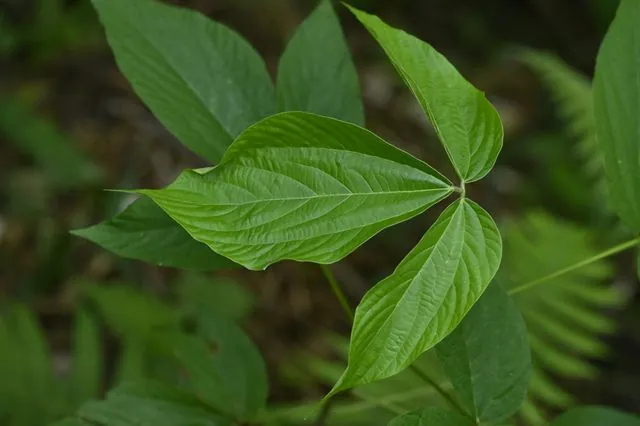
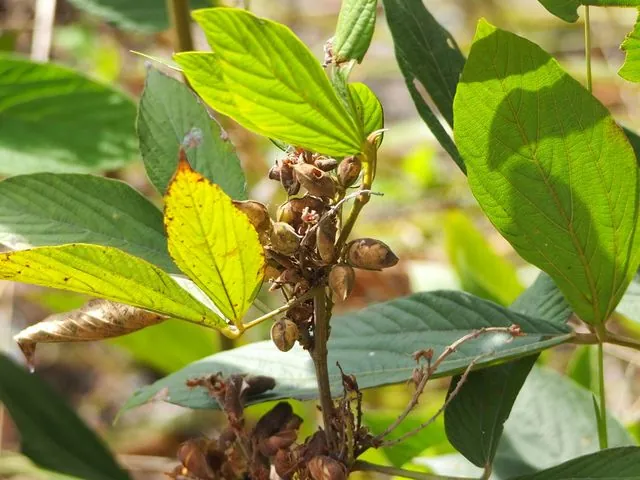
Flemingia macrophylla
Authorship: The author or authors credited with publishing the scientific name. It is written after the name, sometimes with the year, for example L. (Linnaeus) in Zea mays L. An author in parentheses first published the name in another genus or rank. — The author or authors credited with publishing the scientific name. It is written after the name, sometimes with the year, for example L. (Linnaeus) in Zea mays L. An author in parentheses first published the name in another genus or rank.
(Willd.) Kuntze ex Merr.
Common names
FlemingiaNames in other languages (10)Flémingie à grandes feuilles, enoki-mame, 大叶千斤拔, 大葉佛來明豆, 寬葉千斤拔, 绣叶千斤拔, 蚌壳草根, 鏽毛千斤拔, 铁龙穿石, 雲南千斤拔
Kingdom: One of the broadest ranks of biological classification. It groups organisms that share very basic features, for example plants (Plantae), animals (Animalia) or fungi (Fungi). — One of the broadest ranks of biological classification. It groups organisms that share very basic features, for example plants (Plantae), animals (Animalia) or fungi (Fungi).
Plantae
Phylum: Rank below kingdom that groups organisms with a shared general body plan, for example chordates (Chordata), arthropods (Arthropoda) or vascular plants (Tracheophyta). In botany the same rank is also called division. — Rank below kingdom that groups organisms with a shared general body plan, for example chordates (Chordata), arthropods (Arthropoda) or vascular plants (Tracheophyta). In botany the same rank is also called division.
Tracheophyta
Class: Rank below phylum, for example mammals (Mammalia), birds (Aves), insects (Insecta) or monocot plants such as grasses and orchids (Liliopsida). — Rank below phylum, for example mammals (Mammalia), birds (Aves), insects (Insecta) or monocot plants such as grasses and orchids (Liliopsida).
Magnoliopsida
Order: Rank below class that groups related families, for example grasses and their relatives (Poales) or bats (Chiroptera). — Rank below class that groups related families, for example grasses and their relatives (Poales) or bats (Chiroptera).
Fabales
Family: Rank below order that groups related genera. Family names usually end in -aceae in botany (for example Poaceae, the grass family) and in -idae in zoology (for example Felidae, the cat family). — Rank below order that groups related genera. Family names usually end in -aceae in botany (for example Poaceae, the grass family) and in -idae in zoology (for example Felidae, the cat family).
Fabaceae
Genus: Rank that groups closely related species. Its name is the first word of a species' scientific name and starts with a capital letter, for example Zea in Zea mays. — Rank that groups closely related species. Its name is the first word of a species' scientific name and starts with a capital letter, for example Zea in Zea mays.
Flemingia
Specific epithet: The second word of a species' scientific name. On its own it does not name the species: it always goes with the genus, for example mays in Zea mays. — The second word of a species' scientific name. On its own it does not name the species: it always goes with the genus, for example mays in Zea mays.
macrophylla
Taxonomic rank: The level a name occupies in the hierarchy of biological classification, such as kingdom, family, genus, species or subspecies. — The level a name occupies in the hierarchy of biological classification, such as kingdom, family, genus, species or subspecies.
species
Reference species
Flemingia macrophylla
Taxonomic status: Whether the taxonomic catalogue the record comes from currently accepts this name for the organism, or treats it as a synonym of another accepted name or as doubtful. — Whether the taxonomic catalogue the record comes from currently accepts this name for the organism, or treats it as a synonym of another accepted name or as doubtful.
accepted name
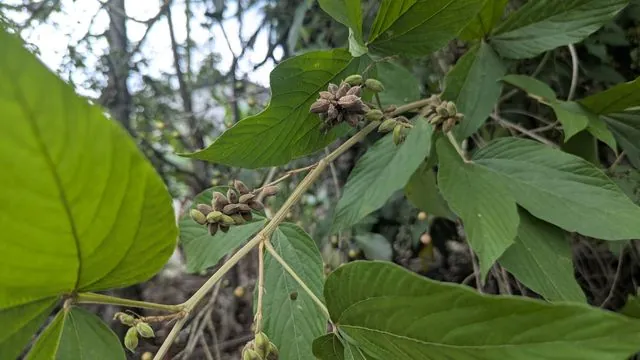
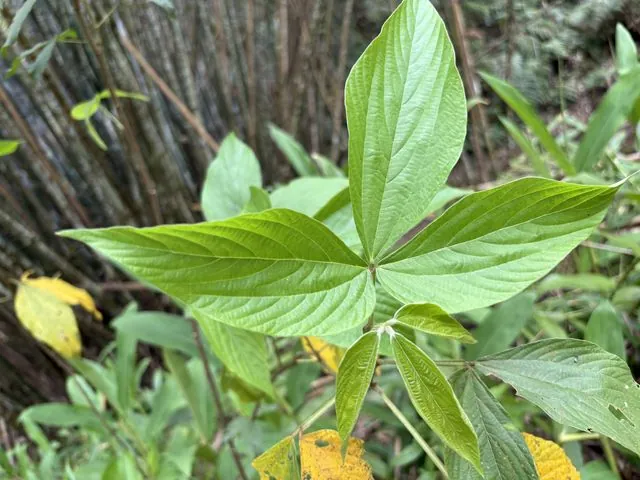
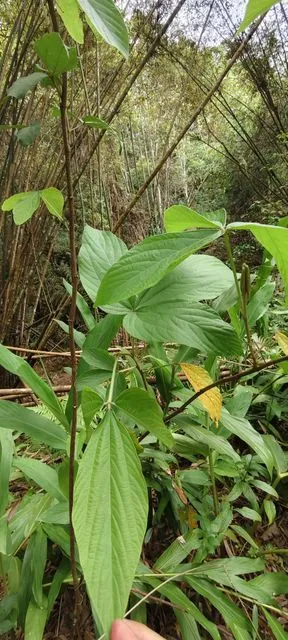
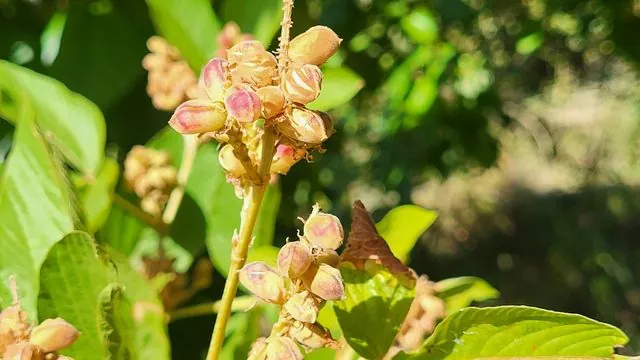
Photos and conservation status
IUCN Red List category: The extinction-risk category that the International Union for Conservation of Nature (IUCN) assigns to a species on its Red List. EX Extinct: there is no reasonable doubt that the last individual has died. EW Extinct in the wild: it survives only in cultivation, in captivity or as a population far outside its past range. CR Critically endangered, EN Endangered and VU Vulnerable: the three threatened categories, from an extremely high to a high risk of extinction in the wild. NT Near threatened: close to qualifying as threatened. LC Least concern: evaluated and not threatened. DD Data deficient: there is not enough information to assess its risk. NE Not evaluated: not yet assessed against the criteria. It describes the risk of the species worldwide, not its situation in a project's area. — The extinction-risk category that the International Union for Conservation of Nature (IUCN) assigns to a species on its Red List. EX Extinct: there is no reasonable doubt that the last individual has died. EW Extinct in the wild: it survives only in cultivation, in captivity or as a population far outside its past range. CR Critically endangered, EN Endangered and VU Vulnerable: the three threatened categories, from an extremely high to a high risk of extinction in the wild. NT Near threatened: close to qualifying as threatened. LC Least concern: evaluated and not threatened. DD Data deficient: there is not enough information to assess its risk. NE Not evaluated: not yet assessed against the criteria. It describes the risk of the species worldwide, not its situation in a project's area.
Not evaluated (NE)
Source: IUCN Red List via GBIF, queried on 2026-10-13 11:01.
Research-grade iNaturalist observations via GBIF, CC0 or CC BY licences only, queried on 2026-10-13 11:01.
Interacciones documentadas
GloBI says it is documented somewhere in the world. Biolitica answers whether it could happen here.
A documented interaction means it was recorded somewhere in the world. It does not mean it occurs here.
Types shown: 4 of 4
is a host of
×
interacts with
×
has as a parasite
×
is eaten by
×
Blocks that do not sit under a navigation concept heading keep the source's own term: no navigation concept has been assigned to them yet.
is a host of
34 organisms
The authority declares no effect on this species for this term: neither that it harms it nor that it benefits it. In the source ontology symbiosis covers mutualism, commensalism and parasitism alike, so this block holds attackers and allies side by side.
Teodoro, N.G.. 1937. An Enumeration of Philippine Fungi. Techn. Bull. Dept. Agric. Comm. Manila 4:1-585
Published in globalbioticinteractions/usda-fungus-host
Context: Philippines · no date published
Claim type
Published relationship between two taxa
Version
GloBI 0.11
Reuse
This release publishes no reuse terms for this record.
Philippines · no date publishedWhere it is: line:hash://sha256/021a206a1459bcca7e251c73f5bd180fc3ac342a09c499855fe42e21fc09edcf!/interactions.tsv.gz!/L3937700
No public URL for this record
A published relationship says these two taxa were documented interacting. It does not say how often, or that it happens in this project's region.
Phyllachora flemingiaePhyllachoraceae
is a host of
4
no location
4 sources · 4 records
Pande, A., and Rao, V.G.. 1998. A Compendium Fungi on Legumes from India. Scientific Publishers (India), Jodhpur :188
Published in globalbioticinteractions/usda-fungus-host
Context: India · no date published
Claim type
Published relationship between two taxa
Version
GloBI 0.11
Reuse
This release publishes no reuse terms for this record.
India · no date publishedWhere it is: line:hash://sha256/021a206a1459bcca7e251c73f5bd180fc3ac342a09c499855fe42e21fc09edcf!/interactions.tsv.gz!/L3801844
No public URL for this record
Lenne, J. M.. 1990. World list of fungal diseases of tropical pasture species. Phytopathol. Pap. 31:1-162
Published in globalbioticinteractions/usda-fungus-host
Context: India · no date published
Claim type
Published relationship between two taxa
Version
GloBI 0.11
Reuse
This release publishes no reuse terms for this record.
India · no date publishedWhere it is: line:hash://sha256/021a206a1459bcca7e251c73f5bd180fc3ac342a09c499855fe42e21fc09edcf!/interactions.tsv.gz!/L4054981
No public URL for this record
Boa, E., and Lenn@e, J.. 1994. Diseases of Nitrogen Fixing Trees in Developing Countries. An annotated list. Natural Resources Inst., Kent, United Kingdom :82
Published in globalbioticinteractions/usda-fungus-host
Context: India · no date published
Claim type
Published relationship between two taxa
Version
GloBI 0.11
Reuse
This release publishes no reuse terms for this record.
India · no date publishedWhere it is: line:hash://sha256/021a206a1459bcca7e251c73f5bd180fc3ac342a09c499855fe42e21fc09edcf!/interactions.tsv.gz!/L4231048
No public URL for this record
Kamat, M.N., Seshadri, V.S., and Pande, A.A.. 1978. A monographic study of Indian species of %Phyllachora%. Univ. Agric. Sci., Hebbal Monogr. 4:1-100
Published in globalbioticinteractions/usda-fungus-host
Context: India · no date published
Claim type
Published relationship between two taxa
Version
GloBI 0.11
Reuse
This release publishes no reuse terms for this record.
India · no date publishedWhere it is: line:hash://sha256/021a206a1459bcca7e251c73f5bd180fc3ac342a09c499855fe42e21fc09edcf!/interactions.tsv.gz!/L4339732
No public URL for this record
A published relationship says these two taxa were documented interacting. It does not say how often, or that it happens in this project's region.
Meliola sp.Meliolaceae
is a host of
3
no location
Not a modelling unit: the source did not resolve a species — the name carries an open-nomenclature qualifier.
3 sources · 3 records
Lenne, J. M.. 1990. World list of fungal diseases of tropical pasture species. Phytopathol. Pap. 31:1-162
Published in globalbioticinteractions/usda-fungus-host
Context: Malaysia · no date published
Claim type
Published relationship between two taxa
Version
GloBI 0.11
Reuse
This release publishes no reuse terms for this record.
Malaysia · no date publishedWhere it is: line:hash://sha256/021a206a1459bcca7e251c73f5bd180fc3ac342a09c499855fe42e21fc09edcf!/interactions.tsv.gz!/L4061420
No public URL for this record
Turner, G.J.. 1971. Fungi and Plant Disease in Sarawak. Phytopathol. Pap. 13:1-55
Published in globalbioticinteractions/usda-fungus-host
Context: Malaysia · no date published
Claim type
Published relationship between two taxa
Version
GloBI 0.11
Reuse
This release publishes no reuse terms for this record.
Malaysia · no date publishedWhere it is: line:hash://sha256/021a206a1459bcca7e251c73f5bd180fc3ac342a09c499855fe42e21fc09edcf!/interactions.tsv.gz!/L4213443
No public URL for this record
Boa, E., and Lenn@e, J.. 1994. Diseases of Nitrogen Fixing Trees in Developing Countries. An annotated list. Natural Resources Inst., Kent, United Kingdom :82
Published in globalbioticinteractions/usda-fungus-host
Context: Malaysia · no date published
Claim type
Published relationship between two taxa
Version
GloBI 0.11
Reuse
This release publishes no reuse terms for this record.
Malaysia · no date publishedWhere it is: line:hash://sha256/021a206a1459bcca7e251c73f5bd180fc3ac342a09c499855fe42e21fc09edcf!/interactions.tsv.gz!/L4232929
No public URL for this record
A published relationship says these two taxa were documented interacting. It does not say how often, or that it happens in this project's region.
Phellinus noxiusHymenochaetaceae
is a host of
3
no location
3 sources · 3 records
Shaw, D.E.. 1984. Microorganisms in Papua New Guinea. Dept. Primary Ind., Res. Bull. 33:1-344
Published in globalbioticinteractions/usda-fungus-host
Context: Papua New Guinea · no date published
Claim type
Published relationship between two taxa
Version
GloBI 0.11
Reuse
This release publishes no reuse terms for this record.
Papua New Guinea · no date publishedWhere it is: line:hash://sha256/021a206a1459bcca7e251c73f5bd180fc3ac342a09c499855fe42e21fc09edcf!/interactions.tsv.gz!/L3799615
No public URL for this record
Lenne, J. M.. 1990. World list of fungal diseases of tropical pasture species. Phytopathol. Pap. 31:1-162
Published in globalbioticinteractions/usda-fungus-host
Context: New Guinea · no date published
Claim type
Published relationship between two taxa
Version
GloBI 0.11
Reuse
This release publishes no reuse terms for this record.
New Guinea · no date publishedWhere it is: line:hash://sha256/021a206a1459bcca7e251c73f5bd180fc3ac342a09c499855fe42e21fc09edcf!/interactions.tsv.gz!/L4062212
No public URL for this record
Boa, E., and Lenn@e, J.. 1994. Diseases of Nitrogen Fixing Trees in Developing Countries. An annotated list. Natural Resources Inst., Kent, United Kingdom :82
Published in globalbioticinteractions/usda-fungus-host
Context: Papua New Guinea · no date published
Claim type
Published relationship between two taxa
Version
GloBI 0.11
Reuse
This release publishes no reuse terms for this record.
Papua New Guinea · no date publishedWhere it is: line:hash://sha256/021a206a1459bcca7e251c73f5bd180fc3ac342a09c499855fe42e21fc09edcf!/interactions.tsv.gz!/L4233037
No public URL for this record
A published relationship says these two taxa were documented interacting. It does not say how often, or that it happens in this project's region.
The authority declares no effect on this species for this term: neither that it harms it nor that it benefits it.
Organism
Reads as
Studies
Where it was documented
Actions
WaspTrichogramma chilonisTrichogrammatidae
interacts with
2
no location
2 sources · 2 records
Bhattacharya, A., Mishra, Y.D., Sushil, S.N., Jaiswal, A.K. & Kumar, K.K. (2003) Relative efficacy of some <i>Trichogramma</i> spp. for management of lepidopteran predators of lac insect, <i>Kerria lacca</i> (Kerr) under field conditions. <i>Biological control of lepidoptera…
Published in urn:lsid:checklistbank.org:dataset:124661
Context: no place published · no date published
Claim type
Published relationship between two taxa
Version
GloBI 0.11
Reuse
This release publishes no reuse terms for this record.
no place published · no date publishedWhere it is: line:hash://sha256/021a206a1459bcca7e251c73f5bd180fc3ac342a09c499855fe42e21fc09edcf!/interactions.tsv.gz!/L1261243
No public URL for this record
@article{54157, author = {Bhattacharya, A. and Mishra, Y.D. and Sushil, S.N. and Jaiswal, A.K. and Kumar, K.K.}, booktitle = {Biological control of lepidopteran pests. Proceedings of the Symposium of Biological Control of Lepidopteran Pests, July 17-18, 2002, Bangalore, Indi…
Published in globalbioticinteractions/taxonworks
Context: no place published · no date published
Claim type
Published relationship between two taxa
Version
GloBI 0.11
Reuse
This release publishes no reuse terms for this record.
no place published · no date publishedWhere it is: line:hash://sha256/021a206a1459bcca7e251c73f5bd180fc3ac342a09c499855fe42e21fc09edcf!/interactions.tsv.gz!/L6103638
No public URL for this record
A published relationship says these two taxa were documented interacting. It does not say how often, or that it happens in this project's region.
Tanaostigmodes cajaninaeTanaostigmatidae
interacts with
2
no location
2 sources · 2 records
Rameshwar Rao, V., Sithanantham, S., Remanandan, P. & Reed, W. (1987) Additional host-plant records for the <i>Tanaostigmodes cajaninae</i>, the hymenopteran pest of pigeonpea. <i>International Pigeonpea Newsletter</i>, 1987(6), 69–70.
Published in urn:lsid:checklistbank.org:dataset:124661
Context: no place published · no date published
Claim type
Published relationship between two taxa
Version
GloBI 0.11
Reuse
This release publishes no reuse terms for this record.
no place published · no date publishedWhere it is: line:hash://sha256/021a206a1459bcca7e251c73f5bd180fc3ac342a09c499855fe42e21fc09edcf!/interactions.tsv.gz!/L1257639
No public URL for this record
@article{89155, author = {Rameshwar Rao, V. and Sithanantham, S. and Remanandan, P. and Reed, W.}, booktitle = {International Pigeonpea Newsletter}, pages = {69-70}, title = {Additional host-plant records for the <i>Tanaostigmodes cajaninae</i>, the hymenopteran pest of …
Published in globalbioticinteractions/taxonworks
Context: no place published · no date published
Claim type
Published relationship between two taxa
Version
GloBI 0.11
Reuse
This release publishes no reuse terms for this record.
no place published · no date publishedWhere it is: line:hash://sha256/021a206a1459bcca7e251c73f5bd180fc3ac342a09c499855fe42e21fc09edcf!/interactions.tsv.gz!/L6042545
No public URL for this record
A published relationship says these two taxa were documented interacting. It does not say how often, or that it happens in this project's region.
Cocoa Tussock MothOrgyia posticaErebidae
interacts with
1
not compared
1 source · 1 record
https://www.inaturalist.org/observations/33115756
Published in globalbioticinteractions/inaturalist
Context: no place published · Sept. 19, 2019 · Human observation
Claim type
Published relationship between two taxa
Version
GloBI 0.11
Reuse
This release publishes no reuse terms for this record.
no place published · Sept. 19, 2019 · Human observationAs published: 2019-09-19T23:13:00Z · HumanObservationWhere it is: line:hash://sha256/021a206a1459bcca7e251c73f5bd180fc3ac342a09c499855fe42e21fc09edcf!/interactions.tsv.gz!/L5175089
A published relationship says these two taxa were documented interacting. It does not say how often, or that it happens in this project's region.
PediobiusEulophidae
interacts with
1
no location
Not a modelling unit: the source publishes it at genus level.
1 source · 1 record
@article{91518, author = {Sah, B.N. and Mehra, B.P.}, booktitle = {Indian Journal of Entomology}, journal = {Indian Journal of Entomology}, month = {mar}, day = {31}, pages = {442-447}, title = {Bionomics of <i>Nephropteryx leucophaella</i> Zell. (Lepidoptera: Pyra…
Published in globalbioticinteractions/taxonworks
Context: no place published · no date published
Claim type
Published relationship between two taxa
Version
GloBI 0.11
Reuse
This release publishes no reuse terms for this record.
no place published · no date publishedWhere it is: line:hash://sha256/021a206a1459bcca7e251c73f5bd180fc3ac342a09c499855fe42e21fc09edcf!/interactions.tsv.gz!/L5964047
No public URL for this record
A published relationship says these two taxa were documented interacting. It does not say how often, or that it happens in this project's region.
This term does declare that the organism harms this species.
Organism
Reads as
Studies
Where it was documented
Actions
Tanaostigmodes cajaninaeTanaostigmatidae
has as a parasite
1
no location
1 source · 1 record
RameshSiRe987 via Universal Chalcidoidea Database
Published in globalbioticinteractions/natural-history-museum-london-interactions-bank
Context: no place published · no date published
Claim type
Published relationship between two taxa
Version
GloBI 0.11
Reuse
This release publishes no reuse terms for this record.
no place published · no date publishedWhere it is: line:hash://sha256/021a206a1459bcca7e251c73f5bd180fc3ac342a09c499855fe42e21fc09edcf!/interactions.tsv.gz!/L18936436
No public URL for this record
A published relationship says these two taxa were documented interacting. It does not say how often, or that it happens in this project's region.
Trichogramma pretiosumTrichogrammatidae
has as a parasite
1
no location
1 source · 1 record
BhattaMiSu2003 via Universal Chalcidoidea Database
Published in globalbioticinteractions/natural-history-museum-london-interactions-bank
Context: no place published · no date published
Claim type
Published relationship between two taxa
Version
GloBI 0.11
Reuse
This release publishes no reuse terms for this record.
no place published · no date publishedWhere it is: line:hash://sha256/021a206a1459bcca7e251c73f5bd180fc3ac342a09c499855fe42e21fc09edcf!/interactions.tsv.gz!/L18853521
No public URL for this record
A published relationship says these two taxa were documented interacting. It does not say how often, or that it happens in this project's region.
WaspTrichogramma chilonisTrichogrammatidae
has as a parasite
1
no location
1 source · 1 record
BhattaMiSu2003 via Universal Chalcidoidea Database
Published in globalbioticinteractions/natural-history-museum-london-interactions-bank
Context: no place published · no date published
Claim type
Published relationship between two taxa
Version
GloBI 0.11
Reuse
This release publishes no reuse terms for this record.
no place published · no date publishedWhere it is: line:hash://sha256/021a206a1459bcca7e251c73f5bd180fc3ac342a09c499855fe42e21fc09edcf!/interactions.tsv.gz!/L18853523
No public URL for this record
A published relationship says these two taxa were documented interacting. It does not say how often, or that it happens in this project's region.
PediobiusEulophidae
has as a parasite
1
no location
Not a modelling unit: the source publishes it at genus level.
1 source · 1 record
SahMe967 via Universal Chalcidoidea Database
Published in globalbioticinteractions/natural-history-museum-london-interactions-bank
Context: no place published · no date published
Claim type
Published relationship between two taxa
Version
GloBI 0.11
Reuse
This release publishes no reuse terms for this record.
no place published · no date publishedWhere it is: line:hash://sha256/021a206a1459bcca7e251c73f5bd180fc3ac342a09c499855fe42e21fc09edcf!/interactions.tsv.gz!/L18882350
No public URL for this record
A published relationship says these two taxa were documented interacting. It does not say how often, or that it happens in this project's region.
This term does declare that the organism harms this species.
Organism
Reads as
Studies
Where it was documented
Actions
Red Costate Tiger MothAloa lactineaErebidae
is eaten by
2
no location
2 sources · 3 records
Kunimi, Y. 1993. A list of insect diseases of Japanese insects. In Iwahana H., Okada M., Kunimi Y., and Shimazu M. [eds.], Manual for the Research on Insect Pathogens. Nihon Shokubutuboeki-kyoukai, Tokyo, p222.; Dongrui, L., Yuneng, C., Daiyue, L., Qilin, Z., Yuanyang, H., Huaju…
Published in millerse/Ecological-Database-of-the-World-s-Insect-Pathogens
Record contexts (sample): China · no date published; Japan · no date published
Claim type
Published relationship between two taxa
Version
GloBI 0.11
Reuse
This release publishes no reuse terms for this record.
China · no date publishedWhere it is: line:hash://sha256/021a206a1459bcca7e251c73f5bd180fc3ac342a09c499855fe42e21fc09edcf!/interactions.tsv.gz!/L191439
Japan · no date publishedWhere it is: line:hash://sha256/021a206a1459bcca7e251c73f5bd180fc3ac342a09c499855fe42e21fc09edcf!/interactions.tsv.gz!/L191445
No public URL for this record
Kunimi, Y. 1993. A list of insect diseases of Japanese insects. In Iwahana H., Okada M., Kunimi Y., and Shimazu M. [eds.], Manual for the Research on Insect Pathogens. Nihon Shokubutuboeki-kyoukai, Tokyo, p222.
Published in millerse/Ecological-Database-of-the-World-s-Insect-Pathogens
Context: Japan · no date published
Claim type
Published relationship between two taxa
Version
GloBI 0.11
Reuse
This release publishes no reuse terms for this record.
Japan · no date publishedWhere it is: line:hash://sha256/021a206a1459bcca7e251c73f5bd180fc3ac342a09c499855fe42e21fc09edcf!/interactions.tsv.gz!/L173300
No public URL for this record
A published relationship says these two taxa were documented interacting. It does not say how often, or that it happens in this project's region.
Brown Tussock MothOlene mendosaErebidae
is eaten by
1
no location
1 source · 1 record
Martignoni, M.E. and Iwai, P.J. A catalogue of viral diseases of insects, mites and ticks. Appendix 2 [pp. 899-912] In, H.D. Burges (ed.) Microbial Control of Pests and Plant Diseases, 1970-1980. London: Academic Press, 1981. 949 pp.
Published in millerse/Ecological-Database-of-the-World-s-Insect-Pathogens
Context: no place published · no date published
Claim type
Published relationship between two taxa
Version
GloBI 0.11
Reuse
This release publishes no reuse terms for this record.
no place published · no date publishedWhere it is: line:hash://sha256/021a206a1459bcca7e251c73f5bd180fc3ac342a09c499855fe42e21fc09edcf!/interactions.tsv.gz!/L189891
No public URL for this record
A published relationship says these two taxa were documented interacting. It does not say how often, or that it happens in this project's region.
Mango Flower WebwormDudua aprobolaTortricidae
is eaten by
1
no location
1 source · 1 record
Edward Baker; Ian Kitching; George W Beccaloni; Amoret Whitaker; Steen Dupont; Vincent Smith; John S Noyes (2017). NHM Interactions Bank. https://doi.org/10.5519/0060767. Accessed at <https://data.nhm.ac.uk/dataset/82e807f0-6273-4f19-be0a-7f7558442a25/resource/f84ad9f1-bd0c-4811…
Published in globalbioticinteractions/natural-history-museum-london-interactions-bank
Context: no place published · no date published
Claim type
Published relationship between two taxa
Version
GloBI 0.11
Reuse
This release publishes no reuse terms for this record.
no place published · no date publishedWhere it is: line:hash://sha256/021a206a1459bcca7e251c73f5bd180fc3ac342a09c499855fe42e21fc09edcf!/interactions.tsv.gz!/L18753268
A published relationship says these two taxa were documented interacting. It does not say how often, or that it happens in this project's region.
Showing 3 of 3, by number of studies
Acompañantes documentados
This agronomic reading comes from a source reserved for internal use, so it is not shown here.
Documented uses and recommendations
Uses and recommendations that a source documents for this species beside a crop, each in its own context. They are the source's statements, not traits of the species and not Biolítica's recommendations, and none of them is a relation between two species.
Among the sources you can read, none documents a use or recommendation of this species beside a crop.