Canonical name: The scientific name without its authorship or date, for example Zea mays instead of Zea mays L. — The scientific name without its authorship or date, for example Zea mays instead of Zea mays L.
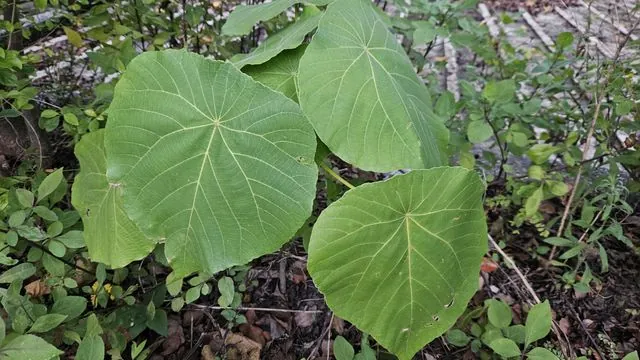
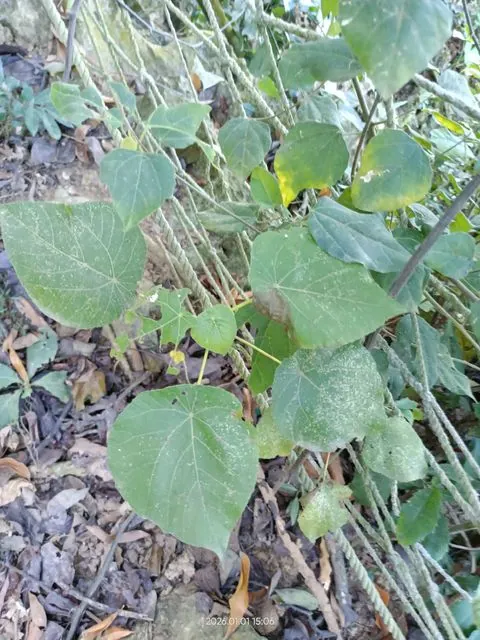
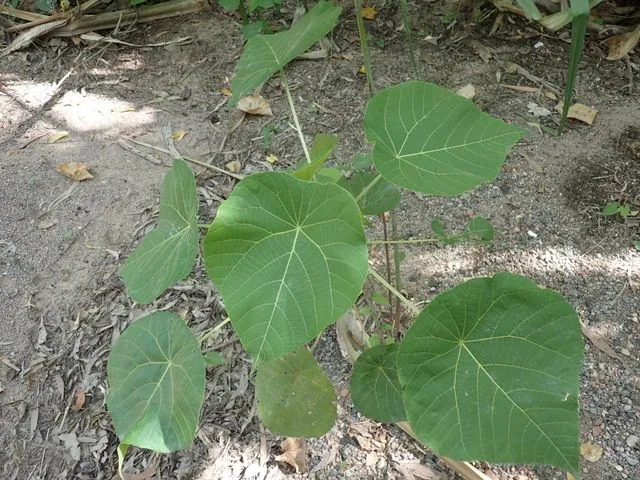
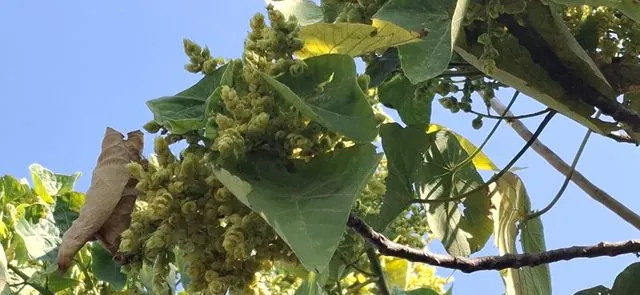
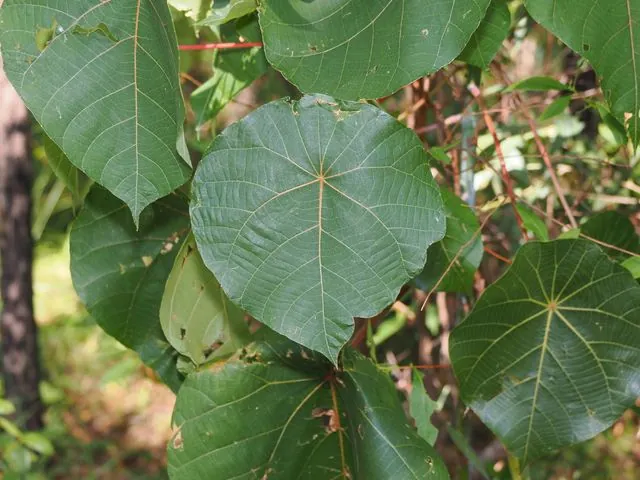
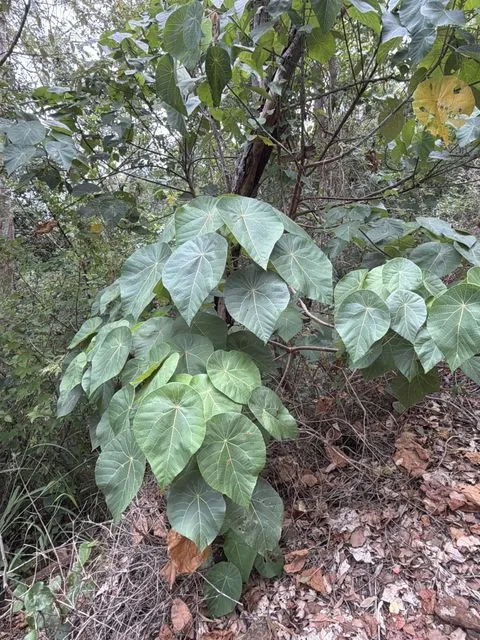
Macaranga tanarius
Authorship: The author or authors credited with publishing the scientific name. It is written after the name, sometimes with the year, for example L. (Linnaeus) in Zea mays L. An author in parentheses first published the name in another genus or rank. — The author or authors credited with publishing the scientific name. It is written after the name, sometimes with the year, for example L. (Linnaeus) in Zea mays L. An author in parentheses first published the name in another genus or rank.
(L.) Müll.Arg.
Common names
Elephant's Ear, Macaranga, Parasol Leaf Tree, bingabing, blush macaranga, david's-heart, hairy-mahogany, heartleaf, nasturtium-tree, parasol-leaf-treeNames in other languages (10)Binunga, Mara, makaranga trieslovinová, Макаранга дубильная, เม็ก, オオバキ, オオバギ, 橙桐, 流血樹, 血桐
Kingdom: One of the broadest ranks of biological classification. It groups organisms that share very basic features, for example plants (Plantae), animals (Animalia) or fungi (Fungi). — One of the broadest ranks of biological classification. It groups organisms that share very basic features, for example plants (Plantae), animals (Animalia) or fungi (Fungi).
Plantae
Phylum: Rank below kingdom that groups organisms with a shared general body plan, for example chordates (Chordata), arthropods (Arthropoda) or vascular plants (Tracheophyta). In botany the same rank is also called division. — Rank below kingdom that groups organisms with a shared general body plan, for example chordates (Chordata), arthropods (Arthropoda) or vascular plants (Tracheophyta). In botany the same rank is also called division.
Tracheophyta
Class: Rank below phylum, for example mammals (Mammalia), birds (Aves), insects (Insecta) or monocot plants such as grasses and orchids (Liliopsida). — Rank below phylum, for example mammals (Mammalia), birds (Aves), insects (Insecta) or monocot plants such as grasses and orchids (Liliopsida).
Magnoliopsida
Order: Rank below class that groups related families, for example grasses and their relatives (Poales) or bats (Chiroptera). — Rank below class that groups related families, for example grasses and their relatives (Poales) or bats (Chiroptera).
Malpighiales
Family: Rank below order that groups related genera. Family names usually end in -aceae in botany (for example Poaceae, the grass family) and in -idae in zoology (for example Felidae, the cat family). — Rank below order that groups related genera. Family names usually end in -aceae in botany (for example Poaceae, the grass family) and in -idae in zoology (for example Felidae, the cat family).
Euphorbiaceae
Genus: Rank that groups closely related species. Its name is the first word of a species' scientific name and starts with a capital letter, for example Zea in Zea mays. — Rank that groups closely related species. Its name is the first word of a species' scientific name and starts with a capital letter, for example Zea in Zea mays.
Macaranga
Specific epithet: The second word of a species' scientific name. On its own it does not name the species: it always goes with the genus, for example mays in Zea mays. — The second word of a species' scientific name. On its own it does not name the species: it always goes with the genus, for example mays in Zea mays.
tanarius
Taxonomic rank: The level a name occupies in the hierarchy of biological classification, such as kingdom, family, genus, species or subspecies. — The level a name occupies in the hierarchy of biological classification, such as kingdom, family, genus, species or subspecies.
species
Reference species
Macaranga tanarius
Taxonomic status: Whether the taxonomic catalogue the record comes from currently accepts this name for the organism, or treats it as a synonym of another accepted name or as doubtful. — Whether the taxonomic catalogue the record comes from currently accepts this name for the organism, or treats it as a synonym of another accepted name or as doubtful.
accepted name
Photos and conservation status
IUCN Red List category: The extinction-risk category that the International Union for Conservation of Nature (IUCN) assigns to a species on its Red List. EX Extinct: there is no reasonable doubt that the last individual has died. EW Extinct in the wild: it survives only in cultivation, in captivity or as a population far outside its past range. CR Critically endangered, EN Endangered and VU Vulnerable: the three threatened categories, from an extremely high to a high risk of extinction in the wild. NT Near threatened: close to qualifying as threatened. LC Least concern: evaluated and not threatened. DD Data deficient: there is not enough information to assess its risk. NE Not evaluated: not yet assessed against the criteria. It describes the risk of the species worldwide, not its situation in a project's area. — The extinction-risk category that the International Union for Conservation of Nature (IUCN) assigns to a species on its Red List. EX Extinct: there is no reasonable doubt that the last individual has died. EW Extinct in the wild: it survives only in cultivation, in captivity or as a population far outside its past range. CR Critically endangered, EN Endangered and VU Vulnerable: the three threatened categories, from an extremely high to a high risk of extinction in the wild. NT Near threatened: close to qualifying as threatened. LC Least concern: evaluated and not threatened. DD Data deficient: there is not enough information to assess its risk. NE Not evaluated: not yet assessed against the criteria. It describes the risk of the species worldwide, not its situation in a project's area.
Least concern (LC)
Source: IUCN Red List via GBIF, queried on 2026-10-13 11:06.
Research-grade iNaturalist observations via GBIF, CC0 or CC BY licences only, queried on 2026-10-13 11:06.
Interacciones documentadas
GloBI says it is documented somewhere in the world. Biolitica answers whether it could happen here.
A documented interaction means it was recorded somewhere in the world. It does not mean it occurs here.
Types shown: 5 of 5
is eaten by
×
is a host of
×
interacts with
×
is dispersed by
×
has as a vector
×
Blocks that do not sit under a navigation concept heading keep the source's own term: no navigation concept has been assigned to them yet.
is eaten by
81 organisms
This term does declare that the organism harms this species.
Organism
Reads as
Studies
Where it was documented
Actions
Black-naped OrioleOriolus chinensisOriolidae
is eaten by
3
not compared
3 sources · 3 records
M_SD_013
Published in globalbioticinteractions/fricke2020
Context: Philippines · no date published
Claim type
Published relationship between two taxa
Version
GloBI 0.11
Reuse
This release publishes no reuse terms for this record.
Philippines · no date publishedWhere it is: line:hash://sha256/021a206a1459bcca7e251c73f5bd180fc3ac342a09c499855fe42e21fc09edcf!/interactions.tsv.gz!/L13268024
No public URL for this record
KITA mammals added
Published in globalbioticinteractions/fricke2020
Context: Thailand · no date published
Claim type
Published relationship between two taxa
Version
GloBI 0.11
Reuse
This release publishes no reuse terms for this record.
Thailand · no date publishedWhere it is: line:hash://sha256/021a206a1459bcca7e251c73f5bd180fc3ac342a09c499855fe42e21fc09edcf!/interactions.tsv.gz!/L13298464
No public URL for this record
Hamman, A. Curio, E. 1999. Interactions among Frugivores and Fleshy Fruit Trees in a Philippine Submontane Rainforest. Conservation Biology, Vol . 13. No. 4. pp. 766-773
Published in fgabriel1891/Plant-Frugivore-Interactions-SouthEastAsia
Context: Patag, Silay City, Philipines · no date published
Claim type
Published relationship between two taxa
Version
GloBI 0.11
Reuse
This release publishes no reuse terms for this record.
Patag, Silay City, Philipines · no date publishedWhere it is: line:hash://sha256/021a206a1459bcca7e251c73f5bd180fc3ac342a09c499855fe42e21fc09edcf!/interactions.tsv.gz!/L2183044
This release publishes no reuse terms for this record.
Philippines · no date publishedWhere it is: line:hash://sha256/021a206a1459bcca7e251c73f5bd180fc3ac342a09c499855fe42e21fc09edcf!/interactions.tsv.gz!/L13268225
No public URL for this record
Hamman, A. Curio, E. 1999. Interactions among Frugivores and Fleshy Fruit Trees in a Philippine Submontane Rainforest. Conservation Biology, Vol . 13. No. 4. pp. 766-773
Published in fgabriel1891/Plant-Frugivore-Interactions-SouthEastAsia
Context: Patag, Silay City, Philipines · no date published
Claim type
Published relationship between two taxa
Version
GloBI 0.11
Reuse
This release publishes no reuse terms for this record.
Patag, Silay City, Philipines · no date publishedWhere it is: line:hash://sha256/021a206a1459bcca7e251c73f5bd180fc3ac342a09c499855fe42e21fc09edcf!/interactions.tsv.gz!/L2183035
This release publishes no reuse terms for this record.
Thailand · no date publishedWhere it is: line:hash://sha256/021a206a1459bcca7e251c73f5bd180fc3ac342a09c499855fe42e21fc09edcf!/interactions.tsv.gz!/L13298140
No public URL for this record
Kitamura, S. Yumoto, T. Poonswad, P. Chuailua, P. Plongmai, K. Noma, N. Maruhashi, T. Wohandee, P. 2005. Fruit-frugivore interactions in a moist evergreen forest of Khao Yai National Park in Thailand. TROPICS. Vol 14 (4).
Published in fgabriel1891/Plant-Frugivore-Interactions-SouthEastAsia
Context: Khao Yai National Park, Thailand · no date published
Claim type
Published relationship between two taxa
Version
GloBI 0.11
Reuse
This release publishes no reuse terms for this record.
Khao Yai National Park, Thailand · no date publishedWhere it is: line:hash://sha256/021a206a1459bcca7e251c73f5bd180fc3ac342a09c499855fe42e21fc09edcf!/interactions.tsv.gz!/L2183314
This release publishes no reuse terms for this record.
Philippines · no date publishedWhere it is: line:hash://sha256/021a206a1459bcca7e251c73f5bd180fc3ac342a09c499855fe42e21fc09edcf!/interactions.tsv.gz!/L13268161
No public URL for this record
Hamman, A. Curio, E. 1999. Interactions among Frugivores and Fleshy Fruit Trees in a Philippine Submontane Rainforest. Conservation Biology, Vol . 13. No. 4. pp. 766-773
Published in fgabriel1891/Plant-Frugivore-Interactions-SouthEastAsia
Context: Patag, Silay City, Philipines · no date published
Claim type
Published relationship between two taxa
Version
GloBI 0.11
Reuse
This release publishes no reuse terms for this record.
Patag, Silay City, Philipines · no date publishedWhere it is: line:hash://sha256/021a206a1459bcca7e251c73f5bd180fc3ac342a09c499855fe42e21fc09edcf!/interactions.tsv.gz!/L2183098
The authority declares no effect on this species for this term: neither that it harms it nor that it benefits it. In the source ontology symbiosis covers mutualism, commensalism and parasitism alike, so this block holds attackers and allies side by side.
Teodoro, N.G.. 1937. An Enumeration of Philippine Fungi. Techn. Bull. Dept. Agric. Comm. Manila 4:1-585
Published in globalbioticinteractions/usda-fungus-host
Context: Philippines · no date published
Claim type
Published relationship between two taxa
Version
GloBI 0.11
Reuse
This release publishes no reuse terms for this record.
Philippines · no date publishedWhere it is: line:hash://sha256/021a206a1459bcca7e251c73f5bd180fc3ac342a09c499855fe42e21fc09edcf!/interactions.tsv.gz!/L3936841
No public URL for this record
Anonymous. 1979. List of plant diseases in Taiwan. Pl. Protect. Soc., Republ. of China :404
Published in globalbioticinteractions/usda-fungus-host
Context: Taiwan · no date published
Claim type
Published relationship between two taxa
Version
GloBI 0.11
Reuse
This release publishes no reuse terms for this record.
Taiwan · no date publishedWhere it is: line:hash://sha256/021a206a1459bcca7e251c73f5bd180fc3ac342a09c499855fe42e21fc09edcf!/interactions.tsv.gz!/L3998458
No public URL for this record
Pollack, F.G.. 1987. An annotated compilation of %Cercospora% names. Mycol. Mem. 12:1-212
Published in globalbioticinteractions/usda-fungus-host
Context: Philippines · no date published
Claim type
Published relationship between two taxa
Version
GloBI 0.11
Reuse
This release publishes no reuse terms for this record.
Philippines · no date publishedWhere it is: line:hash://sha256/021a206a1459bcca7e251c73f5bd180fc3ac342a09c499855fe42e21fc09edcf!/interactions.tsv.gz!/L4043378
No public URL for this record
A published relationship says these two taxa were documented interacting. It does not say how often, or that it happens in this project's region.
Teodoro, N.G.. 1937. An Enumeration of Philippine Fungi. Techn. Bull. Dept. Agric. Comm. Manila 4:1-585
Published in globalbioticinteractions/usda-fungus-host
Context: Philippines · no date published
Claim type
Published relationship between two taxa
Version
GloBI 0.11
Reuse
This release publishes no reuse terms for this record.
Philippines · no date publishedWhere it is: line:hash://sha256/021a206a1459bcca7e251c73f5bd180fc3ac342a09c499855fe42e21fc09edcf!/interactions.tsv.gz!/L3937072
No public URL for this record
Batista, A.C., and Ciferri, R.. 1962. The Chaetothyriales. Beih. Sydowia 3:1-129
Published in globalbioticinteractions/usda-fungus-host
Context: Philippines · no date published
Claim type
Published relationship between two taxa
Version
GloBI 0.11
Reuse
This release publishes no reuse terms for this record.
Philippines · no date publishedWhere it is: line:hash://sha256/021a206a1459bcca7e251c73f5bd180fc3ac342a09c499855fe42e21fc09edcf!/interactions.tsv.gz!/L4170256
No public URL for this record
A published relationship says these two taxa were documented interacting. It does not say how often, or that it happens in this project's region.
Published in globalbioticinteractions/usda-fungus-host
Context: China · no date published
Claim type
Published relationship between two taxa
Version
GloBI 0.11
Reuse
This release publishes no reuse terms for this record.
China · no date publishedWhere it is: line:hash://sha256/021a206a1459bcca7e251c73f5bd180fc3ac342a09c499855fe42e21fc09edcf!/interactions.tsv.gz!/L3843992
No public URL for this record
Hsieh, W.-H., and Goh, T.-K.. 1990. %Cercospora% and Similar Fungi from Taiwan. Maw Chang Book Co., Taipei. :376
Published in globalbioticinteractions/usda-fungus-host
Context: Taiwan · no date published
Claim type
Published relationship between two taxa
Version
GloBI 0.11
Reuse
This release publishes no reuse terms for this record.
Taiwan · no date publishedWhere it is: line:hash://sha256/021a206a1459bcca7e251c73f5bd180fc3ac342a09c499855fe42e21fc09edcf!/interactions.tsv.gz!/L4214593
Published in globalbioticinteractions/usda-fungus-host
Context: China · no date published
Claim type
Published relationship between two taxa
Version
GloBI 0.11
Reuse
This release publishes no reuse terms for this record.
China · no date publishedWhere it is: line:hash://sha256/021a206a1459bcca7e251c73f5bd180fc3ac342a09c499855fe42e21fc09edcf!/interactions.tsv.gz!/L4224128
No public URL for this record
Deighton, F.C.. 1976. Studies on %Cercospora% and allied genera. VI. %Pseudocercospora% Speg., %Pantospora% Cif. and %Cercoseptoria% Petr.. Mycol. Pap. 140:1-168
Published in globalbioticinteractions/usda-fungus-host
Context: Philippines · no date published
Claim type
Published relationship between two taxa
Version
GloBI 0.11
Reuse
This release publishes no reuse terms for this record.
Philippines · no date publishedWhere it is: line:hash://sha256/021a206a1459bcca7e251c73f5bd180fc3ac342a09c499855fe42e21fc09edcf!/interactions.tsv.gz!/L4239369
No public URL for this record
A published relationship says these two taxa were documented interacting. It does not say how often, or that it happens in this project's region.
Context: Hawaii County, Keaau · March 3, 2015 · Material sample
Claim type
Published relationship between two taxa
Version
GloBI 0.11
Reuse
This release publishes no reuse terms for this record.
Hawaii County, Keaau · March 3, 2015 · Material sampleAs published: 2015-03-03T00:00:00Z · MATERIAL_SAMPLEWhere it is: line:hash://sha256/021a206a1459bcca7e251c73f5bd180fc3ac342a09c499855fe42e21fc09edcf!/interactions.tsv.gz!/L12988383
Context: Hawaii County, Keaau · Nov. 9, 2016 · Material sample
Claim type
Published relationship between two taxa
Version
GloBI 0.11
Reuse
This release publishes no reuse terms for this record.
Hawaii County, Keaau · Nov. 9, 2016 · Material sampleAs published: 2016-11-09T00:00:00Z · MATERIAL_SAMPLEWhere it is: line:hash://sha256/021a206a1459bcca7e251c73f5bd180fc3ac342a09c499855fe42e21fc09edcf!/interactions.tsv.gz!/L12988384
A published relationship says these two taxa were documented interacting. It does not say how often, or that it happens in this project's region.
Ryukyu Flying FoxPteropus dasymallusPteropodidae
interacts with
2
no location
2 sources · 2 records
Lee et al., 2009
Published in globalbioticinteractions/aziz2021
Context: Japan (Iriomotejima) · no date published
Claim type
Published relationship between two taxa
Version
GloBI 0.11
Reuse
This release publishes no reuse terms for this record.
Japan (Iriomotejima) · no date publishedWhere it is: line:hash://sha256/021a206a1459bcca7e251c73f5bd180fc3ac342a09c499855fe42e21fc09edcf!/interactions.tsv.gz!/L13005928
No public URL for this record
Nakamoto et al., 2007
Published in globalbioticinteractions/aziz2021
Context: Japan (Okinawa-jima) · no date published
Claim type
Published relationship between two taxa
Version
GloBI 0.11
Reuse
This release publishes no reuse terms for this record.
Japan (Okinawa-jima) · no date publishedWhere it is: line:hash://sha256/021a206a1459bcca7e251c73f5bd180fc3ac342a09c499855fe42e21fc09edcf!/interactions.tsv.gz!/L13006023
No public URL for this record
A published relationship says these two taxa were documented interacting. It does not say how often, or that it happens in this project's region.
Metanastria gemellaLasiocampidae
interacts with
2
not compared
2 sources · 3 records
https://www.inaturalist.org/observations/25492513
Published in globalbioticinteractions/inaturalist
Record contexts (sample): no place published · Feb. 14, 2019 · Human observation; no place published · Feb. 14, 2019 · Human observation
Claim type
Published relationship between two taxa
Version
GloBI 0.11
Reuse
This release publishes no reuse terms for this record.
no place published · Feb. 14, 2019 · Human observationAs published: 2019-02-14T02:44:00Z · HumanObservationWhere it is: line:hash://sha256/021a206a1459bcca7e251c73f5bd180fc3ac342a09c499855fe42e21fc09edcf!/interactions.tsv.gz!/L5014486
no place published · Feb. 14, 2019 · Human observationAs published: 2019-02-14T02:44:00Z · HumanObservationWhere it is: line:hash://sha256/021a206a1459bcca7e251c73f5bd180fc3ac342a09c499855fe42e21fc09edcf!/interactions.tsv.gz!/L5014487
Context: no place published · Sept. 24, 2018 · Human observation
Claim type
Published relationship between two taxa
Version
GloBI 0.11
Reuse
This release publishes no reuse terms for this record.
no place published · Sept. 24, 2018 · Human observationAs published: 2018-09-24T03:29:00Z · HumanObservationWhere it is: line:hash://sha256/021a206a1459bcca7e251c73f5bd180fc3ac342a09c499855fe42e21fc09edcf!/interactions.tsv.gz!/L4901163
Context: Los Banos College Farm · May 12, 1919 · Preserved specimen
Claim type
Published relationship between two taxa
Version
GloBI 0.11
Reuse
This release publishes no reuse terms for this record.
Los Banos College Farm · May 12, 1919 · Preserved specimenAs published: 1919-05-12T00:00:00Z · PreservedSpecimenWhere it is: line:hash://sha256/021a206a1459bcca7e251c73f5bd180fc3ac342a09c499855fe42e21fc09edcf!/interactions.tsv.gz!/L17101304
The authority declares no effect on this species for this term: neither that it harms it nor that it benefits it.
Organism
Reads as
Studies
Where it was documented
Actions
Black-naped OrioleOriolus chinensisOriolidae
is dispersed by
1
not compared
1 source · 1 record
Hammann, A. & Curio, B. (1999) Interactions among frugivores and fleshy fruit trees in a Philippine submontane rainforest.
Published in globalbioticinteractions/web-of-life
Context: no place published · no date published
Claim type
Published relationship between two taxa
Version
GloBI 0.11
Reuse
This release publishes no reuse terms for this record.
no place published · no date publishedWhere it is: line:hash://sha256/021a206a1459bcca7e251c73f5bd180fc3ac342a09c499855fe42e21fc09edcf!/interactions.tsv.gz!/L11454161
No public URL for this record
A published relationship says these two taxa were documented interacting. It does not say how often, or that it happens in this project's region.
Hammann, A. & Curio, B. (1999) Interactions among frugivores and fleshy fruit trees in a Philippine submontane rainforest.
Published in globalbioticinteractions/web-of-life
Context: no place published · no date published
Claim type
Published relationship between two taxa
Version
GloBI 0.11
Reuse
This release publishes no reuse terms for this record.
no place published · no date publishedWhere it is: line:hash://sha256/021a206a1459bcca7e251c73f5bd180fc3ac342a09c499855fe42e21fc09edcf!/interactions.tsv.gz!/L11454156
No public URL for this record
A published relationship says these two taxa were documented interacting. It does not say how often, or that it happens in this project's region.
Hammann, A. & Curio, B. (1999) Interactions among frugivores and fleshy fruit trees in a Philippine submontane rainforest.
Published in globalbioticinteractions/web-of-life
Context: no place published · no date published
Claim type
Published relationship between two taxa
Version
GloBI 0.11
Reuse
This release publishes no reuse terms for this record.
no place published · no date publishedWhere it is: line:hash://sha256/021a206a1459bcca7e251c73f5bd180fc3ac342a09c499855fe42e21fc09edcf!/interactions.tsv.gz!/L11454157
No public URL for this record
A published relationship says these two taxa were documented interacting. It does not say how often, or that it happens in this project's region.
Hammann, A. & Curio, B. (1999) Interactions among frugivores and fleshy fruit trees in a Philippine submontane rainforest.
Published in globalbioticinteractions/web-of-life
Context: no place published · no date published
Claim type
Published relationship between two taxa
Version
GloBI 0.11
Reuse
This release publishes no reuse terms for this record.
no place published · no date publishedWhere it is: line:hash://sha256/021a206a1459bcca7e251c73f5bd180fc3ac342a09c499855fe42e21fc09edcf!/interactions.tsv.gz!/L11454159
No public URL for this record
A published relationship says these two taxa were documented interacting. It does not say how often, or that it happens in this project's region.
The authority declares no effect on this species for this term: neither that it harms it nor that it benefits it.
Organism
Reads as
Studies
Where it was documented
Actions
birdsAves
has as a vector
2
no location
Not a modelling unit: the source publishes it at class level.
2 sources · 2 records
@Book{Cooper_2013, year = {2013}, author = {Wendy Cooper and William T. Cooper}, title = {{Australian rainforest fruits}}, publisher = {CSIRO Publishing}, pages = {272}, }
Published in globalbioticinteractions/austraits
Context: no place published · no date published · literature
Claim type
Published relationship between two taxa
Version
GloBI 0.11
Reuse
This release publishes no reuse terms for this record.
no place published · no date published · literatureAs published: literatureWhere it is: line:hash://sha256/021a206a1459bcca7e251c73f5bd180fc3ac342a09c499855fe42e21fc09edcf!/interactions.tsv.gz!/L13123111
No public URL for this record
@Thesis{Wells_2012, year = {2012}, author = {Jessie Anne Wells}, title = {{Phylogeny and inter-relations of ecological traits and seed dispersal in rainforest plants: Exploring aspects of functional diversity in primary and secondary rainforests in Australia's Wet Tropics.}}, ty…
Published in globalbioticinteractions/austraits
Context: no place published · Jan. 1, 2004 · literature
Claim type
Published relationship between two taxa
Version
GloBI 0.11
Reuse
This release publishes no reuse terms for this record.
no place published · Jan. 1, 2004 · literatureAs published: 2004-01-01T00:00:00Z · literatureWhere it is: line:hash://sha256/021a206a1459bcca7e251c73f5bd180fc3ac342a09c499855fe42e21fc09edcf!/interactions.tsv.gz!/L13129048
No public URL for this record
A published relationship says these two taxa were documented interacting. It does not say how often, or that it happens in this project's region.
Showing 1 of 1, by number of studies
Acompañantes documentados
This agronomic reading comes from a source reserved for internal use, so it is not shown here.
Documented uses and recommendations
Uses and recommendations that a source documents for this species beside a crop, each in its own context. They are the source's statements, not traits of the species and not Biolítica's recommendations, and none of them is a relation between two species.
Among the sources you can read, none documents a use or recommendation of this species beside a crop.