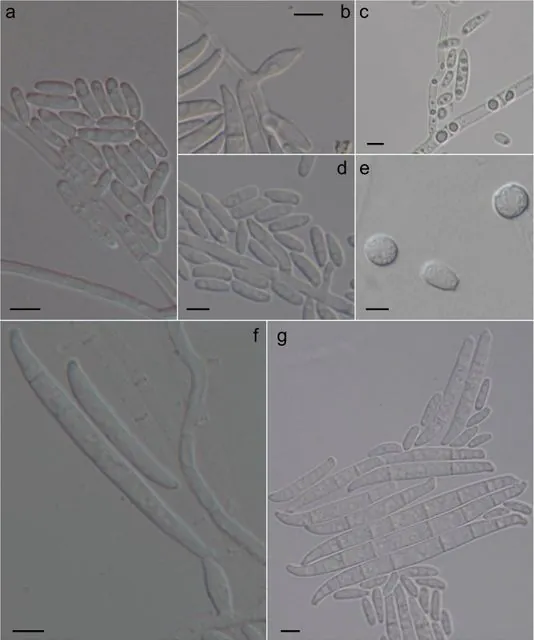
Canonical name: The scientific name without its authorship or date, for example Zea mays instead of Zea mays L. — The scientific name without its authorship or date, for example Zea mays instead of Zea mays L.
Fusarium oxysporum
Authorship: The author or authors credited with publishing the scientific name. It is written after the name, sometimes with the year, for example L. (Linnaeus) in Zea mays L. An author in parentheses first published the name in another genus or rank. — The author or authors credited with publishing the scientific name. It is written after the name, sometimes with the year, for example L. (Linnaeus) in Zea mays L. An author in parentheses first published the name in another genus or rank.
Schltdl.
Common names
Cucumber Fusarium, Fusarium wiltNames in other languages (9)Enfermedad de Panamá, Smailiasporis lielius, fusariosis, chancro del cuello, mal-do-panamá, srpovnička špičatovýtrusá, tvinsjuka, Çilek Kök Çürüğü, 尖鐮孢菌, 蘆筍分化型尖鐮孢菌
Kingdom: One of the broadest ranks of biological classification. It groups organisms that share very basic features, for example plants (Plantae), animals (Animalia) or fungi (Fungi). — One of the broadest ranks of biological classification. It groups organisms that share very basic features, for example plants (Plantae), animals (Animalia) or fungi (Fungi).
Fungi
Phylum: Rank below kingdom that groups organisms with a shared general body plan, for example chordates (Chordata), arthropods (Arthropoda) or vascular plants (Tracheophyta). In botany the same rank is also called division. — Rank below kingdom that groups organisms with a shared general body plan, for example chordates (Chordata), arthropods (Arthropoda) or vascular plants (Tracheophyta). In botany the same rank is also called division.
Ascomycota
Class: Rank below phylum, for example mammals (Mammalia), birds (Aves), insects (Insecta) or monocot plants such as grasses and orchids (Liliopsida). — Rank below phylum, for example mammals (Mammalia), birds (Aves), insects (Insecta) or monocot plants such as grasses and orchids (Liliopsida).
Sordariomycetes
Order: Rank below class that groups related families, for example grasses and their relatives (Poales) or bats (Chiroptera). — Rank below class that groups related families, for example grasses and their relatives (Poales) or bats (Chiroptera).
Hypocreales
Family: Rank below order that groups related genera. Family names usually end in -aceae in botany (for example Poaceae, the grass family) and in -idae in zoology (for example Felidae, the cat family). — Rank below order that groups related genera. Family names usually end in -aceae in botany (for example Poaceae, the grass family) and in -idae in zoology (for example Felidae, the cat family).
Nectriaceae
Genus: Rank that groups closely related species. Its name is the first word of a species' scientific name and starts with a capital letter, for example Zea in Zea mays. — Rank that groups closely related species. Its name is the first word of a species' scientific name and starts with a capital letter, for example Zea in Zea mays.
Fusarium
Specific epithet: The second word of a species' scientific name. On its own it does not name the species: it always goes with the genus, for example mays in Zea mays. — The second word of a species' scientific name. On its own it does not name the species: it always goes with the genus, for example mays in Zea mays.
oxysporum
Taxonomic rank: The level a name occupies in the hierarchy of biological classification, such as kingdom, family, genus, species or subspecies. — The level a name occupies in the hierarchy of biological classification, such as kingdom, family, genus, species or subspecies.
species
Reference species
Fusarium oxysporum
Taxonomic status: Whether the taxonomic catalogue the record comes from currently accepts this name for the organism, or treats it as a synonym of another accepted name or as doubtful. — Whether the taxonomic catalogue the record comes from currently accepts this name for the organism, or treats it as a synonym of another accepted name or as doubtful.
accepted name
Photos and conservation status
IUCN Red List category: The extinction-risk category that the International Union for Conservation of Nature (IUCN) assigns to a species on its Red List. EX Extinct: there is no reasonable doubt that the last individual has died. EW Extinct in the wild: it survives only in cultivation, in captivity or as a population far outside its past range. CR Critically endangered, EN Endangered and VU Vulnerable: the three threatened categories, from an extremely high to a high risk of extinction in the wild. NT Near threatened: close to qualifying as threatened. LC Least concern: evaluated and not threatened. DD Data deficient: there is not enough information to assess its risk. NE Not evaluated: not yet assessed against the criteria. It describes the risk of the species worldwide, not its situation in a project's area. — The extinction-risk category that the International Union for Conservation of Nature (IUCN) assigns to a species on its Red List. EX Extinct: there is no reasonable doubt that the last individual has died. EW Extinct in the wild: it survives only in cultivation, in captivity or as a population far outside its past range. CR Critically endangered, EN Endangered and VU Vulnerable: the three threatened categories, from an extremely high to a high risk of extinction in the wild. NT Near threatened: close to qualifying as threatened. LC Least concern: evaluated and not threatened. DD Data deficient: there is not enough information to assess its risk. NE Not evaluated: not yet assessed against the criteria. It describes the risk of the species worldwide, not its situation in a project's area.
Not evaluated (NE)
Source: IUCN Red List via GBIF, queried on 2026-10-22 09:47.
Research-grade iNaturalist observations via GBIF, CC0 or CC BY licences only, queried on 2026-10-22 09:47.
Interacciones documentadas
GloBI says it is documented somewhere in the world. Biolitica answers whether it could happen here.
A documented interaction means it was recorded somewhere in the world. It does not mean it occurs here.
Types shown: 5 of 5
has as a host
×
interacts with
×
is a symbiont of
×
is a host of
×
is a parasite of
×
Blocks that do not sit under a navigation concept heading keep the source's own term: no navigation concept has been assigned to them yet.
has as a host
51 organisms
The authority declares no effect on this species for this term: neither that it harms it nor that it benefits it. In the source ontology symbiosis covers mutualism, commensalism and parasitism alike, so this block holds attackers and allies side by side.
Organism
Reads as
Studies
Where it was documented
Actions
CornZea maysPoaceae
has as a host
46
no location
46 sources · 62 records
Hanlin, R.T., Foudin, L.L., Berisford, Y., Glover, S.U., Jones, J.P., and Huang, L.H.. 1978. Plant disease index for maize in the United States, Part I: Host index. Agric. Exp. Sta. Univ. Georgia Res. Rep. 277:1-62
Published in globalbioticinteractions/usda-fungus-host
Record contexts (sample): United States · no date published; United States · no date published
Claim type
Published relationship between two taxa
Version
GloBI 0.11
Reuse
This release publishes no reuse terms for this record.
United States · no date publishedWhere it is: line:hash://sha256/021a206a1459bcca7e251c73f5bd180fc3ac342a09c499855fe42e21fc09edcf!/interactions.tsv.gz!/L4006399
United States · no date publishedWhere it is: line:hash://sha256/021a206a1459bcca7e251c73f5bd180fc3ac342a09c499855fe42e21fc09edcf!/interactions.tsv.gz!/L4006404
United States · no date publishedWhere it is: line:hash://sha256/021a206a1459bcca7e251c73f5bd180fc3ac342a09c499855fe42e21fc09edcf!/interactions.tsv.gz!/L4006405
And 7 more records of this source, not listed here.
No public URL for this record
Sprague, R.. 1950. Diseases of Cereals and Grasses in North America. Ronald Press Company, New York :538
Published in globalbioticinteractions/usda-fungus-host
Record contexts (sample): United States · no date published; United States · no date published
Claim type
Published relationship between two taxa
Version
GloBI 0.11
Reuse
This release publishes no reuse terms for this record.
United States · no date publishedWhere it is: line:hash://sha256/021a206a1459bcca7e251c73f5bd180fc3ac342a09c499855fe42e21fc09edcf!/interactions.tsv.gz!/L3746290
United States · no date publishedWhere it is: line:hash://sha256/021a206a1459bcca7e251c73f5bd180fc3ac342a09c499855fe42e21fc09edcf!/interactions.tsv.gz!/L3746291
United States · no date publishedWhere it is: line:hash://sha256/021a206a1459bcca7e251c73f5bd180fc3ac342a09c499855fe42e21fc09edcf!/interactions.tsv.gz!/L3746300
And 5 more records of this source, not listed here.
Context: [not on label] · May 30, 1941 · Preserved specimen
Claim type
Published relationship between two taxa
Version
GloBI 0.11
Reuse
This release publishes no reuse terms for this record.
[not on label] · May 30, 1941 · Preserved specimenAs published: 1941-05-30T00:00:00Z · PreservedSpecimenWhere it is: line:hash://sha256/021a206a1459bcca7e251c73f5bd180fc3ac342a09c499855fe42e21fc09edcf!/interactions.tsv.gz!/L16631008
And 38 more sources, with fewer records, not listed here.
A published relationship says these two taxa were documented interacting. It does not say how often, or that it happens in this project's region.
Butter BeanPhaseolus vulgarisFabaceae
has as a host
19
not compared
19 sources · 25 records
McGuire Jr., J.U., and Crandall, B.S.. 1967. Survey of insect pests and plant diseases of selected food crops of Mexico, Central America and Panama. Int. Agric. Dev. Serv., ARS, USDA, AID :157
Published in globalbioticinteractions/usda-fungus-host
Record contexts (sample): Costa Rica · no date published; Panama · no date published
Claim type
Published relationship between two taxa
Version
GloBI 0.11
Reuse
This release publishes no reuse terms for this record.
Costa Rica · no date publishedWhere it is: line:hash://sha256/021a206a1459bcca7e251c73f5bd180fc3ac342a09c499855fe42e21fc09edcf!/interactions.tsv.gz!/L4020416
Panama · no date publishedWhere it is: line:hash://sha256/021a206a1459bcca7e251c73f5bd180fc3ac342a09c499855fe42e21fc09edcf!/interactions.tsv.gz!/L4020419
Nicaragua · no date publishedWhere it is: line:hash://sha256/021a206a1459bcca7e251c73f5bd180fc3ac342a09c499855fe42e21fc09edcf!/interactions.tsv.gz!/L4020421
And 3 more records of this source, not listed here.
No public URL for this record
Allen, D.J.. 1995. An annotated list of diseases, pathogens and associated fungi of the common bean (%Phaseolus vulgaris%) in eastern and southern Africa.. Phytopathol. Pap. 34:1-42
Published in globalbioticinteractions/usda-fungus-host
Record contexts (sample): Ethiopia · no date published; South Africa · no date published
Claim type
Published relationship between two taxa
Version
GloBI 0.11
Reuse
This release publishes no reuse terms for this record.
Ethiopia · no date publishedWhere it is: line:hash://sha256/021a206a1459bcca7e251c73f5bd180fc3ac342a09c499855fe42e21fc09edcf!/interactions.tsv.gz!/L4136077
South Africa · no date publishedWhere it is: line:hash://sha256/021a206a1459bcca7e251c73f5bd180fc3ac342a09c499855fe42e21fc09edcf!/interactions.tsv.gz!/L4136078
Context: Aylesford · Aug. 6, 1974 · Preserved specimen
Claim type
Published relationship between two taxa
Version
GloBI 0.11
Reuse
This release publishes no reuse terms for this record.
Aylesford · Aug. 6, 1974 · Preserved specimenAs published: 1974-08-06T00:00:00Z · PreservedSpecimenWhere it is: line:hash://sha256/021a206a1459bcca7e251c73f5bd180fc3ac342a09c499855fe42e21fc09edcf!/interactions.tsv.gz!/L16631056
Ginns, J.H.. 1986. Compendium of plant disease and decay fungi in Canada 1960-1980. Res. Br. Can. Agric. Publ. 1813:416
Published in globalbioticinteractions/usda-fungus-host
Context: Canada · no date published
Claim type
Published relationship between two taxa
Version
GloBI 0.11
Reuse
This release publishes no reuse terms for this record.
Canada · no date publishedWhere it is: line:hash://sha256/021a206a1459bcca7e251c73f5bd180fc3ac342a09c499855fe42e21fc09edcf!/interactions.tsv.gz!/L3786853
No public URL for this record
Pande, A., and Rao, V.G.. 1998. A Compendium Fungi on Legumes from India. Scientific Publishers (India), Jodhpur :188
Published in globalbioticinteractions/usda-fungus-host
Context: India · no date published
Claim type
Published relationship between two taxa
Version
GloBI 0.11
Reuse
This release publishes no reuse terms for this record.
India · no date publishedWhere it is: line:hash://sha256/021a206a1459bcca7e251c73f5bd180fc3ac342a09c499855fe42e21fc09edcf!/interactions.tsv.gz!/L3802698
No public URL for this record
Mendes, M.A.S., da Silva, V.L., Dianese, J.C., and et al.. 1998. Fungos em Plants no Brasil. Embrapa-SPI/Embrapa-Cenargen, Brasilia :555
Published in globalbioticinteractions/usda-fungus-host
Context: Brazil · no date published
Claim type
Published relationship between two taxa
Version
GloBI 0.11
Reuse
This release publishes no reuse terms for this record.
Brazil · no date publishedWhere it is: line:hash://sha256/021a206a1459bcca7e251c73f5bd180fc3ac342a09c499855fe42e21fc09edcf!/interactions.tsv.gz!/L3812017
No public URL for this record
Mulenko, W., Majewski, T., and Ruszkiewicz-Michalska, M.. 2008. A preliminary checklist of Micromycetes in Poland. W. Szafer Institute of Botany, Polish Academy of Sciences 9:752
Published in globalbioticinteractions/usda-fungus-host
Context: Poland · no date published
Claim type
Published relationship between two taxa
Version
GloBI 0.11
Reuse
This release publishes no reuse terms for this record.
Poland · no date publishedWhere it is: line:hash://sha256/021a206a1459bcca7e251c73f5bd180fc3ac342a09c499855fe42e21fc09edcf!/interactions.tsv.gz!/L3874351
No public URL for this record
And 11 more sources, with fewer records, not listed here.
A published relationship says these two taxa were documented interacting. It does not say how often, or that it happens in this project's region.
Context: Pedrickton? · July 10, 1943 · Preserved specimen
Claim type
Published relationship between two taxa
Version
GloBI 0.11
Reuse
This release publishes no reuse terms for this record.
Pedrickton? · July 10, 1943 · Preserved specimenAs published: 1943-07-10T00:00:00Z · PreservedSpecimenWhere it is: line:hash://sha256/021a206a1459bcca7e251c73f5bd180fc3ac342a09c499855fe42e21fc09edcf!/interactions.tsv.gz!/L16630986
Context: Detroit · July 10, 1943 · Preserved specimen
Claim type
Published relationship between two taxa
Version
GloBI 0.11
Reuse
This release publishes no reuse terms for this record.
Detroit · July 10, 1943 · Preserved specimenAs published: 1943-07-10T00:00:00Z · PreservedSpecimenWhere it is: line:hash://sha256/021a206a1459bcca7e251c73f5bd180fc3ac342a09c499855fe42e21fc09edcf!/interactions.tsv.gz!/L16630988
Published in globalbioticinteractions/usda-fungus-host
Context: United States · no date published
Claim type
Published relationship between two taxa
Version
GloBI 0.11
Reuse
This release publishes no reuse terms for this record.
United States · no date publishedWhere it is: line:hash://sha256/021a206a1459bcca7e251c73f5bd180fc3ac342a09c499855fe42e21fc09edcf!/interactions.tsv.gz!/L3791083
No public URL for this record
Mendes, M.A.S., da Silva, V.L., Dianese, J.C., and et al.. 1998. Fungos em Plants no Brasil. Embrapa-SPI/Embrapa-Cenargen, Brasilia :555
Published in globalbioticinteractions/usda-fungus-host
Context: Brazil · no date published
Claim type
Published relationship between two taxa
Version
GloBI 0.11
Reuse
This release publishes no reuse terms for this record.
Brazil · no date publishedWhere it is: line:hash://sha256/021a206a1459bcca7e251c73f5bd180fc3ac342a09c499855fe42e21fc09edcf!/interactions.tsv.gz!/L3808313
No public URL for this record
Mulenko, W., Majewski, T., and Ruszkiewicz-Michalska, M.. 2008. A preliminary checklist of Micromycetes in Poland. W. Szafer Institute of Botany, Polish Academy of Sciences 9:752
Published in globalbioticinteractions/usda-fungus-host
Context: Poland · no date published
Claim type
Published relationship between two taxa
Version
GloBI 0.11
Reuse
This release publishes no reuse terms for this record.
Poland · no date publishedWhere it is: line:hash://sha256/021a206a1459bcca7e251c73f5bd180fc3ac342a09c499855fe42e21fc09edcf!/interactions.tsv.gz!/L3871373
No public URL for this record
Holevas, C.D., Chitzanidis, A., Pappas, A.C., and et al.. 2000. Disease agents of cultivated plants observed in Greece from 1981 to 1990. Benaki Phytopathol. Inst., Kiphissia, Athens. 19:1-96
Published in globalbioticinteractions/usda-fungus-host
Context: Greece · no date published
Claim type
Published relationship between two taxa
Version
GloBI 0.11
Reuse
This release publishes no reuse terms for this record.
Greece · no date publishedWhere it is: line:hash://sha256/021a206a1459bcca7e251c73f5bd180fc3ac342a09c499855fe42e21fc09edcf!/interactions.tsv.gz!/L3902104
No public URL for this record
Bobev, S. . 2009. [Reference guide for the diseases of cultivated plants] (Translated from Russian). Makros Publ. :466
Published in globalbioticinteractions/usda-fungus-host
Context: Bulgaria · no date published
Claim type
Published relationship between two taxa
Version
GloBI 0.11
Reuse
This release publishes no reuse terms for this record.
Bulgaria · no date publishedWhere it is: line:hash://sha256/021a206a1459bcca7e251c73f5bd180fc3ac342a09c499855fe42e21fc09edcf!/interactions.tsv.gz!/L4017954
No public URL for this record
Sarbhoy, A.K., and Agarwal, D.K.. 1990. Descriptions of Tropical Plant Pathogenic Fungi. Set 1.. Malhotra Publ. House, New Delhi :--
Published in globalbioticinteractions/usda-fungus-host
Context: India · no date published
Claim type
Published relationship between two taxa
Version
GloBI 0.11
Reuse
This release publishes no reuse terms for this record.
India · no date publishedWhere it is: line:hash://sha256/021a206a1459bcca7e251c73f5bd180fc3ac342a09c499855fe42e21fc09edcf!/interactions.tsv.gz!/L4155627
No public URL for this record
And 9 more sources, with fewer records, not listed here.
A published relationship says these two taxa were documented interacting. It does not say how often, or that it happens in this project's region.
Sweet PotatoIpomoea batatasConvolvulaceae
has as a host
13
no location
13 sources · 13 records
Anonymous. 1960. Index of Plant Diseases in the United States. U.S.D.A. Agric. Handb. 165:1-531
Published in globalbioticinteractions/usda-fungus-host
Context: Range of host · no date published
Claim type
Published relationship between two taxa
Version
GloBI 0.11
Reuse
This release publishes no reuse terms for this record.
Range of host · no date publishedWhere it is: line:hash://sha256/021a206a1459bcca7e251c73f5bd180fc3ac342a09c499855fe42e21fc09edcf!/interactions.tsv.gz!/L3648858
No public URL for this record
Alfieri Jr., S.A., Langdon, K.R., Wehlburg, C., and Kimbrough, J.W.. 1984. Index of Plant Diseases in Florida (Revised). Florida Dept. Agric. and Consumer Serv., Div. Plant Ind. Bull. 11:1-389
Published in globalbioticinteractions/usda-fungus-host
Context: United States · no date published
Claim type
Published relationship between two taxa
Version
GloBI 0.11
Reuse
This release publishes no reuse terms for this record.
United States · no date publishedWhere it is: line:hash://sha256/021a206a1459bcca7e251c73f5bd180fc3ac342a09c499855fe42e21fc09edcf!/interactions.tsv.gz!/L3687165
No public URL for this record
Gilman, J.C., and Archer, W.A.. 1929. The Fungi of Iowa Parasitic on Plants. Iowa State Coll. J. Sci. 3:299-507
Published in globalbioticinteractions/usda-fungus-host
Context: United States · no date published
Claim type
Published relationship between two taxa
Version
GloBI 0.11
Reuse
This release publishes no reuse terms for this record.
United States · no date publishedWhere it is: line:hash://sha256/021a206a1459bcca7e251c73f5bd180fc3ac342a09c499855fe42e21fc09edcf!/interactions.tsv.gz!/L3693280
No public URL for this record
Pennycook, S.R.. 1989. Plant diseases recorded in New Zealand. 3 Vol.. Pl. Dis. Div., D.S.I.R., Auckland :--
Published in globalbioticinteractions/usda-fungus-host
Context: New Zealand · no date published
Claim type
Published relationship between two taxa
Version
GloBI 0.11
Reuse
This release publishes no reuse terms for this record.
New Zealand · no date publishedWhere it is: line:hash://sha256/021a206a1459bcca7e251c73f5bd180fc3ac342a09c499855fe42e21fc09edcf!/interactions.tsv.gz!/L3700963
Published in globalbioticinteractions/usda-fungus-host
Context: United States · no date published
Claim type
Published relationship between two taxa
Version
GloBI 0.11
Reuse
This release publishes no reuse terms for this record.
United States · no date publishedWhere it is: line:hash://sha256/021a206a1459bcca7e251c73f5bd180fc3ac342a09c499855fe42e21fc09edcf!/interactions.tsv.gz!/L3794678
No public URL for this record
Grand, L.F., Ed.. 1985. North Carolina Plant Disease Index. North Carolina Agric. Res. Serv. Techn. Bull. 240:1-157
Published in globalbioticinteractions/usda-fungus-host
Context: United States · no date published
Claim type
Published relationship between two taxa
Version
GloBI 0.11
Reuse
This release publishes no reuse terms for this record.
United States · no date publishedWhere it is: line:hash://sha256/021a206a1459bcca7e251c73f5bd180fc3ac342a09c499855fe42e21fc09edcf!/interactions.tsv.gz!/L3797724
No public URL for this record
Shaw, D.E.. 1984. Microorganisms in Papua New Guinea. Dept. Primary Ind., Res. Bull. 33:1-344
Published in globalbioticinteractions/usda-fungus-host
Context: Papua New Guinea · no date published
Claim type
Published relationship between two taxa
Version
GloBI 0.11
Reuse
This release publishes no reuse terms for this record.
Papua New Guinea · no date publishedWhere it is: line:hash://sha256/021a206a1459bcca7e251c73f5bd180fc3ac342a09c499855fe42e21fc09edcf!/interactions.tsv.gz!/L3800067
No public URL for this record
Mendes, M.A.S., da Silva, V.L., Dianese, J.C., and et al.. 1998. Fungos em Plants no Brasil. Embrapa-SPI/Embrapa-Cenargen, Brasilia :555
Published in globalbioticinteractions/usda-fungus-host
Context: Brazil · no date published
Claim type
Published relationship between two taxa
Version
GloBI 0.11
Reuse
This release publishes no reuse terms for this record.
Brazil · no date publishedWhere it is: line:hash://sha256/021a206a1459bcca7e251c73f5bd180fc3ac342a09c499855fe42e21fc09edcf!/interactions.tsv.gz!/L3812023
No public URL for this record
And 5 more sources, with fewer records, not listed here.
A published relationship says these two taxa were documented interacting. It does not say how often, or that it happens in this project's region.
The authority declares no effect on this species for this term: neither that it harms it nor that it benefits it.
Organism
Reads as
Studies
Where it was documented
Actions
Purple granadillaPassiflora edulisPassifloraceae
interacts with
2
no location
2 sources · 2 records
A. Thessen. 2014. Species associations extracted from EOL text data objects via text mining. Accessed at <https://github.com/EOL/pseudonitzchia/archive/e5838965a186fba4b7215cd0d179c4526773bad5.zip> on 04 Sep 2026.
Published in EOL/pseudonitzchia
Context: no place published · no date published
Claim type
Published relationship between two taxa
Version
GloBI 0.11
Reuse
This release publishes no reuse terms for this record.
no place published · no date publishedWhere it is: line:hash://sha256/021a206a1459bcca7e251c73f5bd180fc3ac342a09c499855fe42e21fc09edcf!/interactions.tsv.gz!/L1425257
Microbial strains used in this work were provided by the USDA-ARS Culture Collection (NRRL). Accessed at <https://github.com/globalbioticinteractions/usda-ars-culture-collection-nrrl/archive/456323fa77493ee467c710366bbeffe7ed86fd5f.zip> on 04 Sep 2026.
Published in globalbioticinteractions/usda-ars-culture-collection-nrrl
Context: Northland · Jan. 1, 2005
Claim type
Published relationship between two taxa
Version
GloBI 0.11
Reuse
This release publishes no reuse terms for this record.
Northland · Jan. 1, 2005As published: 2005-01-01T00:01:00ZWhere it is: line:hash://sha256/021a206a1459bcca7e251c73f5bd180fc3ac342a09c499855fe42e21fc09edcf!/interactions.tsv.gz!/L6545052
A published relationship says these two taxa were documented interacting. It does not say how often, or that it happens in this project's region.
Arabica CoffeeCoffea arabicaRubiaceae
interacts with
2
no location
2 sources · 2 records
A. Thessen. 2014. Species associations extracted from EOL text data objects via text mining. Accessed at <https://github.com/EOL/pseudonitzchia/archive/e5838965a186fba4b7215cd0d179c4526773bad5.zip> on 04 Sep 2026.
Published in EOL/pseudonitzchia
Context: no place published · no date published
Claim type
Published relationship between two taxa
Version
GloBI 0.11
Reuse
This release publishes no reuse terms for this record.
no place published · no date publishedWhere it is: line:hash://sha256/021a206a1459bcca7e251c73f5bd180fc3ac342a09c499855fe42e21fc09edcf!/interactions.tsv.gz!/L1379011
Published in globalbioticinteractions/usda-ars-culture-collection-nrrl
Context: no place published · Jan. 1, 2005
Claim type
Published relationship between two taxa
Version
GloBI 0.11
Reuse
This release publishes no reuse terms for this record.
no place published · Jan. 1, 2005As published: 2005-01-01T00:01:00ZWhere it is: line:hash://sha256/021a206a1459bcca7e251c73f5bd180fc3ac342a09c499855fe42e21fc09edcf!/interactions.tsv.gz!/L6563230
No public URL for this record
A published relationship says these two taxa were documented interacting. It does not say how often, or that it happens in this project's region.
CornZea maysPoaceae
interacts with
2
no location
2 sources · 7 records
P. Johnston, International Collection Of Microorganisms From Plants, Plant Disease Division, DSIR, Auckland, New Zealand
Published in globalbioticinteractions/usda-ars-culture-collection-nrrl
This release publishes no reuse terms for this record.
Waikato · Jan. 1, 2005As published: 2005-01-01T00:01:00ZWhere it is: line:hash://sha256/021a206a1459bcca7e251c73f5bd180fc3ac342a09c499855fe42e21fc09edcf!/interactions.tsv.gz!/L6563088
Waikato · Jan. 1, 2005As published: 2005-01-01T00:01:00ZWhere it is: line:hash://sha256/021a206a1459bcca7e251c73f5bd180fc3ac342a09c499855fe42e21fc09edcf!/interactions.tsv.gz!/L6563128
Wanganui · Jan. 1, 2005As published: 2005-01-01T00:01:00ZWhere it is: line:hash://sha256/021a206a1459bcca7e251c73f5bd180fc3ac342a09c499855fe42e21fc09edcf!/interactions.tsv.gz!/L6563137
And 3 more records of this source, not listed here.
No public URL for this record
A. Thessen. 2014. Species associations extracted from EOL text data objects via text mining. Accessed at <https://github.com/EOL/pseudonitzchia/archive/e5838965a186fba4b7215cd0d179c4526773bad5.zip> on 04 Sep 2026.
Published in EOL/pseudonitzchia
Context: no place published · no date published
Claim type
Published relationship between two taxa
Version
GloBI 0.11
Reuse
This release publishes no reuse terms for this record.
no place published · no date publishedWhere it is: line:hash://sha256/021a206a1459bcca7e251c73f5bd180fc3ac342a09c499855fe42e21fc09edcf!/interactions.tsv.gz!/L1378383
A published relationship says these two taxa were documented interacting. It does not say how often, or that it happens in this project's region.
PeachPrunus persicaRosaceae
interacts with
2
no location
2 sources · 3 records
P. Johnston, International Collection Of Microorganisms From Plants, Plant Disease Division, DSIR, Auckland, New Zealand
Published in globalbioticinteractions/usda-ars-culture-collection-nrrl
Record contexts (sample): Auckland · Jan. 1, 2005; Hawkes Bay · Jan. 1, 2005
Claim type
Published relationship between two taxa
Version
GloBI 0.11
Reuse
This release publishes no reuse terms for this record.
Auckland · Jan. 1, 2005As published: 2005-01-01T00:01:00ZWhere it is: line:hash://sha256/021a206a1459bcca7e251c73f5bd180fc3ac342a09c499855fe42e21fc09edcf!/interactions.tsv.gz!/L6563075
Hawkes Bay · Jan. 1, 2005As published: 2005-01-01T00:01:00ZWhere it is: line:hash://sha256/021a206a1459bcca7e251c73f5bd180fc3ac342a09c499855fe42e21fc09edcf!/interactions.tsv.gz!/L6563078
No public URL for this record
A. Thessen. 2014. Species associations extracted from EOL text data objects via text mining. Accessed at <https://github.com/EOL/pseudonitzchia/archive/e5838965a186fba4b7215cd0d179c4526773bad5.zip> on 04 Sep 2026.
Published in EOL/pseudonitzchia
Context: no place published · no date published
Claim type
Published relationship between two taxa
Version
GloBI 0.11
Reuse
This release publishes no reuse terms for this record.
no place published · no date publishedWhere it is: line:hash://sha256/021a206a1459bcca7e251c73f5bd180fc3ac342a09c499855fe42e21fc09edcf!/interactions.tsv.gz!/L1417934
The authority declares no effect on this species for this term: neither that it harms it nor that it benefits it. In the source ontology symbiosis covers mutualism, commensalism and parasitism alike, so this block holds attackers and allies side by side.
Organism
Reads as
Studies
Where it was documented
Actions
Grand EucalyptusEucalyptus grandisMyrtaceae
is a symbiont of
2
not compared
2 sources · 11 records
Robin, A., Pradier, C., Sanguin, H., Mahé, F., Lambais, G.R., de Araujo Pereira, A.P., Germon, A., Santana, M.C., Tisseyre, P., Pablo, A.-L., Heuillard, P., Sauvadet, M., Bouillet, J.-P., Andreote, F.D., Plassard, C., de Moraes Gonçalves, J.L., Cardoso, E.J.B.N., Laclau, J.-P., …
Published in globalbioticinteractions/globalfungi
Record contexts (sample): Itatinga research station of the University of Sao Paulo · no date published; Itatinga research station of the University of Sao Paulo · no date published
Claim type
Published relationship between two taxa
Version
GloBI 0.11
Reuse
This release publishes no reuse terms for this record.
Itatinga research station of the University of Sao Paulo · no date publishedWhere it is: line:hash://sha256/021a206a1459bcca7e251c73f5bd180fc3ac342a09c499855fe42e21fc09edcf!/interactions.tsv.gz!/L20726607
Itatinga research station of the University of Sao Paulo · no date publishedWhere it is: line:hash://sha256/021a206a1459bcca7e251c73f5bd180fc3ac342a09c499855fe42e21fc09edcf!/interactions.tsv.gz!/L20726626
Itatinga research station of the University of Sao Paulo · no date publishedWhere it is: line:hash://sha256/021a206a1459bcca7e251c73f5bd180fc3ac342a09c499855fe42e21fc09edcf!/interactions.tsv.gz!/L20726628
And 7 more records of this source, not listed here.
Kemler, M., Garnas, J., Wingfield, M.J., Gryzenhout, M., Pillay, K.A. and Slippers, B., 2013. Ion Torrent PGM as tool for fungal community analysis: a case study of endophytes in Eucalyptus grandis reveals high taxonomic diversity.. PLoS One. doi:10.1371/journal.pone.0081718
Published in globalbioticinteractions/globalfungi
Context: Mtubatuba, KwaZulu-Natal · no date published
Claim type
Published relationship between two taxa
Version
GloBI 0.11
Reuse
This release publishes no reuse terms for this record.
Mtubatuba, KwaZulu-Natal · no date publishedWhere it is: line:hash://sha256/021a206a1459bcca7e251c73f5bd180fc3ac342a09c499855fe42e21fc09edcf!/interactions.tsv.gz!/L21200071
A published relationship says these two taxa were documented interacting. It does not say how often, or that it happens in this project's region.
CornZea maysPoaceae
is a symbiont of
2
not compared
2 sources · 89 records
Benitez, M. S., Ewing, P. M., Osborne, S. L. and Lehman, R. M., 2021. Rhizosphere microbial communities explain positive effects of diverse crop rotations on maize and soybean performance. Soil Biology and Biochemistry. doi:10.1016/j.soilbio.2021.108309
Published in globalbioticinteractions/globalfungi
Record contexts (sample): Eastern South Dakota Soil and Water Research Farm in Brookings, South Dakota · no date published; Eastern South Dakota Soil and Water Research Farm in Brookings, South Dakota · no date published
Claim type
Published relationship between two taxa
Version
GloBI 0.11
Reuse
This release publishes no reuse terms for this record.
Eastern South Dakota Soil and Water Research Farm in Brookings, South Dakota · no date publishedWhere it is: line:hash://sha256/021a206a1459bcca7e251c73f5bd180fc3ac342a09c499855fe42e21fc09edcf!/interactions.tsv.gz!/L19869179
Eastern South Dakota Soil and Water Research Farm in Brookings, South Dakota · no date publishedWhere it is: line:hash://sha256/021a206a1459bcca7e251c73f5bd180fc3ac342a09c499855fe42e21fc09edcf!/interactions.tsv.gz!/L19869184
Eastern South Dakota Soil and Water Research Farm in Brookings, South Dakota · no date publishedWhere it is: line:hash://sha256/021a206a1459bcca7e251c73f5bd180fc3ac342a09c499855fe42e21fc09edcf!/interactions.tsv.gz!/L19869191
And 80 more records of this source, not listed here.
Mendoza, J.R., Kok, C.R., Stratton, J., Bianchini, A. and Hallen-Adams, H.E., 2017. Understanding the mycobiota of maize from the highlands of Guatemala, and implications for maize quality and safety.. Crop Protection. doi:10.1016/j.cropro.2017.07.009
Published in globalbioticinteractions/globalfungi
Record contexts (sample): Huehuetenango, Guatemala · no date published; Huehuetenango, Guatemala · no date published
Claim type
Published relationship between two taxa
Version
GloBI 0.11
Reuse
This release publishes no reuse terms for this record.
Huehuetenango, Guatemala · no date publishedWhere it is: line:hash://sha256/021a206a1459bcca7e251c73f5bd180fc3ac342a09c499855fe42e21fc09edcf!/interactions.tsv.gz!/L21200545
Huehuetenango, Guatemala · no date publishedWhere it is: line:hash://sha256/021a206a1459bcca7e251c73f5bd180fc3ac342a09c499855fe42e21fc09edcf!/interactions.tsv.gz!/L21200546
Huehuetenango, Guatemala · no date publishedWhere it is: line:hash://sha256/021a206a1459bcca7e251c73f5bd180fc3ac342a09c499855fe42e21fc09edcf!/interactions.tsv.gz!/L21200547
And 3 more records of this source, not listed here.
A published relationship says these two taxa were documented interacting. It does not say how often, or that it happens in this project's region.
Arabica CoffeeCoffea arabicaRubiaceae
is a symbiont of
2
not compared
2 sources · 48 records
Sternhagen, E.C., Black, K.L., Hartmann, E.D., Shivega, W.G., Johnson, P.G., McGlynn, R.D., Schmaltz, L.C., Asheim Keller, R.J., Vink, S.N. and Aldrich-Wolfe, L., 2020. Contrasting Patterns of Functional Diversity in Coffee Root Fungal Communities Associated with Organic and Con…
Published in globalbioticinteractions/globalfungi
Record contexts (sample): Monteverde · no date published; Monteverde · no date published
Claim type
Published relationship between two taxa
Version
GloBI 0.11
Reuse
This release publishes no reuse terms for this record.
Monteverde · no date publishedWhere it is: line:hash://sha256/021a206a1459bcca7e251c73f5bd180fc3ac342a09c499855fe42e21fc09edcf!/interactions.tsv.gz!/L20711797
Monteverde · no date publishedWhere it is: line:hash://sha256/021a206a1459bcca7e251c73f5bd180fc3ac342a09c499855fe42e21fc09edcf!/interactions.tsv.gz!/L20711807
San Vito · no date publishedWhere it is: line:hash://sha256/021a206a1459bcca7e251c73f5bd180fc3ac342a09c499855fe42e21fc09edcf!/interactions.tsv.gz!/L20711808
And 22 more records of this source, not listed here.
Veloso, T.G.R., da Silva, M.D.C.S., Cardoso, W.S., Guarçoni, R.C., Kasuya, M.C.M. and Pereira, L.L., 2020. Effects of environmental factors on microbiota of fruits and soil of Coffea arabica in Brazil.. Scientific Reports. doi:10.1038/s41598-020-71309-y
Published in globalbioticinteractions/globalfungi
Record contexts (sample): Espírito Santo · no date published; Espírito Santo · no date published
Claim type
Published relationship between two taxa
Version
GloBI 0.11
Reuse
This release publishes no reuse terms for this record.
Espírito Santo · no date publishedWhere it is: line:hash://sha256/021a206a1459bcca7e251c73f5bd180fc3ac342a09c499855fe42e21fc09edcf!/interactions.tsv.gz!/L21017493
Espírito Santo · no date publishedWhere it is: line:hash://sha256/021a206a1459bcca7e251c73f5bd180fc3ac342a09c499855fe42e21fc09edcf!/interactions.tsv.gz!/L21017499
Espírito Santo · no date publishedWhere it is: line:hash://sha256/021a206a1459bcca7e251c73f5bd180fc3ac342a09c499855fe42e21fc09edcf!/interactions.tsv.gz!/L21017505
And 20 more records of this source, not listed here.
A published relationship says these two taxa were documented interacting. It does not say how often, or that it happens in this project's region.
Wild StrawberryFragaria vescaRosaceae
is a symbiont of
1
not compared
1 source · 1 record
Schneider-Maunoury, L., Leclercq, S., Clément, C., Coves, H., Lambourdiere, J., Sauve, M., Richard, F., Selosse, M.A. and Taschen, E., 2018. Is Tuber melanosporum colonizing the roots of herbaceous, non-ectomycorrhizal plants?. Fungal Ecology. doi:10.1016/j.funeco.2017.10.004
Published in globalbioticinteractions/globalfungi
Context: Correze, France · no date published
Claim type
Published relationship between two taxa
Version
GloBI 0.11
Reuse
This release publishes no reuse terms for this record.
Correze, France · no date publishedWhere it is: line:hash://sha256/021a206a1459bcca7e251c73f5bd180fc3ac342a09c499855fe42e21fc09edcf!/interactions.tsv.gz!/L20869421
The authority declares no effect on this species for this term: neither that it harms it nor that it benefits it. In the source ontology symbiosis covers mutualism, commensalism and parasitism alike, so this block holds attackers and allies side by side.
Organism
Reads as
Studies
Where it was documented
Actions
Tectona grandisLamiaceae
is a host of
1
no location
1 source · 2 records
Mathur, S.B. Fungi recorded in seeds of forest tree species at the Danish Government Institute of Seed Pathology, Copenhagen: Institute of Seed Pathology; 1983, 12 pp.
Published in millerse/Checklist-of-Micro-Organisms-Associated-With-Tree-Seeds-in-the-World
Record contexts (sample): no place published · no date published; no place published · no date published
Claim type
Published relationship between two taxa
Version
GloBI 0.11
Reuse
This release publishes no reuse terms for this record.
no place published · no date publishedWhere it is: line:hash://sha256/021a206a1459bcca7e251c73f5bd180fc3ac342a09c499855fe42e21fc09edcf!/interactions.tsv.gz!/L158578
no place published · no date publishedWhere it is: line:hash://sha256/021a206a1459bcca7e251c73f5bd180fc3ac342a09c499855fe42e21fc09edcf!/refuted-interactions.tsv.gz!/L1150
No public URL for this record
A published relationship says these two taxa were documented interacting. It does not say how often, or that it happens in this project's region.
Bell PepperCapsicum annuumSolanaceae
is a host of
1
no location
1 source · 1 record
Basak, A.B.. 1998-1999. Fungi associated with infected leaves and fruits of chilli (%Capsicum annuum% L.) grown in Bangladesh. Kavaka 26 & 27:41-47
Published in globalbioticinteractions/usda-fungus-host
Context: Bangladesh · no date published
Claim type
Published relationship between two taxa
Version
GloBI 0.11
Reuse
This release publishes no reuse terms for this record.
Bangladesh · no date publishedWhere it is: line:hash://sha256/021a206a1459bcca7e251c73f5bd180fc3ac342a09c499855fe42e21fc09edcf!/interactions.tsv.gz!/L4413096
No public URL for this record
A published relationship says these two taxa were documented interacting. It does not say how often, or that it happens in this project's region.
BracatingaMimosa scabrellaFabaceae
is a host of
1
no location
1 source · 2 records
Mathur, S.B. Fungi recorded in seeds of forest tree species at the Danish Government Institute of Seed Pathology, Copenhagen: Institute of Seed Pathology; 1983, 12 pp.
Published in millerse/Checklist-of-Micro-Organisms-Associated-With-Tree-Seeds-in-the-World
Record contexts (sample): Brazil · no date published; Brazil · no date published
Claim type
Published relationship between two taxa
Version
GloBI 0.11
Reuse
This release publishes no reuse terms for this record.
Brazil · no date publishedWhere it is: line:hash://sha256/021a206a1459bcca7e251c73f5bd180fc3ac342a09c499855fe42e21fc09edcf!/interactions.tsv.gz!/L158503
Brazil · no date publishedWhere it is: line:hash://sha256/021a206a1459bcca7e251c73f5bd180fc3ac342a09c499855fe42e21fc09edcf!/refuted-interactions.tsv.gz!/L1108
No public URL for this record
A published relationship says these two taxa were documented interacting. It does not say how often, or that it happens in this project's region.
Showing 3 of 3, by number of studies
is a parasite of
1 organism
This term declares that the organism benefits this species.
Organism
Reads as
Studies
Where it was documented
Actions
Purple granadillaPassiflora edulisPassifloraceae
is a parasite of
1
not compared
1 source · 1 record
Ortiz, E. (2012) Etiología de enfermedades asociadas a fusariosis en el cultivo de gulupa (Passiflora edulis Sims.) en la región del Sumapaz. Tesis M.Sc. Facultad de Agronomía, Universidad Nacional de Colombia, Bogotá.
Published in globalbioticinteractions/delrisco2021
Context: Bogotá, Colombia · no date published
Claim type
Published relationship between two taxa
Version
GloBI 0.11
Reuse
This release publishes no reuse terms for this record.
Bogotá, Colombia · no date publishedWhere it is: line:hash://sha256/021a206a1459bcca7e251c73f5bd180fc3ac342a09c499855fe42e21fc09edcf!/interactions.tsv.gz!/L18979916
No public URL for this record
A published relationship says these two taxa were documented interacting. It does not say how often, or that it happens in this project's region.
Showing 1 of 1, by number of studies
Acompañantes documentados
This agronomic reading comes from a source reserved for internal use, so it is not shown here.
Documented uses and recommendations
Uses and recommendations that a source documents for this species beside a crop, each in its own context. They are the source's statements, not traits of the species and not Biolítica's recommendations, and none of them is a relation between two species.
Among the sources you can read, none documents a use or recommendation of this species beside a crop.