Canonical name: The scientific name without its authorship or date, for example Zea mays instead of Zea mays L. — The scientific name without its authorship or date, for example Zea mays instead of Zea mays L.
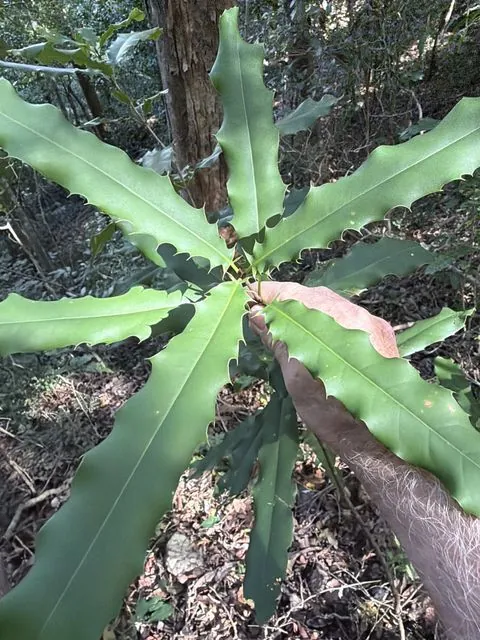
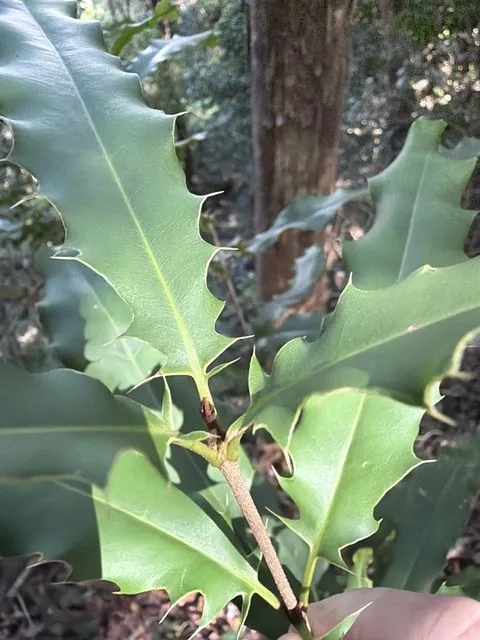
Macadamia integrifolia
Authorship: The author or authors credited with publishing the scientific name. It is written after the name, sometimes with the year, for example L. (Linnaeus) in Zea mays L. An author in parentheses first published the name in another genus or rank. — The author or authors credited with publishing the scientific name. It is written after the name, sometimes with the year, for example L. (Linnaeus) in Zea mays L. An author in parentheses first published the name in another genus or rank.
Maiden & Betche
Common names
Macadamia Nut, Bauplenut, Bush Nut, Macadamia, Macadamia Tree, Macadamia nut, Bauple nut, Queensland nut, Nut oak, Nut Oak, Queensland Nut Tree, Queenslandnut, Smooth-shelled Macadamia, bopplenut, bushnut, macadamia-nut, nut-oak, poppelnut, smooth-shell QueenslandnutNames in other languages (26)Macadamianoot, Macadamianuß, Macadamie à feuilles entières, Noix marteau (fruit), Noix de Macadamia (fruit), Noyer du Queensland, Noyer du Queensland, Noyer du Queensland, Noix du Queensland (fruit), Noix de macadamia (fruit), Nuez de Macadamia, Plačialapė makadamija, Queensland Nut, Queenslandnuß, ao zhou jian guo, echte Macadamianuß, glattschalige Macadamia, macadamier, macadâmia, makadámia celistvolistá, nogueira-do-havaí, noix du Queensland, noz-macadâmia, pähkinämakadamia, trubbmacadamia, אגוז מקדמיה, แมคาเดเมียเปลือกเรียบ, マカダミア, 全緣葉澳洲堅果, 澳洲坚果, 澳洲坚果 ao zhou jian guo
Kingdom: One of the broadest ranks of biological classification. It groups organisms that share very basic features, for example plants (Plantae), animals (Animalia) or fungi (Fungi). — One of the broadest ranks of biological classification. It groups organisms that share very basic features, for example plants (Plantae), animals (Animalia) or fungi (Fungi).
Plantae
Phylum: Rank below kingdom that groups organisms with a shared general body plan, for example chordates (Chordata), arthropods (Arthropoda) or vascular plants (Tracheophyta). In botany the same rank is also called division. — Rank below kingdom that groups organisms with a shared general body plan, for example chordates (Chordata), arthropods (Arthropoda) or vascular plants (Tracheophyta). In botany the same rank is also called division.
Tracheophyta
Class: Rank below phylum, for example mammals (Mammalia), birds (Aves), insects (Insecta) or monocot plants such as grasses and orchids (Liliopsida). — Rank below phylum, for example mammals (Mammalia), birds (Aves), insects (Insecta) or monocot plants such as grasses and orchids (Liliopsida).
Magnoliopsida
Order: Rank below class that groups related families, for example grasses and their relatives (Poales) or bats (Chiroptera). — Rank below class that groups related families, for example grasses and their relatives (Poales) or bats (Chiroptera).
Proteales
Family: Rank below order that groups related genera. Family names usually end in -aceae in botany (for example Poaceae, the grass family) and in -idae in zoology (for example Felidae, the cat family). — Rank below order that groups related genera. Family names usually end in -aceae in botany (for example Poaceae, the grass family) and in -idae in zoology (for example Felidae, the cat family).
Proteaceae
Genus: Rank that groups closely related species. Its name is the first word of a species' scientific name and starts with a capital letter, for example Zea in Zea mays. — Rank that groups closely related species. Its name is the first word of a species' scientific name and starts with a capital letter, for example Zea in Zea mays.
Macadamia
Specific epithet: The second word of a species' scientific name. On its own it does not name the species: it always goes with the genus, for example mays in Zea mays. — The second word of a species' scientific name. On its own it does not name the species: it always goes with the genus, for example mays in Zea mays.
integrifolia
Taxonomic rank: The level a name occupies in the hierarchy of biological classification, such as kingdom, family, genus, species or subspecies. — The level a name occupies in the hierarchy of biological classification, such as kingdom, family, genus, species or subspecies.
species
Reference species
Macadamia integrifolia
Taxonomic status: Whether the taxonomic catalogue the record comes from currently accepts this name for the organism, or treats it as a synonym of another accepted name or as doubtful. — Whether the taxonomic catalogue the record comes from currently accepts this name for the organism, or treats it as a synonym of another accepted name or as doubtful.
accepted name
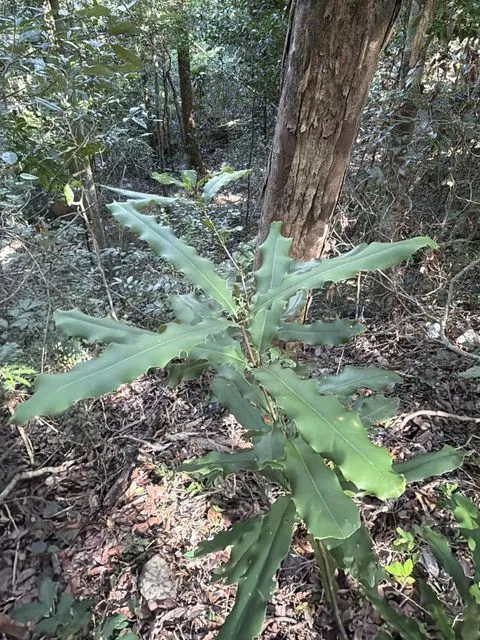
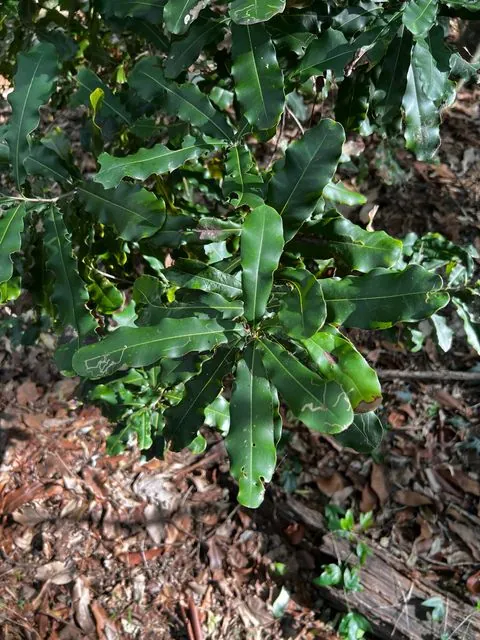
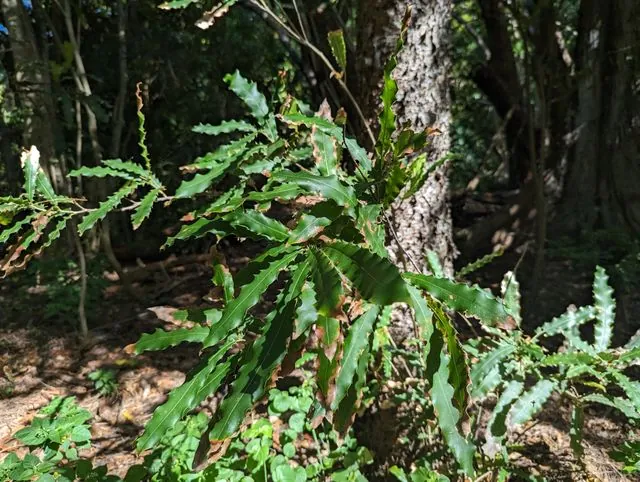
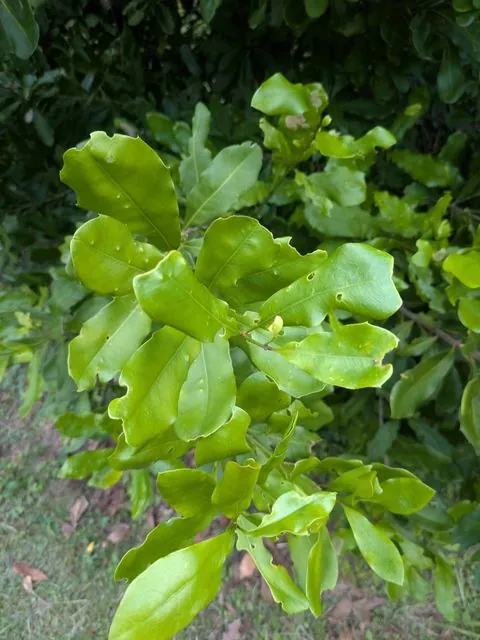
Photos and conservation status
IUCN Red List category: The extinction-risk category that the International Union for Conservation of Nature (IUCN) assigns to a species on its Red List. EX Extinct: there is no reasonable doubt that the last individual has died. EW Extinct in the wild: it survives only in cultivation, in captivity or as a population far outside its past range. CR Critically endangered, EN Endangered and VU Vulnerable: the three threatened categories, from an extremely high to a high risk of extinction in the wild. NT Near threatened: close to qualifying as threatened. LC Least concern: evaluated and not threatened. DD Data deficient: there is not enough information to assess its risk. NE Not evaluated: not yet assessed against the criteria. It describes the risk of the species worldwide, not its situation in a project's area. — The extinction-risk category that the International Union for Conservation of Nature (IUCN) assigns to a species on its Red List. EX Extinct: there is no reasonable doubt that the last individual has died. EW Extinct in the wild: it survives only in cultivation, in captivity or as a population far outside its past range. CR Critically endangered, EN Endangered and VU Vulnerable: the three threatened categories, from an extremely high to a high risk of extinction in the wild. NT Near threatened: close to qualifying as threatened. LC Least concern: evaluated and not threatened. DD Data deficient: there is not enough information to assess its risk. NE Not evaluated: not yet assessed against the criteria. It describes the risk of the species worldwide, not its situation in a project's area.
Vulnerable (VU)
Source: IUCN Red List via GBIF, queried on 2026-10-09 05:34.
Research-grade iNaturalist observations via GBIF, CC0 or CC BY licences only, queried on 2026-10-09 05:34.
Interacciones documentadas
GloBI says it is documented somewhere in the world. Biolitica answers whether it could happen here.
A documented interaction means it was recorded somewhere in the world. It does not mean it occurs here.
Types shown: 6 of 6
is a host of
×
is eaten by
×
interacts with
×
is pollinated by
×
has as a parasite
×
has its flowers visited by
×
Blocks that do not sit under a navigation concept heading keep the source's own term: no navigation concept has been assigned to them yet.
is a host of
72 organisms
The authority declares no effect on this species for this term: neither that it harms it nor that it benefits it. In the source ontology symbiosis covers mutualism, commensalism and parasitism alike, so this block holds attackers and allies side by side.
Organism
Reads as
Studies
Where it was documented
Actions
Phytophthora tropicalisPeronosporaceae
is a host of
8
no location
8 sources · 8 records
Yang, X., Tyler, B.M., and Hong, C.. 2017. An expanded phylogeny for the genus %Phytophthora%. IMA Fungus 8(2):355-384
Published in globalbioticinteractions/usda-fungus-host
Context: United States · no date published
Claim type
Published relationship between two taxa
Version
GloBI 0.11
Reuse
This release publishes no reuse terms for this record.
United States · no date publishedWhere it is: line:hash://sha256/021a206a1459bcca7e251c73f5bd180fc3ac342a09c499855fe42e21fc09edcf!/interactions.tsv.gz!/L4238447
No public URL for this record
Martin, F.N., Blair, J.E., and Coffey, M.D.. 2014. A combined mitochondrial and nuclear multilocus phylogeny of the genus %Phytophthora%. Fungal Genet. Biol. 66:19-32
Published in globalbioticinteractions/usda-fungus-host
Context: United States · no date published
Claim type
Published relationship between two taxa
Version
GloBI 0.11
Reuse
This release publishes no reuse terms for this record.
United States · no date publishedWhere it is: line:hash://sha256/021a206a1459bcca7e251c73f5bd180fc3ac342a09c499855fe42e21fc09edcf!/interactions.tsv.gz!/L4251474
No public URL for this record
Blair, J.E., Coffey, M.D., Park, S.Y., Geiser, D.M., and Kang, S. . 2008. A multi-locus phylogeny for %Phytophthora% utilizing markers derived from complete genome sequences. Fungal Genet. Biol. 45:266-277
Published in globalbioticinteractions/usda-fungus-host
Context: United States · no date published
Claim type
Published relationship between two taxa
Version
GloBI 0.11
Reuse
This release publishes no reuse terms for this record.
United States · no date publishedWhere it is: line:hash://sha256/021a206a1459bcca7e251c73f5bd180fc3ac342a09c499855fe42e21fc09edcf!/interactions.tsv.gz!/L4266232
No public URL for this record
Donahoo, R.S., and Lamour, K.H.. 2008. Interspecific hybridization and apomixis between %Phytophthora capsici% and %Phytophthora tropicalis%. Mycologia 100:911-920
Published in globalbioticinteractions/usda-fungus-host
Context: United States · no date published
Claim type
Published relationship between two taxa
Version
GloBI 0.11
Reuse
This release publishes no reuse terms for this record.
United States · no date publishedWhere it is: line:hash://sha256/021a206a1459bcca7e251c73f5bd180fc3ac342a09c499855fe42e21fc09edcf!/interactions.tsv.gz!/L4296449
No public URL for this record
Ann, P.-J., Huang, J.-H., Tsai, J.-N., and Ko, W.-H.. 2016. Morphological, molecular and pathological characterization of %Phytophthora amaranthi% sp. nov. from Amaranth in Taiwan. J. Phytopathol. 164:94-101
Published in globalbioticinteractions/usda-fungus-host
Context: United States · no date published
Claim type
Published relationship between two taxa
Version
GloBI 0.11
Reuse
This release publishes no reuse terms for this record.
United States · no date publishedWhere it is: line:hash://sha256/021a206a1459bcca7e251c73f5bd180fc3ac342a09c499855fe42e21fc09edcf!/interactions.tsv.gz!/L4304124
No public URL for this record
Jung, T., Jung, M.H., Cacciola, S.O., Cech, T., Bakonyi, J., Seress, D., Mosca, S., Schena, L., Seddaiu, S., Pane, A., di San Lio, G.M., Maia, C., Cravador, A., Franceschini, A., and Scanu, B.. 2017. Multiple new cryptic pathogenic %Phytophthora% species from Fagaceae forests in…
Published in globalbioticinteractions/usda-fungus-host
Context: United States · no date published
Claim type
Published relationship between two taxa
Version
GloBI 0.11
Reuse
This release publishes no reuse terms for this record.
United States · no date publishedWhere it is: line:hash://sha256/021a206a1459bcca7e251c73f5bd180fc3ac342a09c499855fe42e21fc09edcf!/interactions.tsv.gz!/L4304184
No public URL for this record
Abad, Z.G., Ivors, K.L., Gallup, C.A., Abad, J.A., and Shew, H.D.. 2011. Morphological and molecular characterization of %Phytophthora glovera% sp. nov. from tobacco in Brazil. Mycologia 103:341-350
Published in globalbioticinteractions/usda-fungus-host
Context: United States · no date published
Claim type
Published relationship between two taxa
Version
GloBI 0.11
Reuse
This release publishes no reuse terms for this record.
United States · no date publishedWhere it is: line:hash://sha256/021a206a1459bcca7e251c73f5bd180fc3ac342a09c499855fe42e21fc09edcf!/interactions.tsv.gz!/L4332057
No public URL for this record
Aragaki, M., and Uchida, J.Y.. 2001. Morphological distinctions between %Phytophthora capsici% and %P. tropicalis% sp. nov.. Mycologia 93:137-145
Published in globalbioticinteractions/usda-fungus-host
Context: United States · no date published
Claim type
Published relationship between two taxa
Version
GloBI 0.11
Reuse
This release publishes no reuse terms for this record.
United States · no date publishedWhere it is: line:hash://sha256/021a206a1459bcca7e251c73f5bd180fc3ac342a09c499855fe42e21fc09edcf!/interactions.tsv.gz!/L4408762
No public URL for this record
A published relationship says these two taxa were documented interacting. It does not say how often, or that it happens in this project's region.
DiebackPhytophthora cinnamomiPeronosporaceae
is a host of
7
no location
7 sources · 7 records
Pennycook, S.R.. 1989. Plant diseases recorded in New Zealand. 3 Vol.. Pl. Dis. Div., D.S.I.R., Auckland :--
Published in globalbioticinteractions/usda-fungus-host
Context: New Zealand · no date published
Claim type
Published relationship between two taxa
Version
GloBI 0.11
Reuse
This release publishes no reuse terms for this record.
New Zealand · no date publishedWhere it is: line:hash://sha256/021a206a1459bcca7e251c73f5bd180fc3ac342a09c499855fe42e21fc09edcf!/interactions.tsv.gz!/L3701075
Published in globalbioticinteractions/usda-fungus-host
Context: United States · no date published
Claim type
Published relationship between two taxa
Version
GloBI 0.11
Reuse
This release publishes no reuse terms for this record.
United States · no date publishedWhere it is: line:hash://sha256/021a206a1459bcca7e251c73f5bd180fc3ac342a09c499855fe42e21fc09edcf!/interactions.tsv.gz!/L3795093
No public URL for this record
Gadgil, P.D.. 2005. Fungi on trees and shrubs in New Zealand. Fungi of New Zealand (Volume 4). Fungal Diversity Press, Hong Kong :437
Published in globalbioticinteractions/usda-fungus-host
Context: New Zealand · no date published
Claim type
Published relationship between two taxa
Version
GloBI 0.11
Reuse
This release publishes no reuse terms for this record.
New Zealand · no date publishedWhere it is: line:hash://sha256/021a206a1459bcca7e251c73f5bd180fc3ac342a09c499855fe42e21fc09edcf!/interactions.tsv.gz!/L3887312
No public URL for this record
French, A.M.. 1987. California plant disease host index. Part 1: Fruit and nuts. Calif. Dept. Food Agric., Sacramento :39
Published in globalbioticinteractions/usda-fungus-host
Context: United States · no date published
Claim type
Published relationship between two taxa
Version
GloBI 0.11
Reuse
This release publishes no reuse terms for this record.
United States · no date publishedWhere it is: line:hash://sha256/021a206a1459bcca7e251c73f5bd180fc3ac342a09c499855fe42e21fc09edcf!/interactions.tsv.gz!/L3888224
No public URL for this record
Raabe, R.D., Conners, I.L., and Martinez, A.P.. 1981. Checklist of plant diseases in Hawaii. College of Tropical Agriculture and Human Resources, University of Hawaii. Information Text Series No. 22. Hawaii Inst. Trop. Agric. Human Resources :313
Published in globalbioticinteractions/usda-fungus-host
Context: United States · no date published
Claim type
Published relationship between two taxa
Version
GloBI 0.11
Reuse
This release publishes no reuse terms for this record.
United States · no date publishedWhere it is: line:hash://sha256/021a206a1459bcca7e251c73f5bd180fc3ac342a09c499855fe42e21fc09edcf!/interactions.tsv.gz!/L4023355
No public URL for this record
Zentmyer, G.A.. 1960. Phytophthora canker of macadamia trees in California. Pl. Dis. Reporter 44:819
Published in globalbioticinteractions/usda-fungus-host
Context: United States · no date published
Claim type
Published relationship between two taxa
Version
GloBI 0.11
Reuse
This release publishes no reuse terms for this record.
United States · no date publishedWhere it is: line:hash://sha256/021a206a1459bcca7e251c73f5bd180fc3ac342a09c499855fe42e21fc09edcf!/interactions.tsv.gz!/L4258397
No public URL for this record
Hine, R.B.. 1961. Trunk canker of macadamia in Hawaii caused by %Phytophthora cinnamomi% Rands. Pl. Dis. Reporter 45:868
Published in globalbioticinteractions/usda-fungus-host
Context: United States · no date published
Claim type
Published relationship between two taxa
Version
GloBI 0.11
Reuse
This release publishes no reuse terms for this record.
United States · no date publishedWhere it is: line:hash://sha256/021a206a1459bcca7e251c73f5bd180fc3ac342a09c499855fe42e21fc09edcf!/interactions.tsv.gz!/L4258398
No public URL for this record
A published relationship says these two taxa were documented interacting. It does not say how often, or that it happens in this project's region.
Phytophthora capsiciPeronosporaceae
is a host of
5
no location
5 sources · 5 records
Raabe, R.D., Conners, I.L., and Martinez, A.P.. 1981. Checklist of plant diseases in Hawaii. College of Tropical Agriculture and Human Resources, University of Hawaii. Information Text Series No. 22. Hawaii Inst. Trop. Agric. Human Resources :313
Published in globalbioticinteractions/usda-fungus-host
Context: United States · no date published
Claim type
Published relationship between two taxa
Version
GloBI 0.11
Reuse
This release publishes no reuse terms for this record.
United States · no date publishedWhere it is: line:hash://sha256/021a206a1459bcca7e251c73f5bd180fc3ac342a09c499855fe42e21fc09edcf!/interactions.tsv.gz!/L4022861
No public URL for this record
Erwin, D.C., and Ribeiro, O.K.. 1996. %Phytophthora% Diseases Worldwide. APS Press, St. Paul, Minnesota :562
Published in globalbioticinteractions/usda-fungus-host
Context: United States · no date published
Claim type
Published relationship between two taxa
Version
GloBI 0.11
Reuse
This release publishes no reuse terms for this record.
United States · no date publishedWhere it is: line:hash://sha256/021a206a1459bcca7e251c73f5bd180fc3ac342a09c499855fe42e21fc09edcf!/interactions.tsv.gz!/L4103659
No public URL for this record
Oudemans, P., and Coffey, M.D.. 1991. A revised systematics of twelve papillate %Phytophthora% species based on isozyme analysis. Mycol. Res. 95:1025-1046
Published in globalbioticinteractions/usda-fungus-host
Context: United States · no date published
Claim type
Published relationship between two taxa
Version
GloBI 0.11
Reuse
This release publishes no reuse terms for this record.
United States · no date publishedWhere it is: line:hash://sha256/021a206a1459bcca7e251c73f5bd180fc3ac342a09c499855fe42e21fc09edcf!/interactions.tsv.gz!/L4236633
No public URL for this record
Kunimoto, R.K., Aragaki, M., Hunter, J.E., and Ko, W.H.. 1976. %Phytophthora capsici%, corrected name for the cause of Phytophthora blight of macadamia racemes. Phytopathology 66:546-548
Published in globalbioticinteractions/usda-fungus-host
Context: United States · no date published
Claim type
Published relationship between two taxa
Version
GloBI 0.11
Reuse
This release publishes no reuse terms for this record.
United States · no date publishedWhere it is: line:hash://sha256/021a206a1459bcca7e251c73f5bd180fc3ac342a09c499855fe42e21fc09edcf!/interactions.tsv.gz!/L4311545
No public URL for this record
Aragaki, M., and Uchida, J.Y.. 1980. Foliar stage of Phytophthora blight of macadamia. Pl. Dis. 64:483-484
Published in globalbioticinteractions/usda-fungus-host
Context: United States · no date published
Claim type
Published relationship between two taxa
Version
GloBI 0.11
Reuse
This release publishes no reuse terms for this record.
United States · no date publishedWhere it is: line:hash://sha256/021a206a1459bcca7e251c73f5bd180fc3ac342a09c499855fe42e21fc09edcf!/interactions.tsv.gz!/L4311547
No public URL for this record
A published relationship says these two taxa were documented interacting. It does not say how often, or that it happens in this project's region.
Pseudocercospora macadamiaeMycosphaerellaceae
is a host of
4
no location
4 sources · 4 records
Videira, S.I.R., Groenewald, J.Z., Braun, U., Shin, H.D., and Crous, P.W.. 2016. All that glitters is not %Ramularia%. Stud. Mycol. 83:49-163
Published in globalbioticinteractions/usda-fungus-host
Context: Australia · no date published
Claim type
Published relationship between two taxa
Version
GloBI 0.11
Reuse
This release publishes no reuse terms for this record.
Australia · no date publishedWhere it is: line:hash://sha256/021a206a1459bcca7e251c73f5bd180fc3ac342a09c499855fe42e21fc09edcf!/interactions.tsv.gz!/L4146711
No public URL for this record
Videira, S.I.R., Groenewald, J.Z., Nakashima, C., Braun, U., Barreto, R.W., de Wit, P.J.G.M., and Crous, P.W.. 2017. Mycosphaerellaceae - chaos or clarity?. Stud. Mycol. 87:257-421
Published in globalbioticinteractions/usda-fungus-host
Context: Australia · no date published
Claim type
Published relationship between two taxa
Version
GloBI 0.11
Reuse
This release publishes no reuse terms for this record.
Australia · no date publishedWhere it is: line:hash://sha256/021a206a1459bcca7e251c73f5bd180fc3ac342a09c499855fe42e21fc09edcf!/interactions.tsv.gz!/L4181322
No public URL for this record
Beilharz, V. , Mayers, P.E., and Pascoe, I.G.. 2003. %Pseudocercospora macadamiae% sp. nov., the cause of husk spot of macadamia. Australas. Pl. Pathol. 32(2):279-282
Published in globalbioticinteractions/usda-fungus-host
Context: Australia · no date published
Claim type
Published relationship between two taxa
Version
GloBI 0.11
Reuse
This release publishes no reuse terms for this record.
Australia · no date publishedWhere it is: line:hash://sha256/021a206a1459bcca7e251c73f5bd180fc3ac342a09c499855fe42e21fc09edcf!/interactions.tsv.gz!/L4430912
No public URL for this record
Akinsanmi, O.A., Miles, A.K., and Drenth, A.. 2016. Fruit abscission in macadamia due to husk spot disease. Acta Hort. 1109:209-214
Published in globalbioticinteractions/usda-fungus-host
Context: Australia · no date published
Claim type
Published relationship between two taxa
Version
GloBI 0.11
Reuse
This release publishes no reuse terms for this record.
Australia · no date publishedWhere it is: line:hash://sha256/021a206a1459bcca7e251c73f5bd180fc3ac342a09c499855fe42e21fc09edcf!/interactions.tsv.gz!/L4430914
No public URL for this record
A published relationship says these two taxa were documented interacting. It does not say how often, or that it happens in this project's region.
This term does declare that the organism harms this species.
Organism
Reads as
Studies
Where it was documented
Actions
Candalides absimilisLycaenidae
is eaten by
2
no location
2 sources · 2 records
Edward Baker; Ian Kitching; George W Beccaloni; Amoret Whitaker; Steen Dupont; Vincent Smith; John S Noyes (2017). NHM Interactions Bank. https://doi.org/10.5519/0060767. Accessed at <https://data.nhm.ac.uk/dataset/82e807f0-6273-4f19-be0a-7f7558442a25/resource/f84ad9f1-bd0c-4811…
Published in globalbioticinteractions/natural-history-museum-london-interactions-bank
Context: no place published · no date published
Claim type
Published relationship between two taxa
Version
GloBI 0.11
Reuse
This release publishes no reuse terms for this record.
no place published · no date publishedWhere it is: line:hash://sha256/021a206a1459bcca7e251c73f5bd180fc3ac342a09c499855fe42e21fc09edcf!/interactions.tsv.gz!/L18699801
ABRS 2009. Australian Faunal Directory. Candalides absimilis. Australian Biological Resources StudyNode, Canberra. Accessed at <http://biodiversity.org.au/afd/taxa/dfac6e28-fd58-4648-a811-bb511285180b> on 04 Sep 2026.
Published in globalbioticinteractions/siad
Context: no place published · no date published
Claim type
Published relationship between two taxa
Version
GloBI 0.11
Reuse
This release publishes no reuse terms for this record.
no place published · no date publishedWhere it is: line:hash://sha256/021a206a1459bcca7e251c73f5bd180fc3ac342a09c499855fe42e21fc09edcf!/interactions.tsv.gz!/L18985786
Context: no place published · Sept. 18, 2025 · Human observation
Claim type
Published relationship between two taxa
Version
GloBI 0.11
Reuse
This release publishes no reuse terms for this record.
no place published · Sept. 18, 2025 · Human observationAs published: 2025-09-18T05:18:00Z · HumanObservationWhere it is: line:hash://sha256/021a206a1459bcca7e251c73f5bd180fc3ac342a09c499855fe42e21fc09edcf!/interactions.tsv.gz!/L4732400
Context: no place published · Sept. 18, 2025 · Human observation
Claim type
Published relationship between two taxa
Version
GloBI 0.11
Reuse
This release publishes no reuse terms for this record.
no place published · Sept. 18, 2025 · Human observationAs published: 2025-09-18T05:24:00Z · HumanObservationWhere it is: line:hash://sha256/021a206a1459bcca7e251c73f5bd180fc3ac342a09c499855fe42e21fc09edcf!/interactions.tsv.gz!/L4732405
A published relationship says these two taxa were documented interacting. It does not say how often, or that it happens in this project's region.
Nacaduba bereniceLycaenidae
is eaten by
2
no location
2 sources · 2 records
Edward Baker; Ian Kitching; George W Beccaloni; Amoret Whitaker; Steen Dupont; Vincent Smith; John S Noyes (2017). NHM Interactions Bank. https://doi.org/10.5519/0060767. Accessed at <https://data.nhm.ac.uk/dataset/82e807f0-6273-4f19-be0a-7f7558442a25/resource/f84ad9f1-bd0c-4811…
Published in globalbioticinteractions/natural-history-museum-london-interactions-bank
Context: no place published · no date published
Claim type
Published relationship between two taxa
Version
GloBI 0.11
Reuse
This release publishes no reuse terms for this record.
no place published · no date publishedWhere it is: line:hash://sha256/021a206a1459bcca7e251c73f5bd180fc3ac342a09c499855fe42e21fc09edcf!/interactions.tsv.gz!/L18717242
ABRS 2009. Australian Faunal Directory. Nacaduba berenice. Australian Biological Resources StudyNode, Canberra. Accessed at <http://biodiversity.org.au/afd/taxa/0f932d05-f526-4b75-85fd-4721f68526f4> on 04 Sep 2026.
Published in globalbioticinteractions/siad
Context: no place published · no date published
Claim type
Published relationship between two taxa
Version
GloBI 0.11
Reuse
This release publishes no reuse terms for this record.
no place published · no date publishedWhere it is: line:hash://sha256/021a206a1459bcca7e251c73f5bd180fc3ac342a09c499855fe42e21fc09edcf!/interactions.tsv.gz!/L18991607
Context: no place published · Sept. 18, 2025 · Human observation
Claim type
Published relationship between two taxa
Version
GloBI 0.11
Reuse
This release publishes no reuse terms for this record.
no place published · Sept. 18, 2025 · Human observationAs published: 2025-09-18T05:00:00Z · HumanObservationWhere it is: line:hash://sha256/021a206a1459bcca7e251c73f5bd180fc3ac342a09c499855fe42e21fc09edcf!/interactions.tsv.gz!/L4732377
Context: no place published · Sept. 18, 2025 · Human observation
Claim type
Published relationship between two taxa
Version
GloBI 0.11
Reuse
This release publishes no reuse terms for this record.
no place published · Sept. 18, 2025 · Human observationAs published: 2025-09-18T05:22:00Z · HumanObservationWhere it is: line:hash://sha256/021a206a1459bcca7e251c73f5bd180fc3ac342a09c499855fe42e21fc09edcf!/interactions.tsv.gz!/L4732403
The authority declares no effect on this species for this term: neither that it harms it nor that it benefits it.
Organism
Reads as
Studies
Where it was documented
Actions
Australian guava mothCoscinoptycha improbanaCarposinidae
interacts with
3
not compared
3 sources · 3 records
https://www.inaturalist.org/observations/20958885
Published in globalbioticinteractions/inaturalist
Context: no place published · March 4, 2019 · Human observation
Claim type
Published relationship between two taxa
Version
GloBI 0.11
Reuse
This release publishes no reuse terms for this record.
no place published · March 4, 2019 · Human observationAs published: 2019-03-04T01:00:00Z · HumanObservationWhere it is: line:hash://sha256/021a206a1459bcca7e251c73f5bd180fc3ac342a09c499855fe42e21fc09edcf!/interactions.tsv.gz!/L4954945
Context: no place published · July 11, 2023 · Human observation
Claim type
Published relationship between two taxa
Version
GloBI 0.11
Reuse
This release publishes no reuse terms for this record.
no place published · July 11, 2023 · Human observationAs published: 2023-07-11T00:38:47Z · HumanObservationWhere it is: line:hash://sha256/021a206a1459bcca7e251c73f5bd180fc3ac342a09c499855fe42e21fc09edcf!/interactions.tsv.gz!/L5576487
Context: no place published · Aug. 2, 2021 · Human observation
Claim type
Published relationship between two taxa
Version
GloBI 0.11
Reuse
This release publishes no reuse terms for this record.
no place published · Aug. 2, 2021 · Human observationAs published: 2021-08-02T00:13:38Z · HumanObservationWhere it is: line:hash://sha256/021a206a1459bcca7e251c73f5bd180fc3ac342a09c499855fe42e21fc09edcf!/interactions.tsv.gz!/L5860615
A published relationship says these two taxa were documented interacting. It does not say how often, or that it happens in this project's region.
Phymastichus holoholoEulophidae
interacts with
2
no location
2 sources · 2 records
Honsberger, D.N. & Wright, M.G. (2022) A new species of <i>Phymastichus</i> (Hymenoptera: Eulophidae: Tetrastichinae) parasitic on <i>Xyleborus</i> beetles (Coleoptera: Curculionidae: Scolytinae) in Hawaiʻi, and aspects of its biology, life history, and behavior. <i>Zootaxa<…
Published in urn:lsid:checklistbank.org:dataset:124661
Context: no place published · no date published
Claim type
Published relationship between two taxa
Version
GloBI 0.11
Reuse
This release publishes no reuse terms for this record.
no place published · no date publishedWhere it is: line:hash://sha256/021a206a1459bcca7e251c73f5bd180fc3ac342a09c499855fe42e21fc09edcf!/interactions.tsv.gz!/L1266064
@article{124556, author = {Honsberger, David N. and Wright, Mark G.}, journal = {Zootaxa}, month = {mar}, day = {17}, number = {1}, pages = {107-122}, publisher = {Magnolia Press}, title = {A new species of <i>Phymastichus</i> (Hymenoptera: Eulophidae: Tetrastich…
Published in globalbioticinteractions/taxonworks
Context: no place published · no date published
Claim type
Published relationship between two taxa
Version
GloBI 0.11
Reuse
This release publishes no reuse terms for this record.
no place published · no date publishedWhere it is: line:hash://sha256/021a206a1459bcca7e251c73f5bd180fc3ac342a09c499855fe42e21fc09edcf!/interactions.tsv.gz!/L6129496
A published relationship says these two taxa were documented interacting. It does not say how often, or that it happens in this project's region.
Ryhonos elegansEulophidae
interacts with
2
no location
2 sources · 2 records
Bouček, Z. (1988) <i>Australasian Chalcidoidea (Hymenoptera). A Biosystematic Revision of Genera of Fourteen Families, with a Reclassification of Species</i>. CAB International, Wallingford, United Kingdom, 832 pp.
Published in urn:lsid:checklistbank.org:dataset:124661
Context: no place published · no date published
Claim type
Published relationship between two taxa
Version
GloBI 0.11
Reuse
This release publishes no reuse terms for this record.
no place published · no date publishedWhere it is: line:hash://sha256/021a206a1459bcca7e251c73f5bd180fc3ac342a09c499855fe42e21fc09edcf!/interactions.tsv.gz!/L1204811
No public URL for this record
@book{55213, address = {Wallingford, United Kingdom}, author = {Bouček, Zdeněk}, month = {jun}, day = {7}, pages = {832}, publisher = {CAB International}, title = {Australasian Chalcidoidea (Hymenoptera). A Biosystematic Revision of Genera of Fourteen Families, wit…
Published in globalbioticinteractions/taxonworks
Context: no place published · no date published
Claim type
Published relationship between two taxa
Version
GloBI 0.11
Reuse
This release publishes no reuse terms for this record.
no place published · no date publishedWhere it is: line:hash://sha256/021a206a1459bcca7e251c73f5bd180fc3ac342a09c499855fe42e21fc09edcf!/interactions.tsv.gz!/L6045583
No public URL for this record
A published relationship says these two taxa were documented interacting. It does not say how often, or that it happens in this project's region.
Parasitoid waspPhymastichus xyleboriEulophidae
interacts with
2
no location
2 sources · 2 records
LaSalle, J. (1995a) A new species of <i>Phymastichus</i> (Hymenoptera: Eulophidae) parasitic on adult <i>Xyleborus perforans</i> (Coleoptera: Scolytidae) on macadamia tress in Hawai'i. <i>Proceedings of the Hawaiian Entomological Society</i>, 32, 95–101.
Published in urn:lsid:checklistbank.org:dataset:124661
Context: no place published · no date published
Claim type
Published relationship between two taxa
Version
GloBI 0.11
Reuse
This release publishes no reuse terms for this record.
no place published · no date publishedWhere it is: line:hash://sha256/021a206a1459bcca7e251c73f5bd180fc3ac342a09c499855fe42e21fc09edcf!/interactions.tsv.gz!/L1254949
No public URL for this record
@article{76658, author = {LaSalle, J.}, booktitle = {Proceedings of the Hawaiian Entomological Society}, journal = {Proceedings of the Hawaiian Entomological Society}, month = {aug}, day = {10}, pages = {95-101}, title = {A new species of <i>Phymastichus</i> (Hymen…
Published in globalbioticinteractions/taxonworks
Context: no place published · no date published
Claim type
Published relationship between two taxa
Version
GloBI 0.11
Reuse
This release publishes no reuse terms for this record.
no place published · no date publishedWhere it is: line:hash://sha256/021a206a1459bcca7e251c73f5bd180fc3ac342a09c499855fe42e21fc09edcf!/interactions.tsv.gz!/L6071516
No public URL for this record
A published relationship says these two taxa were documented interacting. It does not say how often, or that it happens in this project's region.
This term declares that the organism benefits this species. «Visits the flowers of» is a different term and a different block: a visitor is not a pollinator, and merging the two is the measured defect that turned ~88 shared «pollinators» into birds and primates.
Organism
Reads as
Studies
Where it was documented
Actions
European Honey BeeApis melliferaApidae
is pollinated by
2
not compared
2 sources · 3 records
Bryony Willcox, Romina Rader, Andrew Robson, Brad Howlett
Published in ibartomeus/CropPol
Record contexts (sample): no place published · Jan. 1, 2016; no place published · Jan. 1, 2016
Claim type
Published relationship between two taxa
Version
GloBI 0.11
Reuse
This release publishes no reuse terms for this record.
no place published · Jan. 1, 2016As published: 2016-01-01T00:00:00ZWhere it is: line:hash://sha256/021a206a1459bcca7e251c73f5bd180fc3ac342a09c499855fe42e21fc09edcf!/interactions.tsv.gz!/L784730
no place published · Jan. 1, 2016As published: 2016-01-01T00:00:00ZWhere it is: line:hash://sha256/021a206a1459bcca7e251c73f5bd180fc3ac342a09c499855fe42e21fc09edcf!/interactions.tsv.gz!/L784771
No public URL for this record
African Pollinators Initiative. (2007). Crops, browse and pollinators in Africa: an initial stock-taking. Food and Agriculture Organization of the United Nations.
Published in globalbioticinteractions/kalro2023
Context: Africa · no date published
Claim type
Published relationship between two taxa
Version
GloBI 0.11
Reuse
This release publishes no reuse terms for this record.
Africa · no date publishedWhere it is: line:hash://sha256/021a206a1459bcca7e251c73f5bd180fc3ac342a09c499855fe42e21fc09edcf!/interactions.tsv.gz!/L7054775
No public URL for this record
A published relationship says these two taxa were documented interacting. It does not say how often, or that it happens in this project's region.
SaxifrageSaxifragaSaxifragaceae
is pollinated by
1
not compared
Not a modelling unit: the source publishes it at genus level.
1 source · 2 records
Bryony Willcox, Romina Rader, Andrew Robson, Brad Howlett
Published in ibartomeus/CropPol
Record contexts (sample): no place published · Jan. 1, 2016; no place published · Jan. 1, 2016
Claim type
Published relationship between two taxa
Version
GloBI 0.11
Reuse
This release publishes no reuse terms for this record.
no place published · Jan. 1, 2016As published: 2016-01-01T00:00:00ZWhere it is: line:hash://sha256/021a206a1459bcca7e251c73f5bd180fc3ac342a09c499855fe42e21fc09edcf!/interactions.tsv.gz!/L784715
no place published · Jan. 1, 2016As published: 2016-01-01T00:00:00ZWhere it is: line:hash://sha256/021a206a1459bcca7e251c73f5bd180fc3ac342a09c499855fe42e21fc09edcf!/interactions.tsv.gz!/L784773
No public URL for this record
A published relationship says these two taxa were documented interacting. It does not say how often, or that it happens in this project's region.
Hover FliesSyrphiniSyrphidae
is pollinated by
1
not compared
Not a modelling unit: the source publishes it at tribe level.
1 source · 2 records
Bryony Willcox, Romina Rader, Andrew Robson, Brad Howlett
Published in ibartomeus/CropPol
Record contexts (sample): no place published · Jan. 1, 2016; no place published · Jan. 1, 2016
Claim type
Published relationship between two taxa
Version
GloBI 0.11
Reuse
This release publishes no reuse terms for this record.
no place published · Jan. 1, 2016As published: 2016-01-01T00:00:00ZWhere it is: line:hash://sha256/021a206a1459bcca7e251c73f5bd180fc3ac342a09c499855fe42e21fc09edcf!/interactions.tsv.gz!/L784724
no place published · Jan. 1, 2016As published: 2016-01-01T00:00:00ZWhere it is: line:hash://sha256/021a206a1459bcca7e251c73f5bd180fc3ac342a09c499855fe42e21fc09edcf!/interactions.tsv.gz!/L784751
No public URL for this record
A published relationship says these two taxa were documented interacting. It does not say how often, or that it happens in this project's region.
Monolepta australisChrysomelidae
is pollinated by
1
not compared
1 source · 1 record
Bryony Willcox, Romina Rader, Andrew Robson, Brad Howlett
Published in ibartomeus/CropPol
Context: no place published · Jan. 1, 2016
Claim type
Published relationship between two taxa
Version
GloBI 0.11
Reuse
This release publishes no reuse terms for this record.
no place published · Jan. 1, 2016As published: 2016-01-01T00:00:00ZWhere it is: line:hash://sha256/021a206a1459bcca7e251c73f5bd180fc3ac342a09c499855fe42e21fc09edcf!/interactions.tsv.gz!/L784718
No public URL for this record
A published relationship says these two taxa were documented interacting. It does not say how often, or that it happens in this project's region.
This term does declare that the organism harms this species.
Organism
Reads as
Studies
Where it was documented
Actions
Brachymeria carinatifronsChalcididae
has as a parasite
1
no location
1 source · 1 record
LourenSa994 via Universal Chalcidoidea Database
Published in globalbioticinteractions/natural-history-museum-london-interactions-bank
Context: no place published · no date published
Claim type
Published relationship between two taxa
Version
GloBI 0.11
Reuse
This release publishes no reuse terms for this record.
no place published · no date publishedWhere it is: line:hash://sha256/021a206a1459bcca7e251c73f5bd180fc3ac342a09c499855fe42e21fc09edcf!/interactions.tsv.gz!/L18923882
No public URL for this record
A published relationship says these two taxa were documented interacting. It does not say how often, or that it happens in this project's region.
MetaplectrusEulophidae
has as a parasite
1
no location
Not a modelling unit: the source publishes it at genus level.
1 source · 1 record
Boucek988c via Universal Chalcidoidea Database
Published in globalbioticinteractions/natural-history-museum-london-interactions-bank
Context: no place published · no date published
Claim type
Published relationship between two taxa
Version
GloBI 0.11
Reuse
This release publishes no reuse terms for this record.
no place published · no date publishedWhere it is: line:hash://sha256/021a206a1459bcca7e251c73f5bd180fc3ac342a09c499855fe42e21fc09edcf!/interactions.tsv.gz!/L18828664
No public URL for this record
A published relationship says these two taxa were documented interacting. It does not say how often, or that it happens in this project's region.
Ryhonos elegansEulophidae
has as a parasite
1
no location
1 source · 1 record
Boucek988c via Universal Chalcidoidea Database
Published in globalbioticinteractions/natural-history-museum-london-interactions-bank
Context: no place published · no date published
Claim type
Published relationship between two taxa
Version
GloBI 0.11
Reuse
This release publishes no reuse terms for this record.
no place published · no date publishedWhere it is: line:hash://sha256/021a206a1459bcca7e251c73f5bd180fc3ac342a09c499855fe42e21fc09edcf!/interactions.tsv.gz!/L18828665
No public URL for this record
A published relationship says these two taxa were documented interacting. It does not say how often, or that it happens in this project's region.
Parasitoid waspPhymastichus xyleboriEulophidae
has as a parasite
1
no location
1 source · 1 record
LaSall995 via Universal Chalcidoidea Database
Published in globalbioticinteractions/natural-history-museum-london-interactions-bank
Context: no place published · no date published
Claim type
Published relationship between two taxa
Version
GloBI 0.11
Reuse
This release publishes no reuse terms for this record.
no place published · no date publishedWhere it is: line:hash://sha256/021a206a1459bcca7e251c73f5bd180fc3ac342a09c499855fe42e21fc09edcf!/interactions.tsv.gz!/L18925168
No public URL for this record
A published relationship says these two taxa were documented interacting. It does not say how often, or that it happens in this project's region.
The authority declares no effect on this species for this term: neither that it harms it nor that it benefits it. Visiting a flower is not pollinating it. «Pollinates» is a different term and a different block, and merging the two is the measured defect that turned ~88 shared «pollinators» into birds and primates.
Organism
Reads as
Studies
Where it was documented
Actions
European Honey BeeApis melliferaApidae
has its flowers visited by
1
no location
1 source · 1 record
Boreux, Virginie; Klein, Alexandra-Maria (2019). Global pollinator database. figshare. Dataset. https://doi.org/10.6084/m9.figshare.9980471.v1. Accessed at <https://github.com/globalbioticinteractions/boreux2019/archive/5c93c4bb8416340d60545373847fdcba983c5d8e.zip> on 04 Sep 202…
Published in globalbioticinteractions/boreux2019
Context: no place published · no date published
Claim type
Published relationship between two taxa
Version
GloBI 0.11
Reuse
This release publishes no reuse terms for this record.
no place published · no date publishedWhere it is: line:hash://sha256/021a206a1459bcca7e251c73f5bd180fc3ac342a09c499855fe42e21fc09edcf!/interactions.tsv.gz!/L6350415
A published relationship says these two taxa were documented interacting. It does not say how often, or that it happens in this project's region.
House-flyMusca domesticaMuscidae
has its flowers visited by
1
no location
1 source · 1 record
Boreux, Virginie; Klein, Alexandra-Maria (2019). Global pollinator database. figshare. Dataset. https://doi.org/10.6084/m9.figshare.9980471.v1. Accessed at <https://github.com/globalbioticinteractions/boreux2019/archive/5c93c4bb8416340d60545373847fdcba983c5d8e.zip> on 04 Sep 202…
Published in globalbioticinteractions/boreux2019
Context: no place published · no date published
Claim type
Published relationship between two taxa
Version
GloBI 0.11
Reuse
This release publishes no reuse terms for this record.
no place published · no date publishedWhere it is: line:hash://sha256/021a206a1459bcca7e251c73f5bd180fc3ac342a09c499855fe42e21fc09edcf!/interactions.tsv.gz!/L6350397
Boreux, Virginie; Klein, Alexandra-Maria (2019). Global pollinator database. figshare. Dataset. https://doi.org/10.6084/m9.figshare.9980471.v1. Accessed at <https://github.com/globalbioticinteractions/boreux2019/archive/5c93c4bb8416340d60545373847fdcba983c5d8e.zip> on 04 Sep 202…
Published in globalbioticinteractions/boreux2019
Context: no place published · no date published
Claim type
Published relationship between two taxa
Version
GloBI 0.11
Reuse
This release publishes no reuse terms for this record.
no place published · no date publishedWhere it is: line:hash://sha256/021a206a1459bcca7e251c73f5bd180fc3ac342a09c499855fe42e21fc09edcf!/interactions.tsv.gz!/L6349956
A published relationship says these two taxa were documented interacting. It does not say how often, or that it happens in this project's region.
Showing 3 of 3, by number of studies
Acompañantes documentados
This agronomic reading comes from a source reserved for internal use, so it is not shown here.
Documented uses and recommendations
Uses and recommendations that a source documents for this species beside a crop, each in its own context. They are the source's statements, not traits of the species and not Biolítica's recommendations, and none of them is a relation between two species.
Among the sources you can read, none documents a use or recommendation of this species beside a crop.